

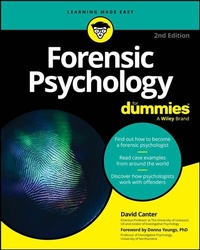
Forensic Psychology For Dummies
Description

A clear introduction to the psychology of crime
Forensic Psychology For Dummies uncovers how forensic psychologists help law enforcement crack major crime cases. This book walks you through the ins-and-outs of this field. It explains why people commit crime, how psychologists assist investigators by profiling offenders and creating interrogation strategies, as well as how some forensic psychiatrists work to treat and rehabilitate the convicted, the imprisoned, and those on supervised release.
Inside:
- Understand what forensic psychology is and isn't
- See how forensic psychologists differ from their fictional counterparts in the media
- Discover real-life case examples from around the world, showcasing the work of forensic psychologists-including in court
- Explore education and career paths taken by established forensic psychologists
Perfect for people interested in the intersection of clinical psychology and the criminal justice system, Forensic Psychology For Dummies is a must-read for aspiring psychologists, forensics and criminology students, law enforcement professionals, and true crime fans.
More details
Other editions
Additional editions
Content
Introduction 1
Part 1: Keeping Up with Forensic Psychology 9
CHAPTER 1: What Is Forensic Psychology? 11
CHAPTER 2: Psychology and the Criminal Process 31
CHAPTER 3: Forensic Psychology and the Law 43
Part 2: Examining the Criminal Mind 61
CHAPTER 4: Why Do People Become Criminals? 63
CHAPTER 5: Measuring, Testing, and Assessing the Psychology of Offenders 85
CHAPTER 6: Diagnosing Evil: How (or whether) Criminals Think 103
Part 3: Assisting Law Enforcement 119
CHAPTER 7: How to Ask Questions of Witnesses, Victims, and Suspects 121
CHAPTER 8: Exposing Liars and Detecting Deception 143
CHAPTER 9: Beyond Offender Profiling 167
CHAPTER 10: Victims of Crime and Their Experiences 191
CHAPTER 11: Preventing Crime: Problems, Processes, and Perseverance 213
Part 4: Psychology in Court and Beyond 233
CHAPTER 12: Giving Guidance in Legal Proceedings 235
CHAPTER 13: Psychological Aspects of Court Procedures 259
Part 5: Helping and Treating Offenders 279
CHAPTER 14: Can Offenders Be Rehabilitated? 281
CHAPTER 15: Dealing with Violence 301
CHAPTER 16: Treating Sexual Offenders 317
CHAPTER 17: Working with Juvenile Offenders 333
Part 6: The Part of Tens 349
CHAPTER 18: Ten Professional Requirements for Forensic Psychologists 351
CHAPTER 19: Ten Stages in Becoming a Professional Forensic Psychologist 361
CHAPTER 20: Ten Cases in Which Forensic Psychology Proved Crucial 371
Index 383
Introduction
In 1985, a senior police officer at Scotland Yard asked me to attend a meeting where the police were planning a major investigation into a series of rapes and murders committed around London. Until that point during my work as a psychologist, I'd had precious little contact with the police or criminals. I was therefore rather taken aback when asked whether I could "help catch this man before he kills again." Out of curiosity about how my experiences as an applied psychologist could assist such an important task, I agreed to help with the investigation. Its eventual success in identifying and convicting the criminal changed my life. As a result, I was drawn ever more intensively into a wide range of police investigations, and then into commenting on psychological evidence presented in court. I began considering rehabilitation programs for offenders and examining processes for assessing the possible risk they posed if they were released. I talked to killers and burglars and many other criminals and their victims.
I became part of the burgeoning field of forensic psychology, reading its journals, giving keynote addresses at conferences, and debating with colleagues and students how many aspects of behavioral science (particularly psychology) were informed by, and carried consequences for, the full range of legal issues. I became increasingly enthusiastic about the evolving ways in which psychology is influencing all aspects of the legal process.
Since that fateful day, I discovered that many people, in all walks of life, have questions about what makes criminals tick and how psychology can be used throughout the investigation, prosecution, treatment, and rehabilitation of criminals and to help their victims. This book aims to answer those questions.
About This Book
Forensic Psychology For Dummies, 2nd Edition, covers the psychological aspects of what happens from when a crime is first reported through to dealing with convicted offenders and, where possible, helping them desist from future criminality. I include many examples of forensic psychology in action to bring to life the excitement of this professional activity.
Here are a few topics, however, that you won't read about in this book: the motives that so delight crime fiction writers (greed, jealousy, revenge - in fact, I avoid even using the vague term motive); whether criminals did (or did not) get along with their mothers; or whether something is wrong with their biology. Instead, Forensic Psychology For Dummies gives you a much wider and more interesting landscape to explore. I go beyond the myths of such popular ideas as offender profiling and deeper than whether criminals are born or made. In this book, I show you what forensic psychologists actually do, and why they do it in the ways they do.
Although psychologists tend to drift into jargon, writing about most of what they do without technical terms is perfectly possible. On the few occasions when specialist words are needed, I make sure their meaning is clear. So if you know absolutely nothing of psychology, this book is for you. Even if you've read or studied any psychology, many aspects are presented here in a new light. If you've already had some contact with forensic psychology or you're considering it as a career path, the breadth of coverage provides a map to help you find your way.
Forensic psychology is a professional area of activity. I do describe some of the requirements and challenges that professionalism creates. But even if you're only curious what all the fuss is about, knowing the underlying principles and processes may come in handy if ever you come into contact with a real-life forensic psychologist (they aren't usually scary - honest).
I think of books in a library as being in conversation with each other, drawing on what they're about and offering connections for others to pick up. Forensic Psychology For Dummies is part of a gaggle of books chatting to each other. Where you can get more detail elsewhere, I make that clear, but bear in mind that I'm using my own point of view to cover what's written about in other books, and, as in any conversation, not everyone agrees with each other. If you want to check out what others have to say, by all means, take a look at Criminology For Dummies, 2nd Edition, by Stephen Briggs (Wiley) and Forensics For Dummies, 2nd Edition, by Douglas P. Lyle (Wiley). Because forensic psychology has such close contacts with the law, I mention the legal issues whenever I absolutely have to, but I'm a psychologist, not a lawyer. If you want to get to grips with all that stuff, do what I do and read Law For Dummies, by John Ventura (Wiley), although be warned that it's about the law in the US, and every country has its own way of doing legal things. Although the views of criminologists, political scientists, historians, and anthropologists - to name just a few - are extremely valuable, I don't engage with these disciplines. This book is about forensic psychology. Psychologists focus on individuals and their relationships with others.
Conventions Used in This Book
I use a few conventions to help you find your way around this book easily:
- Italic text highlights new, often specialist, terms that I always define nearby. Italics are also sometimes used for emphasis.
- Boldfaced text indicates the action part of numbered steps.
Although I keep the number of technical terms and jargon to an absolute minimum, all professional activities include words that have precise meanings for people within that profession. Mastery of these italicized terms enables you to bluff your way in any discussion of crime and criminals.
I'd love for this book to be a laugh-a-minute, but squeezing humor out of rape and murder, or even the more mundane crimes of burglary and robbery, is difficult and often inappropriate. Criminals themselves aren't comic (although some of them are clowns). As an expert in court, I have managed to coax a smile out of the jury from time to time, and so whenever I can, I do the same here. But please don't see these attempts to enliven the topic as implying that anything is other than serious.
What You're Not to Read
One problem with most books is that they start at Page 1 and carry on in a straight line until they end on the last page. But ideas don't always sit along a line so neatly, and often you don't want to find out about topics in the sequence that the writer wants to tell you.
This book is written to take account of such human foibles. In general, each chapter is self-contained, and you can read the chapters in any order you like, although the book makes greater sense if you do read them in the numbered order. If the information in one chapter is elaborated in more detail in another chapter, I refer to that other chapter. To help out, I also make any information that you can safely skip easy to recognize. The shaded text boxes throughout this book (known as sidebars) contain historical examples or more detailed theory that may otherwise break the flow of the text. You can avoid them, or just scan them quickly to get the feel of what's going on.
Foolish Assumptions
I've lectured on psychology to many different audiences for nearly 50 years, which helped me keep a vision of you in my mind while writing this book. The word Dummies in the title means only that I assume you're not an expert in forensic psychology, but that you're intelligent enough to use this book in the way that works best for you. I assume that you have some combination of the following interests:
- You're fascinated by crime and criminals but want to know more than you can gather from fictional accounts or glib documentaries.
- You think that you may want to be a forensic psychologist, but are curious to know what it's all about.
- You know a little about the criminal justice system and wonder how the scientific study of people can contribute to it being more effective.
- You're studying psychology and you're fed up with artificial laboratory experiments and details of which area of the brain lights up when people do odd things, so you want to know what psychologists do in the real world.
- You're studying crime or the law, writing an article or a book, or making a documentary, and you want to know more about psychology and how it connects with the law.
How This Book Is Organized
Except for the first and last parts, each part of this book deals with a different facet of forensic psychology. You can choose the aspect you're most curious about and start there.
Part 1: Keeping Up with Forensic Psychology
Forensic psychology is a rapidly expanding area and takes on different forms in different places. This part, therefore, gives you an overview of what forensic psychology covers to help you recognize it when you stumble across it. Chapter 1 examines what forensic psychologists do (and don't do) and who they deal with. It also outlines the crucial information about forensic psychology research that is carried out. Chapter 2 reviews the psychological contributions from the crime to its being reported, investigated, taken to court, securing a conviction, and dealing with criminals. Chapter 3 shows how forensic...
