

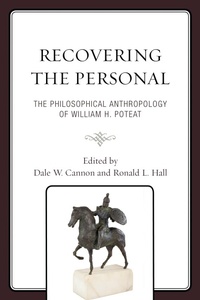
Recovering the Personal
The Philosophical Anthropology of William H. Poteat
1st Edition
Published on 14. September 2016
228 pages
979-8-216-31414-1 (ISBN)
Description

Modernity has radically challenged the assumptions that guide our ordinary lives as persons, in ways we are not normally aware. We live our concrete lives taking for granted that personal decisions, desires, relationships, actions, aspirations, values, and knowledge are central to our existence. But in modernity, we think of these matters as private, idiosyncratic, and subjective, even irrational. This modern conception of ourselves and the associated way of reflection known as modern critical thinking came to dominate our thinking is culminates in the dualistic philosophy of René Descartes. This dualism has spawned a reductionist view of persons and tainted "the personal" with connotations of bias, partiality, and privacy, leaving us with the presumption that if we seek to be objective and intellectually respectable, we must expunge the personal.
William H. Poteat's work in philosophical anthropology has confronted this concern head on. He undertakes a radical critique of the various forms of mind-body dualism and materialist monism that have dominated Western intellectual concepts of the person. In a unique style that Poteat calls post-critical, he uncovers the staggering incoherencies of these dualisms and shows how they have resulted in a loss of the personal in the modern age. He also formulates a way out of this modern cultural insanity. This constructive dimension of his thought is centered on his signature concept of the mindbody, the pre-reflective ground of personal existence. The twelve contributors in this collection explore outgrowths and implications of Poteat's thought.
Recovering the Personal will be of interest to a broad range of intellectual readers with interests in philosophy, psychology, theology, and the humanities.
William H. Poteat's work in philosophical anthropology has confronted this concern head on. He undertakes a radical critique of the various forms of mind-body dualism and materialist monism that have dominated Western intellectual concepts of the person. In a unique style that Poteat calls post-critical, he uncovers the staggering incoherencies of these dualisms and shows how they have resulted in a loss of the personal in the modern age. He also formulates a way out of this modern cultural insanity. This constructive dimension of his thought is centered on his signature concept of the mindbody, the pre-reflective ground of personal existence. The twelve contributors in this collection explore outgrowths and implications of Poteat's thought.
Recovering the Personal will be of interest to a broad range of intellectual readers with interests in philosophy, psychology, theology, and the humanities.
More details
Edition
1. Auflage
Language
English
Place of publication
United States
Publishing group
Bloomsbury Publishing Plc
Target group
Professional and scholarly
ISBN-13
979-8-216-31414-1 (9798216314141)
Copyright in bibliographic data and cover images is held by Nielsen Book Services Limited or by the publishers or by their respective licensors: all rights reserved.
Schweitzer Classification
Other editions
Additional editions
Dale W. Cannon | Ronald L. Hall
Recovering the Personal
The Philosophical Anthropology of William H. Poteat
Book
09/2016
Lexington Books
€119.90
Shipment within 15-20 days
Persons
Dale W. Cannon is professor emeritus of philosophy and religious studies at Western Oregon University.
Ronald L. Hall is professor of philosophy at Stetson University.
Ronald L. Hall is professor of philosophy at Stetson University.
Content
Refinding the Personal Dale W. Cannon and Ronald L. Hall
Philosophical Anthropology
Why Is the Personal So Important? Bruce Haddox and Edward St. Clair
Being Post-Critical Dale W. Cannon
Critical Recollection Ronald L. Hall
The Genealogy of Poteat's Philosophical Anthropology Bruce B. Lawrence
The Primacy of the Person David W. Rutledge
Dethroning Epistemology Ronald L. Hall
Theological Considerations
Personhood and the Problematic of Christianity James W. Stines
Incarnational Theology Elizabeth Newman
Towards a Post-Critical Theology R. Melvin Keiser
Aesthetic Considerations
Post-Critical Aesthetics Kieran Cashell
Paul Cézanne and the Numinous Power of the Real William H. Poteat
Philosophical Anthropology
Why Is the Personal So Important? Bruce Haddox and Edward St. Clair
Being Post-Critical Dale W. Cannon
Critical Recollection Ronald L. Hall
The Genealogy of Poteat's Philosophical Anthropology Bruce B. Lawrence
The Primacy of the Person David W. Rutledge
Dethroning Epistemology Ronald L. Hall
Theological Considerations
Personhood and the Problematic of Christianity James W. Stines
Incarnational Theology Elizabeth Newman
Towards a Post-Critical Theology R. Melvin Keiser
Aesthetic Considerations
Post-Critical Aesthetics Kieran Cashell
Paul Cézanne and the Numinous Power of the Real William H. Poteat
