

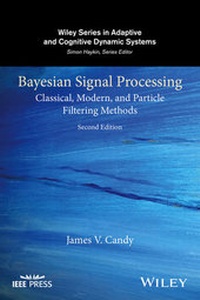
Bayesian Signal Processing
Classical, Modern, and Particle Filtering Methods
2nd Edition
Published on 20. June 2016
640 pages
978-1-119-12547-1 (ISBN)
Description

Presents the Bayesian approach to statistical signal processing for a variety of useful model sets
This book aims to give readers a unified Bayesian treatment starting from the basics (Baye's rule) to the more advanced (Monte Carlo sampling), evolving to the next-generation model-based techniques (sequential Monte Carlo sampling). This next edition incorporates a new chapter on "Sequential Bayesian Detection," a new section on "Ensemble Kalman Filters" as well as an expansion of Case Studies that detail Bayesian solutions for a variety of applications. These studies illustrate Bayesian approaches to real-world problems incorporating detailed particle filter designs, adaptive particle filters and sequential Bayesian detectors. In addition to these major developments a variety of sections are expanded to "fill-in-the gaps" of the first edition. Here metrics for particle filter (PF) designs with emphasis on classical "sanity testing" lead to ensemble techniques as a basic requirement for performance analysis. The expansion of information theory metrics and their application to PF designs is fully developed and applied. These expansions of the book have been updated to provide a more cohesive discussion of Bayesian processing with examples and applications enabling the comprehension of alternative approaches to solving estimation/detection problems.
The second edition of Bayesian Signal Processing features:
* "Classical" Kalman filtering for linear, linearized, and nonlinear systems; "modern" unscented and ensemble Kalman filters: and the "next-generation" Bayesian particle filters
* Sequential Bayesian detection techniques incorporating model-based schemes for a variety of real-world problems
* Practical Bayesian processor designs including comprehensive methods of performance analysis ranging from simple sanity testing and ensemble techniques to sophisticated information metrics
* New case studies on adaptive particle filtering and sequential Bayesian detection are covered detailing more Bayesian approaches to applied problem solving
* MATLAB® notes at the end of each chapter help readers solve complex problems using readily available software commands and point out other software packages available
* Problem sets included to test readers' knowledge and help them put their new skills into practice Bayesian
Signal Processing, Second Edition is written for all students, scientists, and engineers who investigate and apply signal processing to their everyday problems.
More details
Other editions
Additional editions
Book
08/2016
2nd Edition
Wiley-IEEE Press
€140.50
Shipment within 15-20 days
Software
08/2016
Wiley
€162.40
No shipping information available
Person
Content
- Intro
- Bayesian Signal Processing
- Contents
- Preface to Second Edition
- References
- Preface to First Edition
- References
- Acknowledgments
- List of Abbreviations
- 1 Introduction
- 1.1 Introduction
- 1.2 Bayesian Signal Processing
- 1.3 Simulation-Based Approach to Bayesian Processing
- 1.3.1 Bayesian Particle Filter
- 1.4 Bayesian Model-Based Signal Processing
- 1.5 Notation and Terminology
- References
- 2 Bayesian Estimation
- 2.1 Introduction
- 2.2 Batch Bayesian Estimation
- 2.3 Batch Maximum Likelihood Estimation
- 2.3.1 Expectation-Maximization Approach to Maximum Likelihood
- 2.3.2 EM for Exponential Family of Distributions
- 2.4 Batch Minimum Variance Estimation
- 2.5 Sequential Bayesian Estimation
- 2.5.1 Joint Posterior Estimation
- 2.5.2 Filtering Posterior Estimation
- 2.5.3 Likelihood Estimation
- 2.6 Summary
- References
- 3 Simulation-Based Bayesian Methods
- 3.1 Introduction
- 3.2 Probability Density Function Estimation
- 3.3 Sampling Theory
- 3.3.1 Uniform Sampling Method
- 3.3.2 Rejection Sampling Method
- 3.4 Monte Carlo Approach
- 3.4.1 Markov Chains
- 3.4.2 Metropolis-Hastings Sampling
- 3.4.3 Random Walk Metropolis-Hastings Sampling
- 3.4.4 Gibbs Sampling
- 3.4.5 Slice Sampling
- 3.5 Importance Sampling
- 3.6 Sequential Importance Sampling
- 3.7 Summary
- References
- 4 State-Space Models for Bayesian Processing
- 4.1 Introduction
- 4.2 Continuous-Time State-Space Models
- 4.3 Sampled-Data State-Space Models
- 4.4 Discrete-Time State-Space Models
- 4.4.1 Discrete Systems Theory
- 4.5 Gauss-Markov State-Space Models
- 4.5.1 Continuous-Time/Sampled-Data Gauss-Markov Models
- 4.5.2 Discrete-Time Gauss-Markov Models
- 4.6 Innovations Model
- 4.7 State-Space Model Structures
- 4.7.1 Time Series Models
- 4.7.2 State-Space and Time Series Equivalence Models
- 4.8 Nonlinear (Approximate) Gauss-Markov State-Space Models
- 4.9 Summary
- References
- 5 Classical Bayesian State-Space Processors
- 5.1 Introduction
- 5.2 Bayesian Approach to the State-Space
- 5.3 Linear Bayesian Processor (Linear Kalman Filter)
- 5.4 Linearized Bayesian Processor (Linearized Kalman Filter)
- 5.5 Extended Bayesian Processor (Extended Kalman Filter)
- 5.6 Iterated-Extended Bayesian Processor (Iterated-Extended Kalman Filter)
- 5.7 Practical Aspects of Classical Bayesian Processors
- 5.8 Case Study: RLC Circuit Problem
- 5.9 Summary
- References
- 6 Modern Bayesian State-Space Processors
- 6.1 Introduction
- 6.2 Sigma-Point (Unscented) Transformations
- 6.2.1 Statistical Linearization
- 6.2.2 Sigma-Point Approach
- 6.2.3 SPT for Gaussian Prior Distributions
- 6.3 Sigma-Point Bayesian Processor (Unscented Kalman Filter)
- 6.3.1 Extensions of the Sigma-Point Processor
- 6.4 Quadrature Bayesian Processors
- 6.5 Gaussian Sum (Mixture) Bayesian Processors
- 6.6 Case Study: 2D-Tracking Problem
- 6.7 Ensemble Bayesian Processors (Ensemble Kalman Filter)
- 6.8 Summary
- References
- 7 Particle-Based Bayesian State-Space Processors
- 7.1 Introduction
- 7.2 Bayesian State-Space Particle Filters
- 7.3 Importance Proposal Distributions
- 7.3.1 Minimum Variance Importance Distribution
- 7.3.2 Transition Prior Importance Distribution
- 7.4 Resampling
- 7.4.1 Multinomial Resampling
- 7.4.2 Systematic Resampling
- 7.4.3 Residual Resampling
- 7.5 State-Space Particle Filtering Techniques
- 7.5.1 Bootstrap Particle Filter
- 7.5.2 Auxiliary Particle Filter
- 7.5.3 Regularized Particle Filter
- 7.5.4 MCMC Particle Filter
- 7.5.5 Linearized Particle Filter
- 7.6 Practical Aspects of Particle Filter Design
- 7.6.1 Sanity Testing
- 7.6.2 Ensemble Estimation
- 7.6.3 Posterior Probability Validation
- 7.6.4 Model Validation Testing
- 7.7 Case Study: Population Growth Problem
- 7.8 Summary
- References
- 8 Joint Bayesian State/Parametric Processors
- 8.1 Introduction
- 8.2 Bayesian Approach to Joint State/Parameter Estimation
- 8.3 Classical/Modern Joint Bayesian State/Parametric Processors
- 8.3.1 Classical Joint Bayesian Processor
- 8.3.2 Modern Joint Bayesian Processor
- 8.4 Particle-Based Joint Bayesian State/Parametric Processors
- 8.4.1 Parametric Models
- 8.4.2 Joint Bayesian State/Parameter Estimation
- 8.5 Case Study: Random Target Tracking Using a Synthetic Aperture Towed Array
- 8.6 Summary
- References
- 9 Discrete Hidden Markov Model Bayesian Processors
- 9.1 Introduction
- 9.2 Hidden Markov Models
- 9.2.1 Discrete-Time Markov Chains
- 9.2.2 Hidden Markov Chains
- 9.3 Properties of the Hidden Markov Model
- 9.4 HMM Observation Probability: Evaluation Problem
- 9.5 State Estimation in HMM: The Viterbi Technique
- 9.5.1 Individual Hidden State Estimation
- 9.5.2 Entire Hidden State Sequence Estimation
- 9.6 Parameter Estimation in HMM: The EM/Baum-Welch Technique
- 9.6.1 Parameter Estimation with State Sequence Known
- 9.6.2 Parameter Estimation with State Sequence Unknown
- 9.7 Case Study: Time-Reversal Decoding
- 9.8 Summary
- References
- 10 Sequential Bayesian Detection
- 10.1 Introduction
- 10.2 Binary Detection Problem
- 10.2.1 Classical Detection
- 10.2.2 Bayesian Detection
- 10.2.3 Composite Binary Detection
- 10.3 Decision Criteria
- 10.3.1 Probability-of-Error Criterion
- 10.3.2 Bayes Risk Criterion
- 10.3.3 Neyman-Pearson Criterion
- 10.3.4 Multiple (Batch) Measurements
- 10.3.5 Multichannel Measurements
- 10.3.6 Multiple Hypotheses
- 10.4 Performance Metrics
- 10.4.1 Receiver Operating Characteristic (ROC) Curves
- 10.5 Sequential Detection
- 10.5.1 Sequential Decision Theory
- 10.6 Model-Based Sequential Detection
- 10.6.1 Linear Gaussian Model-Based Processor
- 10.6.2 Nonlinear Gaussian Model-Based Processor
- 10.6.3 Non-Gaussian Model-Based Processor
- 10.7 Model-Based Change (Anomaly) Detection
- 10.7.1 Model-Based Detection
- 10.7.2 Optimal Innovations Detection
- 10.7.3 Practical Model-Based Change Detection
- 10.8 Case Study: Reentry Vehicle Change Detection
- 10.8.1 Simulation Results
- 10.9 Summary
- References
- 11 Bayesian Processors for Physics-Based Applications
- 11.1 Optimal Position Estimation for the Automatic Alignment
- 11.1.1 Background
- 11.1.2 Stochastic Modeling of Position Measurements
- 11.1.3 Bayesian Position Estimation and Detection
- 11.1.4 Application: Beam Line Data
- 11.1.5 Results: Beam Line (KDP Deviation) Data
- 11.1.6 Results: Anomaly Detection
- 11.2 Sequential Detection of Broadband Ocean Acoustic Sources
- 11.2.1 Background
- 11.2.2 Broadband State-Space Ocean Acoustic Propagators
- 11.2.3 Discrete Normal-Mode State-Space Representation
- 11.2.4 Broadband Bayesian Processor
- 11.2.5 Broadband Particle Filters
- 11.2.6 Broadband Bootstrap Particle Filter
- 11.2.7 Bayesian Performance Metrics
- 11.2.8 Sequential Detection
- 11.2.9 Broadband BSP Design
- 11.2.10 Summary
- 11.3 Bayesian Processing for Biothreats
- 11.3.1 Background
- 11.3.2 Parameter Estimation
- 11.3.3 Bayesian Processor Design
- 11.3.4 Results
- 11.4 Bayesian Processing for the Detection of Radioactive Sources
- 11.4.1 Physics-Based Processing Model
- 11.4.2 Radionuclide Detection
- 11.4.3 Implementation
- 11.4.4 Detection
- 11.4.5 Data
- 11.4.6 Radionuclide Detection
- 11.4.7 Summary
- 11.5 Sequential Threat Detection: An X-ray Physics-Based Approach
- 11.5.1 Physics-Based Models
- 11.5.2 X-ray State-Space Simulation
- 11.5.3 Sequential Threat Detection
- 11.5.4 Summary
- 11.6 Adaptive Processing for Shallow Ocean Applications
- 11.6.1 State-Space Propagator
- 11.6.2 Processors
- 11.6.3 Model-Based Ocean Acoustic Processing
- 11.6.4 Summary
- References
- Appendix: Probability and Statistics Overview
- A.1 Probability Theory
- A.2 Gaussian Random Vectors
- A.3 Uncorrelated Transformation: Gaussian Random Vectors
- References
- Index
- Wiley Series on Adaptive and Cognitive Dynamic Systems
- EULA
