

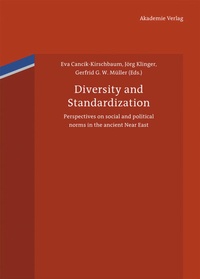
Diversity and Standardization
Description

The ancient Near East is a construct defined by present-day scientific investigations, a construct whose temporal and spatial boundaries are fuzzy, constantly shifting under the weight of new empirical data and increasingly sophisticated analytical methods. Its objects of investigation, even those that have resided in museum collections for generations, are in flux, as the profound cultural, geographical, ethnic and social diversity of the ancient Near East threatens to drown out any points of commonality. Yet it is these points of commonality that draw us inevitably to questions of Diversity and Standardization as categories for cross-cultural and trans-historical analysis. As we look across the variegated horizons of antiquity, do these categories have any real analytical power? For instance, the introduction of a new system of measurement or bookkeeping technique or even the imposition of a standardized repertoire of pottery forms on a more-or-less subject population are all examples of the real power of processes of standardization to stabilize territorial political entities. The problem must be posed for the ancient Near East at an even more fundamental level, however: what role do concepts, methods of standardization and, more generally, sign systems play in the reconfiguration and reconstitution of cultural, political, religious, scientific and social spaces? This volume results from a symposium under the aegis of the TOPOI Research Cluster (a trans-disciplinary research center devoted to the investigation of the interdependencies between space and knowledge in the ancient world) that brought together leading archaeologists, philologists, historians and linguists in order to investigate concrete historical examples that speak to questions of Diversity and Standardization in the ancient Near East.
More details
Other editions
Additional editions
Persons
Content
2 - Preface [Seite 9]
3 - Vorwort [Seite 13]
4 - The Anatolian Fate-Goddesses and their Different Traditions [Seite 17]
5 - Harrâdum, entre Babylone et le « pays de Mari » [Seite 43]
6 - Nommer à l'époque amorrite [Seite 65]
7 - Gods of Commagene: The Cult of the Stag-God in the inscriptions of Ancoz [Seite 81]
8 - Urbanisierung, Stadtplanung und Wirtschaftsweise in "marginalen Gebieten" Nordostsyriens Das Beispiel von Tell Chuera sowie erste Überlegungen zum Transfer dieser Siedlungsweise nach Westsyrien [Seite 97]
9 - A Tale of Two Cities New Ur III Archives and their Implication for Early Old Babylonian History and Culture [Seite 115]
10 - Neuassyrische Schrift und Sprache in den urartäischen Königsinschriften (9.-7. Jahrhundert v. Chr.) [Seite 129]
11 - Gauging the influence of Babylonian magic: The reception of Mesopotamian traditions in Hittite ritual practice [Seite 161]
12 - Between scepticism and credulity: In defence of Hittite historiography [Seite 189]
13 - Index of texts cited [Seite 231]
14 - Program of the Symposium Normierung und Emanzipation: Bausteine für eine Kulturgeschichte des 2. Jts. v.Chr. im Alten Orient [Seite 237]
