

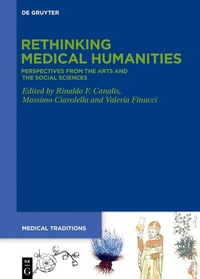
Rethinking Medical Humanities
Description

Medical Humanities may be broadly conceptualized as a discipline wherein medicine and its specialties intersect with those of the humanities and social sciences. As such it is a hybrid area of study where the impact of disease and healing science on culture is assessed and expressed in the particular language of the disciplines concerned with the human experience. However, as much as at first sight this definition appears to be clear, it does not reflect how the interaction of medicine with the humanities has evolved to become a separate field of study. In this publication we have explored, through the analysis of a group of selected multidisciplinary essays, the dynamics of this process. The essays predominantly address the interaction of literature, philosophy, art, art history, ethics, and education with medicine and its specialties from the classical period to the present. Particular attention has been given to the Medieval, Early Modern, and Enlightenment periods. To avoid a rigid compartmentalization of the book based on individual fields of study we opted for a fluid division into multidisciplinary sections, reflective of the complex interactions of the included works with medicine.
More details
Other editions
Additional editions
Persons
Rinaldo F. Canalis and Massimo Ciavolella , UCLA, Los Angeles, CA, USA; Valeria Finucci , Duke University, Durham, NC, USA.
Content
- Intro
- Acknowledgments
- Contents
- List of Figures
- List of Contributors
- Introduction: Setting up the Terms
- Rethinking Medical Humanities
- Philosophy and Ethical Queries
- Pondering the Perimeters: Towards a Definition of Medical Humanism
- Avoidable Mistakes - Premodern Medical Fallibility as an Ethical Problem with Epistemological Implications
- When the Fetus Becomes a Child: Some Reflections from the Long Eighteenth Century
- Ethical Responsibilities in the Curing/Caring Relationship
- Haling or Hale: The Body in the Arts and Literature
- Disease and the Problem of Evil in the Novels of Thomas Mann
- Monstrosity and the Monstrous Revisited: Fortunio Liceti's Medical Imagination
- The Flesh of Wax: The Use of Scientific Collection in Medical Humanities
- The Body between Life and Death: Berengario da Carpi and the Anatomical Image of the Sixteenth Century
- The Anatomy Lesson of Dr. Jan Deijman and the Social History of the Brain
- Secrets of the Dead
- The Bio-Turn in History Writing: Death, Last Wishes, and Lasting Wishes
- The Fatal Disease of the Last Reigning Inca: A Historical and Clinical Study
- Paleopathology and Anthropology of the Renaissance: From the Morbus Dominorum to the Alleged 'Michelangelo's Shoes'
- Reason, Affects and Madness
- The New World Opened by Madness
- Why Listen to the Mad? What Schizophrenic Girl Offers to Narrative Medicine
- The Malady of Love in Early Modern Medical Thought
- The Humanities in Medical Education
- Art Images And Medical Teaching
- Medical Humanities: A Tautology or a Necessity?
- Teaching PTSD with Film: The Case of Peter Weir's Fearless
- The Humanities and Global Health: Travels with Philippa Foot and Karl Popper
- Postface
- Medical Humanities as a Search for Unity
- Cumulative Bibliography
- Index of Names
