

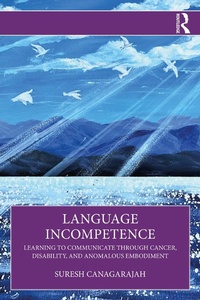
Language Incompetence
Learning to Communicate through Cancer, Disability, and Anomalous Embodiment
1st Edition
Published on 8. May 2022
236 pages
978-1-000-54850-1 (ISBN)
Description

This book is framed as a memoir of the author's journey through a cancer diagnosis and resulting impairments, as he continued his teaching and research activities during and after medical procedures. The narrative weaves together theoretical debates, textual analyses, and ethnographic data from communicative practices to redefine language competence.
The book demonstrates:
the generative and resistant value of human vulnerability
the importance of vulnerability in motivating engagement with social networks and material ecologies for productive thinking, communication, and community
the role of relational ethics in social and communicative life
a decolonizing orientation to disability studies and language competence.
While language competence was traditionally defined as mentally internalized grammatical knowledge for individual mastery of communication, this book demonstrates the need for distributed, ethical, and embodied practice.
The book is intended for graduate students and researchers in language and literacy studies. It would interest scholars outside these disciplines to understand what language studies can offer to address the role of disabilities, impairments, and debilities in embodied communication and thinking. In the context of the global pandemic, compounded by environmental catastrophes and structural injustices which disproportionately affect marginalized communities, the book helps readers treat human vulnerability as the starting point for ethical social relations, strategic communication, and transformative education.
The book demonstrates:
the generative and resistant value of human vulnerability
the importance of vulnerability in motivating engagement with social networks and material ecologies for productive thinking, communication, and community
the role of relational ethics in social and communicative life
a decolonizing orientation to disability studies and language competence.
While language competence was traditionally defined as mentally internalized grammatical knowledge for individual mastery of communication, this book demonstrates the need for distributed, ethical, and embodied practice.
The book is intended for graduate students and researchers in language and literacy studies. It would interest scholars outside these disciplines to understand what language studies can offer to address the role of disabilities, impairments, and debilities in embodied communication and thinking. In the context of the global pandemic, compounded by environmental catastrophes and structural injustices which disproportionately affect marginalized communities, the book helps readers treat human vulnerability as the starting point for ethical social relations, strategic communication, and transformative education.
Reviews / Votes
"This is a ground-breaking book, situated at the intersection of disability studies and applied linguistics. Suresh Canagarajah writes about important contemporary themes. He argues for a non-deficit perspective, where English language students are no longer seen as needing remediation. He criticizes applied linguists' exclusive reliance on western discourse and knowledge-making practices. He establishes the importance of social networks, material resources, and distributed practice in the emergence of meaning. He calls for researchers to engage in ethical inquiry, consistent with several recent reminders that applied linguists should seek to solve problems in the real world. In short, this is a thought-provoking book-a memoir sure to spark much discussion."Diane Larsen-Freeman, University of Michigan, USA
"Reading Language Incompetence is a unique experience - we encounter a very different author than what we usually expect when we read academic literature. Indeed, this is a very different author than the Suresh Canagarajah that we have known from his academic literature. But there is incredible strength embodied in the anomalies of this book, just as the author argues for the strength in anomalous embodiment more generally. Most impressive is the honesty with which Canagarajah recounts his engagement with disability, through layers of internalized ableism, grappling and often struggling with the ways that our academic discourses suffice, and do not suffice, to recognize the very real vulnerability of our bodies and minds. Language Incompetence should be read by any student or scholar invested in the reliability and normativity of linguistics, of science, of rhetoric - Canagarajah will gently replace their desire for precision and certainty with something much more human."
Jay Dolmage, Professor of English, University of Waterloo, Canada; Editor, Canadian Journal of Disability Studies
More details
Edition
1. Auflage
Language
English
Place of publication
London
United Kingdom
Publishing group
Taylor & Francis Ltd
Target group
Professional and scholarly
College/higher education
Illustrations
2 Line drawings, color; 4 Line drawings, black and white; 16 Halftones, color; 4 Halftones, black and white; 18 Illustrations, color; 8 Illustrations, black and white
ISBN-13
978-1-000-54850-1 (9781000548501)
Copyright in bibliographic data and cover images is held by Nielsen Book Services Limited or by the publishers or by their respective licensors: all rights reserved.
Schweitzer Classification
Other editions
Additional editions
Suresh Canagarajah
Language Incompetence
Learning to Communicate through Cancer, Disability, and Anomalous Embodiment
Book
05/2022
1st Edition
Routledge
€79.10
Shipment within 10-20 days
Suresh Canagarajah
Language Incompetence
Learning to Communicate through Cancer, Disability, and Anomalous Embodiment
Book
05/2022
1st Edition
Routledge
€223.20
Shipment within 10-20 days
Person
Suresh Canagarajah is Edwin Erle Sparks Professor of Applied Linguistics, English, and Asian Studies at Pennsylvania State University, USA. He was the former editor of TESOL Quarterly and President of the American Association of Applied Linguistics.
Content
Preface
1. Am I Disabled?
2. Learning to be Able
3. BC/AC: Changing Identities and Communities
4. Designer Babies and Chosen Tribes: Toward a Relational Politics
5. From War Zones to Cancer Wards: A Community of Dependent Frail Bodies
6. Composing at Chemo Time: Cancer Journals as Performative Writing
7. John's Final Blogs: Anomalous Embodiment and Religious Disability Rhetoric
8. The Arbor and the Rhizome: Rethinking Language Competence
9. Weaving Texts: Scientific Communication as Anomalous Embodiment
10. "Supplement or Compensate our Weak Points": Relational Ethics in Academic Interactions
11. Cafe Conversations: Embracing Vulnerability in Society and Education
Index
1. Am I Disabled?
2. Learning to be Able
3. BC/AC: Changing Identities and Communities
4. Designer Babies and Chosen Tribes: Toward a Relational Politics
5. From War Zones to Cancer Wards: A Community of Dependent Frail Bodies
6. Composing at Chemo Time: Cancer Journals as Performative Writing
7. John's Final Blogs: Anomalous Embodiment and Religious Disability Rhetoric
8. The Arbor and the Rhizome: Rethinking Language Competence
9. Weaving Texts: Scientific Communication as Anomalous Embodiment
10. "Supplement or Compensate our Weak Points": Relational Ethics in Academic Interactions
11. Cafe Conversations: Embracing Vulnerability in Society and Education
Index
