

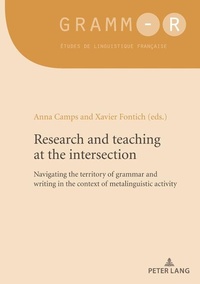
Research and teaching at the intersection
Description

The studies included in this volume describe the process embedded in learning to write in Language Arts, as well as in teaching it and assessing it, focusing on the metalinguistic activity triggered in this process. Because of the latter, they also examine students' grammar concepts and the process of learning and teaching grammar. These four objectives are included in the overarching objective of elaborating a theoretical frame that accounts for metalinguistic activity as a social and cognitive activity oriented towards the learning of language use. A qualitative, descriptive, and interpretative perspective is adopted, based on case study and action-research; also, the tenets of sociocultural psychology, contributions from cognitive psychology and functional linguistics, and pedagogic studies concerned with peer and small group interaction in dealing with classroom complexity. The chapters result from the necessary collaboration between researchers and teachers, who contribute their speci?c knowledge both to the design as well as to the monitoring and analysis of the results of the di?erent projects. We believe that the interest of the book lies precisely in this diversity. This book highlights "the remarkable epistemological, theoretical and methodological coherence of the research program in language teaching conducted by GREAL research group over the past three decades." (Jean-Paul Bronckart, from the "Foreword").
More details
Other editions
Additional editions
Persons
Anna Camps has been a Professor at the Universitat Autònoma de Barcelona (UAB) (Spain). She is the founder of GREAL research group (Grup de Recerca sobre Ensenyament i Aprenentatge de Llengües, the Research Group on Teaching and Learning Languages).
Xavier Fontich has been a secondary school teacher and in 2015 obtained a tenure-track position at the Universitat Autònoma de Barcelona (UAB) (Spain).
Content
- Cover
- Title
- Copyright
- Contents
- Dedication
- Foreword
- Introduction
- 1. The link between the writing process and the learning process
- 2. The model of Writing Instructional Sequence (WIS)
- 3. Metalinguistic activity in writing
- 4. Students' grammar concepts
- 5. A model for teaching grammar: Grammar Instructional Sequence (GIS)
- 6. Metalinguistic activity and grammar learning
- 7. Writing, grammar, and metalinguistic activity
- 7.1. Synthesis and final consideration
- Part I. Writing process and learning process
- Different perspectives on the teaching and learning of written composition
- 1. The text
- 2. The written composition processes
- 3. The emergence of the context
- 4. Writing and learning to write as discursive activities
- 5. In conclusion
- Towards a renewal of the teaching of written composition in schools
- 1. The written composition process is complex and involves a series of sub-processes and interrelated operations at different levels
- 2. Writing is a social activity
- 3. To learn how to write, speaking is necessary
- 4. The writing activity
- 5. In conclusion
- Some observations about adolescents' capacity to revise written texts
- 1. Revision as a sub-process
- 2. Analysis of three students' review operations carried out in a group production situation
- 2.1. Description of the planned work and the conditions in which it was completed
- 2.2. Analysis of the protocols
- 3. Some observations and findings
- 3.1. Limited scope in the revision
- 3.2. The large number of revision episodes
- 3.3. Revision as a recursive operation
- 3.4. Revision before writing
- 3.5. Revision that does not entail any change
- 3.6. The trigger for a revision operation
- 3.7. Different levels of revision
- 4. Conclusions
- The regulation of the process of collaborative written composition: Analysis of the use of revision guidelines
- 1. Research references
- 1.2. Methodological framework
- 2. Research design
- 2.1. Fieldwork
- 2.2. Data analysed
- 3. Research questions
- 4. Data analysis
- 4.1. First analysis: The written composition process
- 4.2. Second analysis: The formative assessment process
- 5. Conclusions
- Language "projects" between theory and practice Anna Camps
- 1. Towards the basic foundations of project work
- 1.1. The pedagogical tradition
- 1.2. Language sciences focused on the study of language use
- 1.3. Socio-cultural psychology
- 1.4. Cognitive psychology
- 1.5. Activity theory
- 1.6. Research in language teaching
- 2. Language projects
- 3. A model of how projects develop
- 4. Sequence of objectives, planning, and project work
- 5. Conclusion
- Part II. Writing instructional sequences
- A poetry exhibition: Poems to read and understand, to recite, to look at, to play with
- 1. A poetry exhibition
- 2. Poems to read
- 3. Poems to be recited
- 4. Poems to read and look at
- 5. Poems to play with
- 6. Preparation of the exhibition
- The medieval hero: A project on European literature
- 1. Why the medieval hero?
- 2. Project planning
- 3. The selection of text fragments
- 4. Support materials
- 5. Learning activities
- The composition of the news
- 1. The text plan
- 2. Writing the headline
- 3. From the headlines to the lead
- 4. The body of the news: Cohesion procedures
- 5. Conclusions
- And what did you feel when.? Interview with a character
- 1. Reading the novel
- 2. Behaviour of the characters and the backdrop of war
- 3. Script of the sequence
- 4. Interview of a character
- 4.1. Why interview a character?
- 4.2. Why an interview?
- 5. Planning and writing the interview
- 5.1. Synopsis of the work, formulation of questions and answers, and inclusion of reporting verbs
- 5.2. Lexical modality to indirectly convey one's own opinion
- 5.3. Live writing
- 6. Final ideas
- Writing theatre reviews
- 1. The writing of theatre criticism and its pedagogic interest
- 2. The parameters of the experience
- 3. Dynamics and content of the different sessions
- 4. Final observations
- Part III. Metalinguistic activity in the process of writing
- Metalinguistic activity in learning to write
- 1. About the concept "metalinguistic"
- 2. Agreements and controversies
- Interlinguistic reflection in teaching and learning languages
- 1. Theoretical framework
- 1.1. The connections between the linguistic knowledge of different languages
- 1.2. Students' construction of grammatical knowledge
- 1.3. Acquisition of temporality
- 2. The work project
- 2.1. The development of some of the activities carried out in the second phase
- 2.2. Summary of the activity developed by the group
- 3. Conclusions
- Metalinguistic activity in group writing situations: The influence of pedagogic situations and group characteristics
- 1. The teaching/learning situation
- 2. Analysis of the metalinguistic activity
- 2.1. Analysis of the metalinguistic activity carried out during the production of the first draft
- 2.1.1. Utterances with a metalinguistic function
- 2.1.2. Reformulation in the process of producing drafts or initial texts
- 2.2. References to the guideline and incidence of the guideline in the metalinguistic activity
- 3. Conclusions
- Part IV. Students' grammar concepts
- Learning grammar
- 1. What does "to know grammar" mean?
- 1.1. Implicit grammar and explicit grammar
- 1.2. Metalinguistic activity
- 1.3. An integrative approach
- 2. The grammatical knowledge of the learners
- 2.1. Studies on the development of language
- 2.2. The specific development of children's metalinguistic activity
- 2.3. The grammar concepts of the apprentices
- 2.4. A search on the category "pronoun"
- 2.5. Some general conclusions
- 3. Final reflections
- The grammatical concepts of secondary school students: The personal pronoun
- 1. Methodology of the research
- 2. Data analysis and discussion of the results
- 2.1. Definition of pronoun
- 2.2. Identification of pronouns in a text
- 3. The interviews
- 4. Underlying grammatical concepts
- 4.1. The concept of substitution
- 4.2. The concept of referent
- 5. Conclusions
- Secondary school students' grammatical concepts: The subject
- 1. Theoretical underpinnings and previous empirical studies
- 1.1. Previous research on students' grammatical concepts
- 1.2. The concept of "subject" and its problems
- 2. An empirical approach to the concept of subject in students in the 4th year of compulsory secondary school
- 2.1. Objectives and methodology
- 2.2. Data collection
- 3. Results
- 3.1. Definition of subject
- 4.2. Identification of the subject
- 3.2. Interviews
- 4. Conclusions
- Secondary school students' grammatical representations and metalinguistic activity: The "verb" category
- 1. Research framework
- 1.1. Students' grammatical representations
- 1.2. The epistemological difficulties of the category "verb"
- 1.3. Metalinguistic activity and the appropriation of grammatical knowledge
- 2. The current study
- 3. Analysis of the data and comments of the results
- 3.1. Identification of the verb and recognition of verb tense
- 3.2. Definition of the category
- 3.3. Relationships between declarative knowledge and procedural knowledge
- 3.4. Interviews
- 4. Conclusions
- Part V. The teaching of grammar: Grammar instructional sequences The teaching of grammar
- 1. The nature of grammatical knowledge
- 1.1. On the meanings of the term "grammar"
- 1.1.1. Grammar as an implicit knowledge
- 1.1.2. Grammar as a scientific knowledge about language
- 1.1.3. Metalinguistic knowledge
- 1.2. The nature of grammatical knowledge students are asked about
- 2. The objectives of teaching grammar
- 2.1. To improve the uses of language through the mastery of linguistic-discursive forms
- 3. Contributions of language sciences to the delimitation of the content of grammatical education
- 3.1. Linguistic structuralism
- 3.2. Transformational-Generative Grammar (TGG)
- 3.3. Enunciative theories
- 3.4. Studies on text and discourse
- 3.5. Cognitive linguistics
- 4. The contents of grammatical education
- 5. Planning grammatical contents
- 5.1. Domain of language system
- 5.2. Domain of language use
- 6. Methodological implications
- 6.1. Learn grammar from written composition projects
- 6.2. From the development of the grammatical object to the creation of the concept
- 6.3. Investigate the uses of personal pronouns
- Instructional sequences to work on grammar at school
- 1. Proposals subordinate to text production and comprehension
- 2. Instructional sequences that start off with a reflection on language
- 3. Towards a model for teaching grammar: Grammar Instructional Sequence (GIS)
- 4. Conclusions
- The construction of secondary students' grammatical knowledge through research and reason: The use of the pronoun "hi" in spoken Catalan
- 1. Research objectives
- 2. Grammar Instructional Sequences (GIS)
- 3. Project work to explore the possibilities of the model
- 4. GIS implementation
- 5. Last considerations
- Towards a pedagogical grammar
- 1. Communicative-approach syntax?
- 2. Towards semantic-oriented syntax for school
- 2.1. The verb as the sentence organizer
- 2.2. Verb, verb arguments and headlines
- 2.3. Verb arguments in narrative texts
- 3. The word order in the sentence
- 4. Sentence composition: Cohesive style
- 5. Conclusions
- 5.1. Beyond just a change in language description models and metalanguage
- 5.2. Semantics and pragmatics as core aspects
- 5.3. Sentence and discourse levels
- Towards a grammar for teaching: Definition and description
- 1. A grammar of reference: Normative, descriptive and contrastive
- 2. The foundations of a grammar for language teaching and learning
- 3. Addressing the study of linguistic-discursive forms from pragmatic, semantic and formal viewpoints
- 4. Offering tools to make gradual knowledge of grammar possible
- 5. Providing systematic knowledge of grammar concepts
- 6. Facilitating the link between systematic knowledge and the use of language
- 7. Providing criteria for sequencing the syllabus throughout primary and secondary education
- 7.1. Interrelating syntax and discourse
- 7.2. Adapting to the level of psycholinguistic development
- 7.3. Regulating the transition from the use of language forms to the generalization of the concept
- 8. Final reflection
- Part VI. Metalinguistic activity and grammar learning
- Metalinguistic activity and learning grammar: Towards a teaching model based on reflexive activity
- 1. The obstacles in grammatical learning
- 1.1. Obstacles referring to content
- 1.2. Obstacles referring to the modes of reasoning accessible to students
- 1.3. Methodological obstacles
- 2. Grammar Instructional Sequences
- 3. Final consideration
- The verb, centre of the sentence: Students classify verbs by considering verbal complements
- 1. Sentence-based language studies which focus on the verb
- 2. The verb in the classroom to study the sentence
- 3. An intervention sequence: The verb as the sentence core and the classification of verbs according to verbal complements
- 4. Analysis and interpretation of the four dialogues
- 5. Conclusions
- The construction of grammatical knowledge by students of primary and secondary education: Some approaches to the learning of the verb
- 1. Approaching the verb in the classroom
- 2. Methodology
- 3. Recognition of the retrospective value of the present tense by primary-school students
- 3.1. Strategies to build knowledge about the retrospective value
- 3.2. Interaction as a strategy to promote metalinguistic reflection
- 4. The conceptualization of verb mood and mood values by secondary students
- 4.1. From meaning to linguistic form, from use to grammar conceptualization
- 4.2. The notion of verb mood that emerges from students' metalinguistic writing
- 5. Metalinguistic reflection on verb complementation by secondary school students
- 5.1. Analysis of four verb complementation segments
- 6. Conclusions and implications
- Metalinguistic activity during a task of segmenting a text into words in early primary school
- 1. The task: Characteristics, participants and realization
- 2. Analysis and results
- 2.1. On competence in graphic segmentation
- 2.2. On metalinguistic knowledge
- 3. Last consideration
- Part VII. Writing, grammar and metalinguistic activity
- The instructional sequence model, twenty years on: A valid model for teaching how to learn and learning how to teach
- 1. Changes and evolution in theoretical approaches
- 2. Changes and evolution in the institutional framework of education
- 3. The evolution and expansion of the IS
- 4. Conclusion
- Grammar and writing in late primary: Noun complement
- 1. A framework for working on grammar at school
- 2. Design of the sequence
- 3. Students talk to learn grammar
- 4. Some final observations about the sequence
- Grammar instruction and writing: The role of revision
- 1. Grammar revision and metalinguistic awareness: The use of past tenses
- 2. The revision of the text: Data
- 4. Discussion and conclusion
- Saying "what it is": The hypernym in early secondary school
- 1. The instructional sequence to design a crossword puzzle
- 2. Comment on results
- 2.1. Language use
- 2.2. Metalinguistic knowledge
- 2.3. Metalanguage
- 3. Invitations to reflection
- Part VIII. An approach to research into language teaching
- Research in language pedagogy at the crossroads of many paths
- 1. Language Pedagogy/Didactics of language as a field of knowledge and specific research
- 2. The pedagogic system
- 3. The dynamic processes of teaching and learning languages
- 4. The relationship between theory and practice
- 5. Some current questions concerning the teaching of language which should be investigated
- 5.1. The contents of education in relation to curricular formulations
- 5.2. Oral and written genres: A diversity that converges in the school environment
- 5.3. Grammatical knowledge and the use of language: A problematic relationship
- 5.4. Plurilingualism: A term that hides diverse problems
- 5.5. The linguistic-didactic teacher education
- 6. A final reflection
- Interaction of contexts within research in writing composition
- 1. Research as an activity system
- 2. Research planning
- 3. Changes throughout the research activity
- 4. Data analysis
- 5. Conclusions
- 5.1. Conclusions on the results of the research
- 5.2. Conclusions on the research activity in language pedagogy
- Intervention, innovation, and research: A necessary relationship for pedagogy
- 1. Human activities as a target of research
- 2. Scientific knowledge in the field of teaching
- 2.1. Relationship between the knowledge that arises from practice and the systematic knowledge
- 2.2. Systematizing knowledge about something that is dynamic and changing
- 3. The levels of investigation in and on action
- 4. Conclusion
- The construction of written discourse in an academic environment: A vision into the dynamics of learning discursive genres
- 1. The study
- 2. The basic theoretical-conceptual framework
- 2.1. Discursive genres as an activity
- 3. Some key concepts of the theory of activity
- 3.1. Activity and action
- 3.2. Significance and meaning
- 3.3. The systems of activity
- 4. What the data of this study contribute: An approach to understanding learning through the writing of academic genres
- 4.1. Diversity and confluence of genres in writing situations
- 4.2. Interrelation of activity systems
- 4.3. Contradictions (tensions) between activity systems
- 4.4. Contradictions (tensions) fuelling learning by triggering a zone of proximal development
- 5. Conclusions
- Postface
- (a) The role of grammar within the process of teaching and learning to write
- (b) The various grammatical subsystems provisionally outside the communicative flow
- (d) The contrast between languages or between (social, geographical and functional) registers
- Classroom research and teacher training
- Synthesis ?
- References
- Editors
- Authors
