

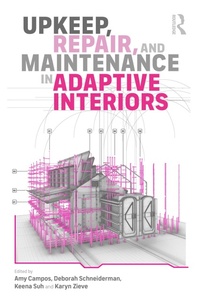
Upkeep, Repair, and Maintenance in Adaptive Interiors
1st Edition
Published on 19. November 2025
272 pages
978-1-040-42902-0 (ISBN)
Description

This volume explores issues of repair, maintenance, sustenance, and adaptation within the context of interior design and its histories.
The contributions to this volume celebrate critical analysis of past and present work as well as potentials for upkeeping the built environment, sustaining our histories and cultures, and maintaining our shared resources as we face radical shifts in the ways in which we inhabit the various spaces where we work, live, convene, cross, and connect. Chapters recognize the ways in which the interior has defined, reinforced, hidden, and protected servitude and repair. They offer an appreciation of the role of interiors to extend the lives of our architectures and the human interactions they sustain. Expert and emerging contributing authors explore varied topics such as Dalit cleaning as a practice of decolonial interior architecture, responses to pest invasion, cultural attitudes toward age, wear and waste, and creative repair, among many others.
This will be of great interest to all students and academics of interior design, as well as architecture, architectural conservation, visual culture, history of art, and all those interested in the theory and philosophy of the reuse of interiors.
The contributions to this volume celebrate critical analysis of past and present work as well as potentials for upkeeping the built environment, sustaining our histories and cultures, and maintaining our shared resources as we face radical shifts in the ways in which we inhabit the various spaces where we work, live, convene, cross, and connect. Chapters recognize the ways in which the interior has defined, reinforced, hidden, and protected servitude and repair. They offer an appreciation of the role of interiors to extend the lives of our architectures and the human interactions they sustain. Expert and emerging contributing authors explore varied topics such as Dalit cleaning as a practice of decolonial interior architecture, responses to pest invasion, cultural attitudes toward age, wear and waste, and creative repair, among many others.
This will be of great interest to all students and academics of interior design, as well as architecture, architectural conservation, visual culture, history of art, and all those interested in the theory and philosophy of the reuse of interiors.
Reviews / Votes
"In a world with finite resources and with the demise of extractivist approaches with which to remove them, the refrain of 'no more new build' will preside over the future of the built environment. The upkeep, repair and maintenance of the existing is an essential feature of these approaches. This volume provides a valuable overview of the thinking around how orthodox creative processes of the origination of the unfettered new are now reversed. As it states, working with the not new, cleaning, pedagogies of waste and the delegitimization of authorship in any construction are the only ways forward for a climatically challenged built environment in the 21st century."Prof. Graeme Brooker. Head of Interiors at the Royal College of Art, London and the author of 'The superREUSE Manifesto' (Routledge 2025).
"Upkeep, Repair and Maintenance in Adaptive Interiors is a valuable resource for design students, researchers, and practitioners interested in how care and stewardship shape the built environment. By probing often invisible forms of labor as well as the visible cracks that permeate life at all scales, the book makes an optimistic and timely case for thinking and making in a material world prone to breakage."
Igor Siddiqui, Associate Professor and Program Director for Interior Design, The University of Texas at Austin; Editor-in-Chief of the journal Interiors: Design/Architecture/Culture.
More details
Edition
1. Auflage
Language
English
Place of publication
London
United Kingdom
Publishing group
Taylor & Francis Ltd
Target group
College/higher education
Illustrations
1 Tables, black and white; 1 Line drawings, black and white; 26 Halftones, color; 95 Halftones, black and white; 26 Illustrations, color; 96 Illustrations, black and white
File size
85,86 MB
ISBN-13
978-1-040-42902-0 (9781040429020)
Copyright in bibliographic data and cover images is held by Nielsen Book Services Limited or by the publishers or by their respective licensors: all rights reserved.
Schweitzer Classification
Other editions
Additional editions
Amy Campos | Deborah Schneiderman | Keena Suh
Upkeep, Repair, and Maintenance in Adaptive Interiors
Book
approx. 11/2025
1st Edition
Routledge
€215.41
Not yet published
Amy Campos | Deborah Schneiderman | Keena Suh
Upkeep, Repair, and Maintenance in Adaptive Interiors
Book
approx. 11/2025
1st Edition
Routledge
€52.50
Not yet published
Persons
Amy Campos is a Professor at California College of the Arts. She focuses on durability and design, and the impermanent, migratory potentials of the interior. Recent publications include Public Interiority (Routledge, 2024), Interior Design On Edge (Routledge, 2024), Interior Futures (Crucible Press, 2019), Interiors Beyond Architecture (Routledge, 2018), and Interior Architecture Theory Reader (Routledge, 2018). She received a BArch from Cal Poly, San Luis Obispo and an MSAAD from Columbia University.
Deborah Schneiderman is a Professor at Pratt Institute. Her scholarship and praxis explore the emerging fabricated interior environment. Recent publications include Inside Prefab: The Ready-Made Interior; The Prefab Bathroom; Textile, Technology and Design: From Interior Space to Outer Space; Interiors Beyond Architecture; Interior Provocations: History, Theory, and Practice of Autonomous Interiors; Appropriated Interiors, Interiors On Edge, and The Prefabricated Interior.
Keena Suh is a Professor in the Interior Design Department at Pratt Institute, where she teaches and coordinates courses across the programs at undergraduate and graduate levels, with a focus on interdisciplinary learning. She holds an MArch from Columbia University.
Karyn Zieve is Assistant Dean in the School of Liberal Arts and Sciences and Adjunct Assistant Professor in the Department of History of Art & Design at Pratt Institute. She teaches classes that range from the introductory history of art and design sequence to topics in museum studies and the long nineteenth-century European art, design, and theory with a focus on cross-cultural communication and miscommunication. She received her PhD from the Institute of Fine Arts, NYU, completing her dissertation on Eugene Delacroix, Orientalism, and Historicism.
Deborah Schneiderman is a Professor at Pratt Institute. Her scholarship and praxis explore the emerging fabricated interior environment. Recent publications include Inside Prefab: The Ready-Made Interior; The Prefab Bathroom; Textile, Technology and Design: From Interior Space to Outer Space; Interiors Beyond Architecture; Interior Provocations: History, Theory, and Practice of Autonomous Interiors; Appropriated Interiors, Interiors On Edge, and The Prefabricated Interior.
Keena Suh is a Professor in the Interior Design Department at Pratt Institute, where she teaches and coordinates courses across the programs at undergraduate and graduate levels, with a focus on interdisciplinary learning. She holds an MArch from Columbia University.
Karyn Zieve is Assistant Dean in the School of Liberal Arts and Sciences and Adjunct Assistant Professor in the Department of History of Art & Design at Pratt Institute. She teaches classes that range from the introductory history of art and design sequence to topics in museum studies and the long nineteenth-century European art, design, and theory with a focus on cross-cultural communication and miscommunication. She received her PhD from the Institute of Fine Arts, NYU, completing her dissertation on Eugene Delacroix, Orientalism, and Historicism.
Content
Part 1: Upkeep: Keeping Up Or Working Toward A Sustained Social State 1. Move >> Interiority and Upkeep in Syrian Refugee Camps 2.The Merits of Dust: Remaking the Interiors of 8-14 West Eighth Street and American Studio Art Practice 3. Alternative Reality Creation as Liberatory Ideology 4. Francisco Toledo and CaSa: Cultural Conservation through Activism and Institution Building in Oaxaca, Mexico 5. Mixed Not Stirred: Diverging Outside the Confines of Racial and Disciplinary Boxes of Identification Part 2: Repair: The Resistance of Change through Acts of Care 6. In-between Surfaces: the Fragile and Failing 7. From Making Good to Repair 8. The New Historic House: Mending Historic Space to Center Black Life in the United States 9. Moving Interiors: Disassembling, Reassembling, Re-Installing 10. Creative Repair: Sites and Strategies for Renewal Part 3: Maintenance: Adding Perceived or Functional Value through Acts of Rehabilitation 11. Infested Interiors 12. Recipe for Disaster: Keeping Up with the American Kitchen 13. Dalit Spatial Continuities: Dirt and the Construction of Interior-Exterior Binaries in Colonial India 14. Upkeep and the Ghost in the Machine: Bataille Bursts Banham's Bubble 15. Ruined Testimony: Rogelio Salmona's Abandoned Vision for the Jorge Eliecer Gaitan Cultural Center Afterword: Time Is Our Most Precious Commodity
