

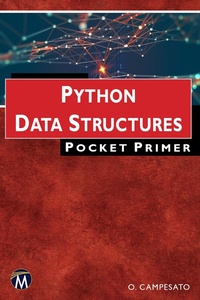
Python Data Structures Pocket Primer
1st Edition
Published on 20. December 2022
229 pages
978-1-68392-756-3 (ISBN)
Description

As part of the best-selling Pocket Primer series, this book is designed to present the fundamentals of data structures using Python. Data structures provide a means to manage huge amounts of information such as large databases and the ability to use search and sort algorithms effectively. It is intended to be a fast-paced introduction to the core concepts of Python and data structures, illustrated with numerous code samples. Companion files with source code are available for downloading.
FEATURES:
- Begins with an introduction to Python, and covers recursion, strings, search and sort, linked lists, stacks, and more
- Features numerous code samples throughout
- Includes companion files with source code available for downloading.
More details
Series
Language
English
Place of publication
Berlin
United States
Target group
Professional and scholarly
US School Grade: College Graduate Student
File size
1,18 MB
ISBN-13
978-1-68392-756-3 (9781683927563)
Copyright in bibliographic data and cover images is held by Nielsen Book Services Limited or by the publishers or by their respective licensors: all rights reserved.
Schweitzer Classification
Other editions
Additional editions
Oswald Campesato
Python Data Structures Pocket Primer
Book
12/2022
1st Edition
Mercury Learning & Information
€44.95
Article not available at the moment
Oswald Campesato
Python Data Structures Pocket Primer
E-Book
12/2022
1st Edition
Mercury Learning and Information
€48.99
Available for download
Content
- Cover
- Title Page
- Copyright
- Dedication
- Contents
- Preface
- Chapter 1: Introduction to Python
- Some Standard Modules in Python
- Simple Data Types in Python
- Working With Numbers
- Working With Other Bases
- The chr() Function
- The round() Function in Python
- Unicode and UTF-8
- Working With Unicode
- Working With Strings
- Comparing Strings
- Uninitialized Variables and the Value None in Python
- Slicing and Splicing Strings
- Testing for Digits and Alphabetic Characters
- Search and Replace a String in Other Strings
- Precedence of Operators in Python
- Python Reserved Words
- Working With Loops in Python
- Python for Loops
- Numeric Exponents in Python
- Nested Loops
- The split() Function With for Loops
- Using the split() Function to Compare Words
- Python while Loops
- Conditional Logic in Python
- The break/continue/pass Statements
- Comparison and Boolean Operators
- The in/not in/is/is not Comparison Operators
- The and, or, and not Boolean Operators
- Local and Global Variables
- Scope of Variables
- Pass by Reference Versus Value
- Arguments and Parameters
- User-Defined Functions in Python
- Specifying Default Values in a Function
- Returning Multiple Values From a Function
- Lambda Expressions
- Working With Lists
- Lists and Basic Operations
- Lists and Arithmetic Operations
- Lists and Filter-Related Operations
- The join(), range(), and split() Functions
- Arrays and the append() Function
- Other List-Related Functions
- Working With List Comprehensions
- Working With Vectors
- Working With Matrices
- Queues
- Tuples (Immutable Lists)
- Sets
- Dictionaries
- Creating a Dictionary
- Displaying the Contents of a Dictionary
- Checking for Keys in a Dictionary
- Deleting Keys From a Dictionary
- Iterating Through a Dictionary
- Interpolating Data From a Dictionary
- Dictionary Functions and Methods
- Other Sequence Types in Python
- Mutable and Immutable Types in Python
- Summary
- Chapter 2: Recursion and Combinatorics
- What Is Recursion?
- Arithmetic Series
- Calculating Arithmetic Series (Iterative)
- Calculating Arithmetic Series (Recursive)
- Calculating Partial Arithmetic Series
- Geometric Series
- Calculating a Geometric Series (Iterative)
- Calculating Arithmetic Series (Recursive)
- Factorial Values
- Calculating Factorial Values (Iterative)
- Calculating Factorial Values (Recursive)
- Calculating Factorial Values (Tail Recursion)
- Fibonacci Numbers
- Calculating Fibonacci Numbers (Recursive)
- Calculating Fibonacci Numbers (Iterative)
- Task: Reverse a String via Recursion
- Task: Check for Balanced Parentheses
- Task: Calculate the Number of Digits
- Task: Determine if a Positive Integer Is Prime
- Task: Find the Prime Factorization of a Positive Integer
- Task: Goldbach's Conjecture
- Task: Calculate the GCD (Greatest Common Divisor)
- Task: Calculate the LCM (Lowest Common Multiple)
- What Is Combinatorics?
- Working With Permutations
- Working With Combinations
- Task: Calculate the Sum of Binomial Coefficients
- The Number of Subsets of a Finite Set
- Task: Subsets Containing a Value Larger Than k
- Summary
- Chapter 3: Strings and Arrays
- Time and Space Complexity
- Task: Maximum and Minimum Powers of an Integer
- Task: Binary Substrings of a Number
- Task: Common Substring of Two Binary Numbers
- Task: Multiply and Divide via Recursion
- Task: Sum of Prime and Composite Numbers
- Task: Count Word Frequencies
- Task: Check if a String Contains Unique Characters
- Task: Insert Characters in a String
- Task: String Permutations
- Task: Find All Subsets of a Set
- Task: Check for Palindromes
- Task: Check for the Longest Palindrome
- Working With Sequences of Strings
- The Maximum Length of a Repeated Character in a String
- Find a Given Sequence of Characters in a String
- Task: Longest Sequences of Substrings
- The Longest Sequence of Unique Characters
- The Longest Repeated Substring
- Task: Match a String With a Word List (Simple Case)
- The Harder Case
- Working With 1D Arrays
- Rotate an Array
- Task: Shift Non-Zero Elements Leftward
- Task: Sort Array In-Place in O(n) Without a Sort Function
- Task: Invert Adjacent Array Elements
- Task: Generate 0 That Is Three Times More Likely Than a 1
- Task: Invert Bits in Even and Odd Positions
- Task: Invert Pairs of Adjacent Bits
- Task: Find Common Bits in Two Binary Numbers
- Task: Check for Adjacent Set Bits in a Binary Number
- Task: Count Bits in a Range of Numbers
- Task: Find the Right-Most Set Bit in a Number
- Task: The Number of Operations to Make All Characters Equal
- Task: Compute XOR Without XOR for Two Binary Numbers
- Working With 2D Arrays
- The Transpose of a Matrix
- Summary
- Chapter 4: Search and Sort Algorithms
- Search Algorithms
- Linear Search
- Binary Search Walk-Through
- Binary Search (Iterative Solution)
- Binary Search (Recursive Solution)
- Well-Known Sorting Algorithms
- Bubble Sort
- Find Anagrams in a List of Words
- Selection Sort
- Insertion Sort
- Comparison of Sort Algorithms
- Merge Sort
- Merge Sort With a Third Array
- Merge Sort Without a Third Array
- Merge Sort: Shift Elements From End of Lists
- How Does Quick Sort Work?
- Quick Sort Code Sample
- Shellsort
- Summary
- Chapter 5: Linked Lists
- Types of Data Structures
- Linear Data Structures
- Nonlinear Data Structures
- Data Structures and Operations
- Operations on Data Structures
- What Are Singly Linked Lists?
- Trade-Offs for Linked Lists
- Singly Linked Lists: Create and Append Operations
- A Node Class for Singly Linked Lists
- Appending a Node in a Linked List
- Python Code for Appending a Node
- Singly Linked Lists: Finding a Node
- Singly Linked Lists: Update and Delete Operations
- Updating a Node in a Singly Linked List
- Python Code to Update a Node
- Deleting a Node in a Linked List: Method #1
- Python Code for Deleting a Node: Method #2
- Circular Linked Lists
- Python Code for Updating a Circular Linked List
- Working With Doubly Linked Lists (DLL)
- A Node Class for Doubly Linked Lists
- Appending a Node in a Doubly Linked List
- Python Code for Appending a Node
- Python Code for Inserting an Intermediate Node
- Searching and Updating a Node in a Doubly Linked List
- Updating a Node in a Doubly Linked List
- Python Code to Update a Node
- Deleting a Node in a Doubly Linked List
- Python Code to Delete a Node
- Summary
- Chapter 6: Linked Lists and Common Tasks
- Task: Adding Numbers in a Linked List (1)
- Task: Reconstructing Numbers in a Linked List (1)
- Task: Reconstructing Numbers in a Linked List (2)
- Task: Display the First k Nodes
- Task: Display the Last k Nodes
- Display a Singly Linked List in Reverse Order via Recursion
- Task: Remove Duplicate Nodes
- Task: Concatenate Two Lists
- Task: Merge Two Lists
- Task: Split a Single List into Two Lists
- Task: Find the Middle Element in a List
- Task: Reversing a Linked List
- Task: Check for Palindromes in a Linked List
- Summary
- Chapter 7: Queues and Stacks
- What Is a Queue?
- Types of Queues
- Creating a Queue Using a Python List
- Creating a Rolling Queue
- Creating a Queue Using an Array
- What Is a Stack?
- Use Cases for Stacks
- Operations With Stacks
- Working With Stacks
- Task: Reverse and Print Stack Values
- Task: Display the Min and Max Stack Values (1)
- Creating Two Stacks Using an Array
- Task: Reverse a String Using a Stack
- Task: Balanced Parentheses
- Task: Tokenize Arithmetic Expressions
- Task: Evaluate Arithmetic Expressions
- Infix, Prefix, and Postfix Notations
- Summary
- Index
