

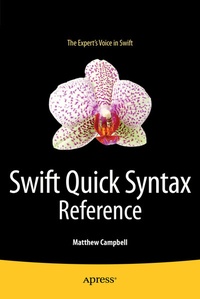
Swift Quick Syntax Reference
Description

Swift Quick Syntax Reference is a condensed code and syntax reference to the new Apple Swift programming language, which is the alternative new programming language alongside Objective-C behind the APIs found in the Apple iOS SDK 8 and OS X Yosemite SDK. It presents the essential Swift syntax in a well-organized format that can be used as a handy reference.
You won't find any technical jargon, bloated samples, drawn out history lessons, or witty stories in this book. What you will find is a language reference that is concise, to the point, and highly accessible. The book is packed with useful information and is a must-have for any Swift programmer.
In the Swift Quick Syntax Reference, you will find a concise reference to the Swift language syntax using the new Playgrounds. Playgrounds lets you type a line of code and the result appears immediately.
More details
Other editions
Additional editions
Person
Content
- Intro
- Contents at a Glance
- Contents
- About the Author
- About the Technical Reviewer
- Introduction
- Chapter 1: Hello World
- Xcode
- Install Xcode
- Create a New Playground
- Chapter 2: Declaring Constants and Variables
- Constants
- Constants Are Immutable
- Variables
- Variables Are Mutable
- Type Inference
- Data Types
- Chapter 3: Printing Variables and Constants
- Creating a Command-Line Tool
- Printing to the Console
- String Interpolation
- Chapter 4: Code Comments
- One-Line Code Comments
- Multiline Comments
- Nested Code Comments
- Chapter 5: Numbers
- Integers
- Integer Sizes
- Floating-Point Numbers
- Chapter 6: Strings
- Unicode Characters
- Character Data Type
- Concatenation
- Comparing Strings
- String Interpolation
- Chapter 7: Booleans
- Chapter 8: Tuples
- Chapter 9: Optionals
- Forced Unwrapping
- Optional Bindings
- Chapter 10: Type Aliases
- Chapter 11: Global and Local Variables
- Scope Defined
- Global Variables
- Chapter 12: Assertions
- Chapter 13: Assignment Operators
- Compound Operators
- Chapter 14: Arithmetic Operators
- Remainder Operator
- Order of Operations and Parentheses
- Increment and Decrement Operators
- Unary Minus Operator
- Compound Operators
- String Concatenation
- Chapter 15: Comparison Operators
- Chapter 16: Ternary Conditional Operator
- Chapter 17: Range Operators
- Closed Range Operator
- Half-Open Range Operator
- Chapter 18: Logical Operators
- Chapter 19: Enumerations
- Chapter 20: Arrays
- Array Mutability
- Adding Items to Arrays
- Removing Items from Arrays
- Changing Items in Arrays
- Iterating Over Array Items
- Chapter 21: Dictionaries
- Referencing Dictionary Items
- Updating Dictionary Items
- Iterating Over Dictionary Items
- Chapter 22: Loops
- for-condition-increment Loop
- for-in Loop
- While Loop
- do-while Loop
- Chapter 23: if Statements
- else Keyword
- Chapter 24: switch Statements
- switch Keyword
- Case Keyword
- Chapter 25: Control Transfer Statements
- continue Statement
- break Statement
- fallthrough Statement
- Chapter 26: Labeled Statements
- Chapter 27: Functions
- Parameters
- Chapter 28: Nested Functions
- Chapter 29: Closures
- Chapter 30: Structures
- Structure Instances
- Accessing Structure Properties
- Structure Functions
- Chapter 31: Classes
- Class Instances (Objects)
- Accessing Class Properties
- Class Functions
- Chapter 32: Using Instances
- Reference vs. Copy
- Chapter 33: Class Identity Operators
- Class Equality Identity Operator
- Class Inequality Identity Operator
- Chapter 34: Properties
- Lazy and Computed Properties
- Lazy Properties
- Computed Properties
- Chapter 35: Property Observers
- Chapter 36: Class Type Properties
- Value Type Properties
- Chapter 37: Type Methods
- Type Methods for Value Types
- Chapter 38: Subscripts
- Chapter 39: Inheritance
- Chapter 40: Overriding Methods and Properties
- Chapter 41: Initialization
- Chapter 42: De-initialization
- Chapter 43: Type Casting
- Type Casting Instances
- Chapter 44: Nested Types
- Chapter 45: Extensions
- Chapter 46: Protocols
- Chapter 47: Delegation
- Implementing Delegation
- Defining a Protocol
- Adopting the Protocol
- Implement Protocol
- Adding Delegate Property
- Assigning Delegate Property
- Using Delegation
- Chapter 48: Generics
- Type Checking
- Chapter 49: Automatic Reference Counting
- Strong References and Reference Cycles
- Index
