

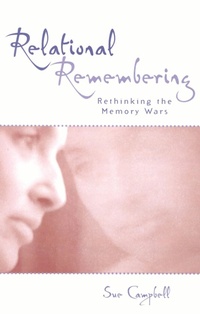
Relational Remembering
Rethinking the Memory Wars
1st Edition
Published on 7. October 2003
1 pages
979-8-7651-7944-4 (ISBN)
Description

Tracing the impact of the "memory wars" on science and culture, Relational Remembering offers a vigorous philosophical challenge to the contemporary skepticism about memory that is their legacy. Campbell's work provides a close conceptual analysis of the strategies used to challenge women's memories, particularly those meant to provoke a general social alarm about suggestibility. Sue Campbell argues that we cannot come to an adequate understanding of the nature and value of memory through a distorted view of rememberers.
The harmful stereotypes of women's passivity and instability that have repopulated discussions of abuse have led many theorists to regard the social dimensions of remembering only negatively, as a threat or contaminant to memory integrity. Such models of memory cannot help us grasp the nature of harms linked to oppression, as these models imply that changed group understandings of the past are incompatible with the integrity of personal memory. Campbell uses the false memory debates to defend a feminist reconceptualization of personal memory as relational, social, and subject to politics. Memory is analyzed as a complex of cognitive abilities and social/narrative activities where one's success or failure as a rememberer is both affected by one's social location and has profound ramifications for one's cultural status as a moral agent.
The harmful stereotypes of women's passivity and instability that have repopulated discussions of abuse have led many theorists to regard the social dimensions of remembering only negatively, as a threat or contaminant to memory integrity. Such models of memory cannot help us grasp the nature of harms linked to oppression, as these models imply that changed group understandings of the past are incompatible with the integrity of personal memory. Campbell uses the false memory debates to defend a feminist reconceptualization of personal memory as relational, social, and subject to politics. Memory is analyzed as a complex of cognitive abilities and social/narrative activities where one's success or failure as a rememberer is both affected by one's social location and has profound ramifications for one's cultural status as a moral agent.
More details
Other editions
Additional editions
Book
10/2003
Rowman & Littlefield Publishers
€167.50
Shipment within 10-20 days
Person
Sue Campbell is associate professor of philosophy and women's studies at Dalhousie University in Halifax, Nova Scotia. She is the author of Interpreting the Personal (1997) and co-editor of Racism and Philosophy (1999).
Content
Chapter 1 Constructing the "memory wars"
Chapter 2 Respecting rememberers
Chapter 3 Framing women's testimony: narrative position and memory authority
Chapter 4 The subjects of therapy: Revisiting Trauma and Recovery
Chapter 5 "The feeling of identity is quite wanting...in the true woman": Models of memory and moral character
Chapter 6 Suggestibility, misdesign, and social skepticism
Chapter 7 The costs of a stereotype: Defending women's confidential records
Chapter 8 A singular and representative life: Personal memory and systematic harms
Chapter 2 Respecting rememberers
Chapter 3 Framing women's testimony: narrative position and memory authority
Chapter 4 The subjects of therapy: Revisiting Trauma and Recovery
Chapter 5 "The feeling of identity is quite wanting...in the true woman": Models of memory and moral character
Chapter 6 Suggestibility, misdesign, and social skepticism
Chapter 7 The costs of a stereotype: Defending women's confidential records
Chapter 8 A singular and representative life: Personal memory and systematic harms
