

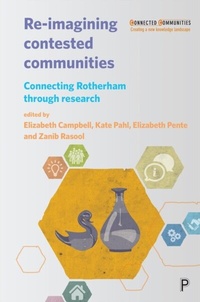
Re-imagining Contested Communities
Connecting Rotherham through Research
1st Edition
Published on 21. March 2018
192 pages
978-1-4473-3331-9 (ISBN)
Description

This is a book that challenges contemporary images of 'place'. Too often we are told about 'deprived neighbourhoods' but rarely do the people who live in those communities get to shape the agenda and describe, from their perspective, what is important to them. In this unique book the process of re-imagining comes to the fore in a fresh and contemporary look at one UK town, Rotherham.
Using history, artistic practice, writing, poetry, autobiography and collaborative ethnography, this book literally and figuratively re-imagines a place. It is a manifesto for alternative visions of community, located in histories and cultural reference points that often remain unheard within the mainstream media. As such, the book presents a 'how to' for researchers interested in community collaborative research and accessing alternative ways of knowing and voices in marginalised communities.
Using history, artistic practice, writing, poetry, autobiography and collaborative ethnography, this book literally and figuratively re-imagines a place. It is a manifesto for alternative visions of community, located in histories and cultural reference points that often remain unheard within the mainstream media. As such, the book presents a 'how to' for researchers interested in community collaborative research and accessing alternative ways of knowing and voices in marginalised communities.
More details
Other editions
Additional editions
Elizabeth Campbell | Kate Pahl | Elizabeth Pente
Re-imagining Contested Communities
Connecting Rotherham through Research
Book
03/2018
1st Edition
Policy Press
€48.40
Shipment within 15-20 days
Elizabeth Campbell | Kate Pahl | Elizabeth Pente
Re-imagining Contested Communities
Connecting Rotherham through Research
Book
03/2018
1st Edition
Policy Press
€105.00
Shipment within 15-20 days
Elizabeth Campbell | Kate Pahl | Elizabeth Pente
Re-imagining Contested Communities
Connecting Rotherham through Research
E-Book
03/2018
1st Edition
Policy Press
€68.49
Available for download
Persons
Editor
Marshall University, US
Elizabeth Campbell, co-author of Doing Ethnography Today and The Other Side of Middletown, is Associate Professor of Education at Marshall University, US
Elizabeth Campbell, co-author of Doing Ethnography Today and The Other Side of Middletown, is Associate Professor of Education at Marshall University, US
Manchester Metropolitan University
Kate Pahl is Professor of Arts and Literacy at Manchester Metropolitan University, UK.
Kate Pahl is Professor of Arts and Literacy at Manchester Metropolitan University, UK.
Doctoral student, University of Huddersfield
Elizabeth Pente was awarded her PhD from the University of Huddersfield in 2018. Her research is concerned with public history and post-Second World War urban decline and regeneration. She is co-editor of Re-Imagining Contested Communities (Policy, 2017).
Elizabeth Pente was awarded her PhD from the University of Huddersfield in 2018. Her research is concerned with public history and post-Second World War urban decline and regeneration. She is co-editor of Re-Imagining Contested Communities (Policy, 2017).
Rotherham United Community Sports Trust
Zanib Rasool, MBE has worked 30 years in the community and is currently employed as Partnership and Development Manager for the charity Rotherham United Community Sports Trust.
Zanib Rasool, MBE has worked 30 years in the community and is currently employed as Partnership and Development Manager for the charity Rotherham United Community Sports Trust.
Contributions
Centre for Science and Policy, University of Cambridge
Manchester Metropolitan University
Macquarie University
Marshall University
University of Leeds
Department for Communities and Local Government
Edge Hill University
Professor of Public History and Community Heritage and Head of the Department of English, History and Creative Writing, Edge Hill University
Professor of Public History and Community Heritage and Head of the Department of English, History and Creative Writing, Edge Hill University
Content
Part One: Introductions;
What kind of book is this? ~ Elizabeth Campbell;
Policy, practice and racism: social cohesion in action ~ Zanib Rasool;
Part Two: Community histories;
Introducing Rotherham ~ Kate Pahl and Miles Crompton;
How can historical knowledge help us to make sense of communities like Rotherham? ~ Elizabeth Pente and Paul Ward;
Some poems, a song and a prose piece ~ Ray Hearne and Ryan Bramley;
Who are we now? Local history, industrial decline and ethnic diversity ~ Elizabeth Pente and Paul Ward;
Silk and steel ~ Shahin Shah;
History and co-production in the home: documents, artefacts and migrant identities in Rotherham ~ William Gould and Mariam Shah;
Tassibee: a case study ~ Khalida Luqman;
Identity ~ Zanib Rasool;
Part Three: Community ways of knowing;
Methodology: an introduction ~ Elizabeth Campbell;
Collaborative ethnography in context ~ Elizabeth Campbell, Luke Eric Lassiter and Kate Pahl;
Safe spaces and community activism ~ Zanib Rasool;
Emotions in community research ~ Zanib Rasool;
What parents know: a call for realistic accounts of parenting young children ~ Tanya Evans, Abigail Hackett, Joanna Magagula and Steve Pool;
Where I come from and where I'm going to: exploring identity, hopes and futures with Roma girls in Rotherham ~ Deborah Bullivant;
Introduction to artistic methods for understanding contested communities ~ Kate Pahl and Steve Pool with Marcus Hurcombe;
What can art do? Artistic approaches to community experiences ~ Zahir Rafiq in conversation with Kate Pahl and Steve Pool;
Using poetry to engage the voices of women and girls in research ~ Zanib Rasool;
The Tassibee 'Skin and Spirit' project ~ Cassie Limb;
'The Rotherham project': young men represent themselves and their town ~ Nathan Gibson with Zanib Rasool and Kate Pahl;
Part Four: Communities going forward;
Re-imagining contested communities: implications for policy research ~ Robert Rutherfoord and Maria O'Beirne;
What this book can teach us ~ Elizabeth Campbell, Kate Pahl, Elizabeth Pente and Zanib Rasool.
What kind of book is this? ~ Elizabeth Campbell;
Policy, practice and racism: social cohesion in action ~ Zanib Rasool;
Part Two: Community histories;
Introducing Rotherham ~ Kate Pahl and Miles Crompton;
How can historical knowledge help us to make sense of communities like Rotherham? ~ Elizabeth Pente and Paul Ward;
Some poems, a song and a prose piece ~ Ray Hearne and Ryan Bramley;
Who are we now? Local history, industrial decline and ethnic diversity ~ Elizabeth Pente and Paul Ward;
Silk and steel ~ Shahin Shah;
History and co-production in the home: documents, artefacts and migrant identities in Rotherham ~ William Gould and Mariam Shah;
Tassibee: a case study ~ Khalida Luqman;
Identity ~ Zanib Rasool;
Part Three: Community ways of knowing;
Methodology: an introduction ~ Elizabeth Campbell;
Collaborative ethnography in context ~ Elizabeth Campbell, Luke Eric Lassiter and Kate Pahl;
Safe spaces and community activism ~ Zanib Rasool;
Emotions in community research ~ Zanib Rasool;
What parents know: a call for realistic accounts of parenting young children ~ Tanya Evans, Abigail Hackett, Joanna Magagula and Steve Pool;
Where I come from and where I'm going to: exploring identity, hopes and futures with Roma girls in Rotherham ~ Deborah Bullivant;
Introduction to artistic methods for understanding contested communities ~ Kate Pahl and Steve Pool with Marcus Hurcombe;
What can art do? Artistic approaches to community experiences ~ Zahir Rafiq in conversation with Kate Pahl and Steve Pool;
Using poetry to engage the voices of women and girls in research ~ Zanib Rasool;
The Tassibee 'Skin and Spirit' project ~ Cassie Limb;
'The Rotherham project': young men represent themselves and their town ~ Nathan Gibson with Zanib Rasool and Kate Pahl;
Part Four: Communities going forward;
Re-imagining contested communities: implications for policy research ~ Robert Rutherfoord and Maria O'Beirne;
What this book can teach us ~ Elizabeth Campbell, Kate Pahl, Elizabeth Pente and Zanib Rasool.
