

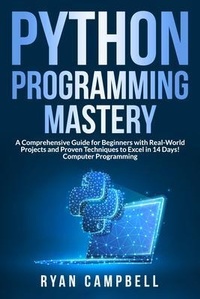
Python Programming Mastery
A Comprehensive Guide for Beginners with Real-World Projects and Proven Techniques to Excel in 14 Days! Computer Programming
1st Edition
Published on 16. May 2024
58 pages
979-8-8693-8036-4 (ISBN)
Description

Dive into the world of Python with our comprehensive guide, "Python Programming Mastery" Whether you are a beginner or an experienced programmer, this book is your ultimate resource for mastering the intricacies of Python.
Key Features:
- Explore Python's intuitive syntax and learn how to write clean and efficient code
- Discover the versatility of Python through real-world applications in web development, data analysis, machine learning, and more
- Master advanced programming techniques such as generators, decorators, context managers, and metaclasses
- Learn best practices for error handling, exception handling, and writing reliable and maintainable code
- Unleash the power of Python libraries and packages for various domains, including data science, web development, and scientific computing
- Prepare for Python job interviews with confidence using our expert tips and guidance
- Gain a solid understanding of object-oriented programming in Python and apply it to build robust software systems
- Sharpen your algorithmic thinking and problem-solving skills with hands-on coding challenges and exercises
Unlock the true potential of Python and become a proficient Python programmer with "Python Programming Mastery: A Comprehensive Guide for Beginners" Whether you are pursuing a career in software development, data science, or machine learning, or simply looking to enhance your programming skills, this book will be your comprehensive guide on your Python journey.
Get your copy today and embark on an exciting programming adventure!
More details
Content
- Intro
- INTRODUCTION
- CHAPTER 1: INTRODUCTION TO PYTHON PROGRAMMING
- Why Python?
- CHAPTER 2: SETTING UP YOUR PYTHON ENVIRONMENT
- Choosing the Right Python Version
- Python 2 vs. Python 3
- Why Python 3?
- Installing Python and PIP
- Installing PIP
- Setting Up Your Virtual Environment
- Selecting an Integrated Development Environment (IDE)
- PyCharm
- Visual Studio Code (VS Code)
- Jupyter Notebooks
- Getting Familiar with Python's Interactive Shell
- CHAPTER 3: UNDERSTANDING VARIABLES AND DATA TYPES
- What is a Variable?
- Data Types
- Integers
- Floats
- Strings
- Booleans
- CHAPTER 4: MAKING DECISIONS WITH CONDITIONAL STATEMENTS
- The if Statement
- The else Statement
- The elif Statement
- Boolean Logic
- CHAPTER 5: LOOPING AND ITERATION IN PYTHON
- The for Loop
- The while Loop
- The range Function
- The break Statement
- The continue Statement
- Looping Techniques and More
- List Comprehensions
- CHAPTER 6: WORKING WITH LISTS, TUPLES, AND SETS
- Introduction to Lists
- Creating a List
- Accessing List Elements
- Modifying Lists
- List Operations and Methods
- Introduction to Tuples
- Creating a Tuple
- Accessing Tuple Elements
- Tuple Unpacking
- Tuple Operations and Functions
- Introduction to Sets
- Set Operations
- List, Tuple, and Set Comprehensions
- Choosing the Right Data Structure
- CHAPTER 7: DICTIONARIES AND DATA MANIPULATION
- Introducing Dictionaries
- Accessing Values in a Dictionary
- Modifying a Dictionary
- Dictionary Comprehension
- Data Manipulation in Python
- Sorting
- Filtering
- Introducing pandas
- CHAPTER 8: FUNCTIONS AND MODULES IN PYTHON
- Understanding Functions
- Calling a Function
- Return Values
- Understanding Modules
- Creating a Module
- Importing a Module
- The Python Standard Library
- CHAPTER 9: OBJECT-ORIENTED PROGRAMMING IN PYTHON
- Understanding Classes and Objects
- Creating an Object
- Understanding Inheritance
- Overriding Methods
- Understanding Polymorphism
- The self Parameter
- CHAPTER 10: FILE HANDLING AND INPUT/OUTPUT OPERATIONS
- Working with Files
- Reading from a File
- Writing to a File
- The with Statement
- Working with Directories
- CHAPTER 11: ERROR HANDLING AND EXCEPTION HANDLING
- Common Python Exceptions
- Handling Multiple Exceptions
- Raising Exceptions
- Exception Handling in Real World Scenarios
- CHAPTER 12: INTRODUCTION TO PYTHON LIBRARIES AND PACKAGES
- What are Python Libraries and Packages?
- Installing Libraries and Packages
- Essential Python Libraries
- Creating Your Own Libraries
- CHAPTER 13: ADVANCED PYTHON PROGRAMMING TECHNIQUES
- List Comprehensions
- Generators
- Decorators
- Metaclasses
- CHAPTER 14: PYTHON JOB INTERVIEW PREPARATION AND BEST PRACTICES
- Understanding the Job Role and Requirements
- Mastering Python Basics
- Advanced Python Concepts
- Knowledge of Python Libraries
- Data Structures and Algorithms
- Coding Challenges
- Python Best Practices
- Mock Interviews and Pair Programming
- System Design and Architecture
- After the Interview
- CONCLUSION
- ACKNOWLEDGEMENTS
- REFERENCES
