

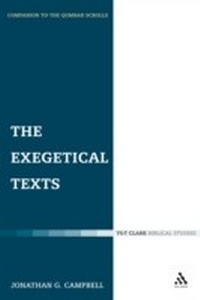
The Exegetical Texts
Description

Jonathan G. Campbell provides an introduction to eight sectarian manuscripts from among the Qumran Dead Sea Scrolls that can loosely be called the 'Exegetical Texts'. He examines their contents, background, genre, and significance and he provides a history of the relevant research. The Exegetical Texts constitute a particularly diverse strand of sectarian compositions among the Qumran Dead Sea Scrolls. For this reason, the eight documents are treated in turn in more or less equal measure, with two introductory chapters to set the scene and a conclusion drawing the discussion to a close. Each chapter can be read either alone in its own right or together with the others to gain a broader picture. In order to encourage the reader to encounter the relevant Qumran documents firsthand extensive listings of editions in Hebrew and English are provided. The contributors to the Companion to the Qumran Scrolls series take account of a wide range of relevant and recently published texts and provide extensive bibliographies. The books in the series are authoritatively written in accessible language and are ideal for students and non-specialist scholars. Companion to the Qumran Scrolls, volume 4
More details
Other editions
Additional editions
Person
Content
Abbreviations
Editions, Translations, and Bibliographies
I. Introduction
1. The Dead Sea Scrolls from Qumran
2. The Qumran-Essene Hypothesis
3. Recent Developments in Qumran Studies
4. 'The Pesher Phenomenon'
5. The Exegetical Texts from Qumran
6. Further Reading
II. Scripture and Interpretation
1. Scripture in Second Temple Judaism
2. Scriptural Manuscripts from Qumran
3. Textual Fluidity in Scriptural Writings
4. Scripture Interpreting Scripture
5. Exegesis in Non-scriptural Works
6. Exegetical Techniques
7. Scriptural Interpretation in the Exegetical Texts
8. Further Reading
III. 4QFlorilegium (4Q174)
1. Introduction
2. The Text of 4QFlorilegium
3. The Genre of 4QFlorilegium
4. The Content of 4QFlorilegium
5. Exegesis in 4QFlorilegium
6. 4QFlorilegium and the Reconstruction of Damaged Scrolls 7. Further Reading
IV. 4QCatenae A-B (4Q177, 182)
1. Introduction
2. The Text of 4QCatena A
3. The Genre of 4QCatena A
4. The Content of 4QCatena A
5. Exegesis in 4QCatena A
6. The Fragmentary Nature of 4QCatena B
7. The Existence of 4QMidrash on Eschatologya-b
8. Further Reading
V. 11QMelchizedek (11Q13)
1. Introduction
2. The Text of 11QMelchizedek
3. The Genre of 11QMelchizedek
4. The Content of 11QMelchizedek
5. Exegesis in 11QMelchizedek
6. 11QMelchizedek and the Schematization of History
7. Further Reading
VI. 4QAges of Creation A-B (4Q180-181)
1. Introduction
2. The Text of 4QAges of Creation A-B
3. The Genre of 4QAges of Creation A-B
4. The Content of 4QAges of Creation A-B
5. Exegesis in 4QAges of Creation A-B
6. 4QAges of Creation A-B and Other Sectarian Writings
7. Further Reading
VII. 4QTanhumim (4Q176)
1. Introduction
2. The Text of 4QTanhumim
3. The Genre of 4QTanhumim
4. The Content of 4QTanhumim
5. Exegesis in 4QTanhumim
6. 4QTanhumim and 4QApocryphal Lamentations A-B (4Q179, 501)
7. Further Reading
VIII. 4QTestimonia (4Q175)
1. Introduction
2. The Text of 4QTestimonia
3. The Genre of 4QTestimonia
4. The Content of 4QTestimonia
5. Exegesis in 4QTestimonia
6. The Historical Background of 4QTestimonia
7. Further Reading
IX. Scripture and Interpretation in the Exegetical Texts
1. The Evidence of the Exegetical Texts
2. Scripture in the Exegetical Texts
3. Interpretation in the Exegetical Texts
4. The Exegetical Texts and 'the Pesher Phenomenon'
5. The Exegetical Texts and the Qumran Community
6. The Exegetical Texts and other Late Second Temple Literature
7. Further Reading
Bibliography
Index of References
Index of Authors
