

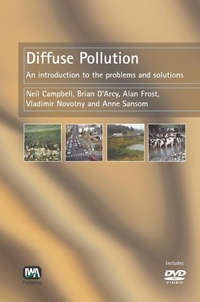
Diffuse Pollution
An Introduction to the Problems and Solutions
Published on 1. February 2005
337 pages
978-1-78040-295-6 (ISBN)
Description

Diffuse (non-point source) pollution is increasingly being recognised as a major source of water quality problems in both surface and ground water. Indeed, as pollution resulting from point sources is reduced by the efforts of regulators, diffuse sources frequently remain as the dominant source of pollution. The book is an introductory text covering the nature, causes and the significance of diffuse pollution of both urban and rural origin. Best management practices to tackle the problems are examined as are the ways in which the adoption of such practices may be brought about. Use is made of case studies from several countries to examine the strengths and weaknesses of various approaches. Diffuse Pollution covers both urban and rural sources. Urban sources include run-off from impermeable surfaces of roads, industrial areas and housing which may be contaminated by hydrocarbons, heavy metals, organic chemicals and other undesirable substances. Rural sources include water containing pollutants arising from agriculture and forestry such as plant nutrients, pesticides, microbes and soil itself. This concise book will prove useful to practitioners in the field of pollution control both in an urban and a rural environment, to regulators, to researchers new to the field, and to academics and students. An extensive reference section aids the reader in exploring the subject further. Contents Diffuse pollution A Best Practice Approach An Introduction to BMPs for built environments Managing diffuse pollution from urban sources - a survey of best practice experience Rural BMPs Rural best practice experience Regulation, Economic instruments, and Education for controlling diffuse pollution Sustainability Full Contents List (439KB)
More details
Language
English
Place of publication
London
United Kingdom
Target group
College/higher education
Professional and scholarly
File size
4,69 MB
ISBN-13
978-1-78040-295-6 (9781780402956)
Copyright in bibliographic data and cover images is held by Nielsen Book Services Limited or by the publishers or by their respective licensors: all rights reserved.
Schweitzer Classification
Other editions
Additional editions
N. Campbell | Brian D' Arcy | A. Frost
Diffuse Pollution
Book
02/2005
IWA Publishing
€186.01
Article exhausted; check different version
Content
- Cover
- Copyright
- Contents
- Dedication
- Preface
- The Authors
- The Steering Group
- Useful websites
- 1. The nature and importance of diffuse pollution
- 1.1 Introduction
- 1.2 Water quality and pollution
- 1.3 Point source and non-point source pollution
- 1.4 Diffuse Pollution
- 1.5 Land use and transition
- 1.6 Urban diffuse sources
- 1.7 Agricultural diffuse sources
- 2. Best management practices
- 2.1 Introduction
- 2.2 Options to control pollution - why diffuse pollution requires a different approach
- 2.3 How do BMPs work?
- 2.4 Examples of structural BMPs and landscape features
- 2.5 Watershed (catchment) management
- 3. An introduction to BMPs for the built environment
- 3.1 General principles for urban surface water drainage management
- 3.2 Effects on run-off
- 3.3 Effects on receiving waters
- 3.4 Basic considerations for sustainability
- 3.5 Water quality treatment
- 3.6 Flood control and water resource management
- 3.7 The surface water management train
- 3.8 Selecting the most appropriate urban BMP treatment/control facility
- 3.9 Structural rural BMPs
- 3.10 An integrated sustainable approach to urban surface water drainage
- 3.11 Examples determining and using the unit design treatment volume
- 4. Managing diffuse pollution from urban sources: a survey of best management practice experience
- 4.1 Introduction: making best practice routine
- 4.2 Land-take for new developments
- 4.3 Maintenance of urban stormwater management facilities
- 4.4 Adoption and public ownership issues
- 4.5 Costs associated with urban BMPs
- 4.6 Retro-fitting urban BMPs
- 4.7 Integrating requirements: flood control, water quality and amenity
- 4.8 Monitoring effectiveness
- 4.9 The treatment train concept in practice
- 4.10 BMPS and biodiversity
- 5. Best management practice for agriculture
- 5.1 Pollution control standards
- 5.2 Best management practice
- 5.3 Agriculturally derived diffuse pollution
- 5.4 General
- 5.5 Nitrogen
- 5.6 Phosphorus
- 5.7 Pesticides
- 5.8 Suspended solids
- 5.9 Micro-organisms
- 5.10 Overview
- 5.11 Targeting BMPs on critical areas
- 5.12 Interaction between BMPs
- 5.13 Persuading farmers to adopt BMPs
- Appendix 5.1: Sample worked nutrient balances
- Appendix 5.2: Sample farm waste management plan
- 6. Rural best practice experience
- 6.1 Advantages and drawbacks of a BMP approach
- 6.2 Loch Leven Catchment, Scotland
- 6.3 Sny Magill Creek, Iowa
- 6.4 French Creek, California, USA
- 6.5 The Bretagne Eau Pure programme: Brittany, France
- 6.6 The use of wetlands to reduce nitrogen and phosphorus pollution from agriculture in Sweden
- 6.7 Application of BMPs at the farm scale
- 6.8 Conclusions
- 7. Economic instruments, regulation and education
- 7.1 Introduction: proximal and ultimate causes of diffuse pollution
- 7.2 Economic instruments
- 7.3 Regulation
- 7.4 Education
- 7.5 Integrating approaches to the prevention and control of diffuse pollution
- 8. Diffuse pollution and sustainable development
- 8.1 Introduction
- 8.2 Trends
- 8.3 Restricting the use of identified problem chemicals
- 8.4 Sustainable agriculture and forestry
- 8.5 Towards more sustainability in urban drainage and development
- 8.6 Catchment management and social issues
- Appendix 1: Effectiveness of Rural BMPs
- Appendix 2: The International Stormwater BMPs Performance Database
- Glossary of diffuse pollution and best management practice
- References
- Index
