

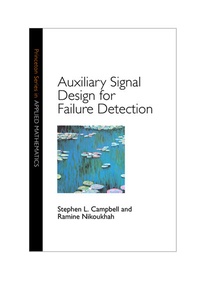
Auxiliary Signal Design for Failure Detection
1st Edition
Published on 7. November 2016
224 pages
978-1-4008-8004-1 (ISBN)
Description

Many industries, such as transportation and manufacturing, use control systems to insure that parameters such as temperature or altitude behave in a desirable way over time. For example, pilots need assurance that the plane they are flying will maintain a particular heading. An integral part of control systems is a mechanism for failure detection to insure safety and reliability.
This book offers an alternative failure detection approach that addresses two of the fundamental problems in the safe and efficient operation of modern control systems: failure detection--deciding when a failure has occurred--and model identification--deciding which kind of failure has occurred. Much of the work in both categories has been based on statistical methods and under the assumption that a given system was monitored passively.
Campbell and Nikoukhah's book proposes an "active" multimodel approach. It calls for applying an auxiliary signal that will affect the output so that it can be used to easily determine if there has been a failure and what type of failure it is. This auxiliary signal must be kept small, and often brief in duration, in order not to interfere with system performance and to ensure timely detection of the failure. The approach is robust and uses tools from robust control theory. Unlike some approaches, it is applicable to complex systems. The authors present the theory in a rigorous and intuitive manner and provide practical algorithms for implementation of the procedures.
This book offers an alternative failure detection approach that addresses two of the fundamental problems in the safe and efficient operation of modern control systems: failure detection--deciding when a failure has occurred--and model identification--deciding which kind of failure has occurred. Much of the work in both categories has been based on statistical methods and under the assumption that a given system was monitored passively.
Campbell and Nikoukhah's book proposes an "active" multimodel approach. It calls for applying an auxiliary signal that will affect the output so that it can be used to easily determine if there has been a failure and what type of failure it is. This auxiliary signal must be kept small, and often brief in duration, in order not to interfere with system performance and to ensure timely detection of the failure. The approach is robust and uses tools from robust control theory. Unlike some approaches, it is applicable to complex systems. The authors present the theory in a rigorous and intuitive manner and provide practical algorithms for implementation of the procedures.
More details
Other editions
Additional editions
Stephen L. Campbell | Ramine Nikoukhah
Auxiliary Signal Design for Failure Detection
Book
02/2004
Princeton University Press
€61.00
Shipment within 10-20 days
Persons
Stephen L.Campbell is Professor of Mathematics at North Carolina State University. Ramine Nikoukhah is Senior Scientist (Directeur de Recherche) at Institut National de Recherche en Informatique et en Automatique (INRIA) in France.
Content
Preface vii
Chapter 1. Introduction 1
1.1 The Basic Question 1
1.2 Failure etection 3
1.3 Failure Identification 9
1.4 Active Approach versus Passive Approach 10
1.5 Outline of the Book 13
Chapter 2. Failure Detection 14
2.1 Introduction 14
2.2 Static Case 15
2.3 Continuous-Time Systems 25
2.4 iscrete-Time Systems 36
2.5 Real-Time Implementation Issues 42
2.6 Useful Results 44
Chapter 3. Multimodel Formulation 59
3.1 Introduction 59
3.2 Static Case 60
3.3 Continuous-Time Case 76
3.4 Case of On-line Measured Input 90
3.5 More GeneralCost Functions 92
3.6 iscrete-Time Case 99
3.7 Suspension Example 102
3.8 Asymptotic Behavior 111
3.9 Useful Results 112
Chapter 4. Direct Optimization Formulations 122
4.1 Introduction 122
4.2 Optimization Formulation for Two Models 123
4.3 General-ModelCase 138
4.4 Early etection 142
4.5 Other Extensions 150
4.6 Systems with Delays 155
4.7 Setting Error Bounds 172
4.8 Model Uncertainty 173
Chapter 5. Remaining Problems and Extensions 176
5.1 Direct Extensions 177
5.2 Hybrid and Sampled Data Systems 179
5.3 Relation to Stochastic Modeling 179
Chapter 6. Scilab Programs 181
6.1 Introduction 181
6.2 Riccati-based Solution 181
6.3 The Block iagonalization Approach 185
6.4 Getting Scilab and the Programs 188
Appendix A. List of Symbols 189
Bibliography 193
Index 201
Chapter 1. Introduction 1
1.1 The Basic Question 1
1.2 Failure etection 3
1.3 Failure Identification 9
1.4 Active Approach versus Passive Approach 10
1.5 Outline of the Book 13
Chapter 2. Failure Detection 14
2.1 Introduction 14
2.2 Static Case 15
2.3 Continuous-Time Systems 25
2.4 iscrete-Time Systems 36
2.5 Real-Time Implementation Issues 42
2.6 Useful Results 44
Chapter 3. Multimodel Formulation 59
3.1 Introduction 59
3.2 Static Case 60
3.3 Continuous-Time Case 76
3.4 Case of On-line Measured Input 90
3.5 More GeneralCost Functions 92
3.6 iscrete-Time Case 99
3.7 Suspension Example 102
3.8 Asymptotic Behavior 111
3.9 Useful Results 112
Chapter 4. Direct Optimization Formulations 122
4.1 Introduction 122
4.2 Optimization Formulation for Two Models 123
4.3 General-ModelCase 138
4.4 Early etection 142
4.5 Other Extensions 150
4.6 Systems with Delays 155
4.7 Setting Error Bounds 172
4.8 Model Uncertainty 173
Chapter 5. Remaining Problems and Extensions 176
5.1 Direct Extensions 177
5.2 Hybrid and Sampled Data Systems 179
5.3 Relation to Stochastic Modeling 179
Chapter 6. Scilab Programs 181
6.1 Introduction 181
6.2 Riccati-based Solution 181
6.3 The Block iagonalization Approach 185
6.4 Getting Scilab and the Programs 188
Appendix A. List of Symbols 189
Bibliography 193
Index 201
