

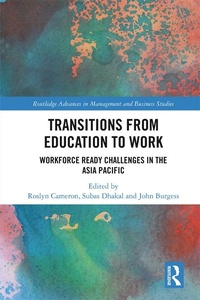
Transitions from Education to Work
Workforce Ready Challenges in the Asia Pacific
Published on 22. November 2017
262 pages
978-1-315-53396-4 (ISBN)
Description

Labour markets are becoming more dynamic in response to pressures from globalisation, new technologies and trade agreements, as well as cross-border migration, inter-generation differences, changing education imperatives and employer expectations. By focusing on several Asia Pacific countries, this book explores the differences in their workforces: ageing, or abundant in labour but lacking in skilled employees. One similarity these countries share is the difficulty in attracting and retaining employees with the required skillset and capabilities, and these constraints can stymie national economic growth and long term development.
This book brings together national and international perspectives on employability challenges faced by selected countries in the Asia Pacific region. While the region is forecast to enjoy high growth in the coming decade, a recurring challenge is addressing skill shortages and ensuring effective transition from training colleges and universities into employment. Consequently, the book focuses on the roles of multiple stakeholders, primarily: governments, education providers and employers - in more effectively addressing these key socio-economic challenges.
This book brings together national and international perspectives on employability challenges faced by selected countries in the Asia Pacific region. While the region is forecast to enjoy high growth in the coming decade, a recurring challenge is addressing skill shortages and ensuring effective transition from training colleges and universities into employment. Consequently, the book focuses on the roles of multiple stakeholders, primarily: governments, education providers and employers - in more effectively addressing these key socio-economic challenges.
Reviews / Votes
'This book focuses on the Asia Pacific region, aiming to understand how tertiary education prepares young people to meet the skills and capabilities required by national labour markets. Specifically, it is concerned with 'work readiness' of graduates...This book draws on the expertise of those who specialise in, and often have personal experience of, each of the countries covered, which adds to the nuance of comment on education systems and labour markets, especially in countries that have fewer official statistics available. The book provides a strong foundation of information that could easily lead to further volumes further exploring the role of employers in the development of skill and capability, and including a greater range of Pacific countries.' ? Journal of Industrial Relations, Volume 62 Issue 1, February 2020More details
Series
Language
English
Place of publication
London
United Kingdom
Publishing group
Taylor & Francis Ltd
Target group
College/higher education
Illustrations
21 s/w Abbildungen, 43 s/w Tabellen, 21 s/w Zeichnungen
43 Tables, black and white; 21 Line drawings, black and white; 21 Illustrations, black and white
File size
1,49 MB
ISBN-13
978-1-315-53396-4 (9781315533964)
Copyright in bibliographic data and cover images is held by Nielsen Book Services Limited or by the publishers or by their respective licensors: all rights reserved.
Schweitzer Classification
Other editions
Additional editions
Roslyn Cameron | Subas Dhakal | John Burgess
Transitions from Education to Work
Workforce Ready Challenges in the Asia Pacific
Book
03/2021
1st Edition
Routledge
€65.50
Shipment within 15-20 days
Roslyn Cameron | Subas Dhakal | John Burgess
Transitions from Education to Work
Workforce Ready Challenges in the Asia Pacific
Book
11/2017
1st Edition
Routledge
€206.50
Shipment within 10-20 days
Persons
Roslyn Cameron is Associate Professor and Head of HRM Discipline at the Australian Institute of Business. She is also Co-Convenor of the Mixed Methods Special Interest Group (MMR SIG) of the Australian and New Zealand Academy of Management (ANZAM).
Subas P. Dhakal is Lecturer at Curtin Business School in Curtin University. He is a management academic with expertise in the theory and practice of sustainable development.
John Burgess is Professor of Management at RMIT University, Australia. His research interests include HRM practices of multinational enterprises, the relationship between working time and health, and work in care sectors.
Subas P. Dhakal is Lecturer at Curtin Business School in Curtin University. He is a management academic with expertise in the theory and practice of sustainable development.
John Burgess is Professor of Management at RMIT University, Australia. His research interests include HRM practices of multinational enterprises, the relationship between working time and health, and work in care sectors.
Content
Part I: The Issues and the Challenges
1. Introduction: Applicant Work-Readiness and Graduate Employability Challenges in the Asia Pacific (John Burgess, Roslyn Cameron, Subas Dhakal and Kerry Brown)
2. Graduate Work Readiness in Asia Pacific Economies: A Review of the Literature (Alan Nankervis, Verma Prikshat and Roslyn Cameron)
Part II: Country Studies
3. Labour Market and Work Readiness Challenges: The Case of Taiwan (Min-Wen Sophie Chang and Julia Connell)
4. Enhancing Graduate Work-readiness in Vietnam (Nguyen Danh Nguyen and Nguyen Ba Ngoc)
5. Work Readiness in Malaysia (Noorziah Mohd Salleh, Jude Emelifeonwu, Jonathan Winterton and Kwok Mow Chan)
6. "The Perfect Storm": Constraints on Indonesian Economic Growth Posed by Graduate Work-readiness Challenges (Soegeng Priyono and Alan Nankervis)
7. Work Readiness in Singapore (Peter Waring, Christopher Vas and Azad Singh Bali)
8. Antecedents, Consequences, and Strategic Responses to Graduate Work-Readiness: Challenges in India (Verma Prikshat, Sanjeev Kumar and Parinita Raje)
9. Graduate Employability in Australia: Time for a VET and HE Overhaul? (Alan Montague, Julia Connell and Barbara Mumme)
10. The State of Higher Education and Vocational Education and Training Sectors in Nepal: Implications for Graduate Work-Readiness and Sustainable Development (Subas Dhakal)
11. Work Readiness in Lao PDR (Vipapone Apayvanh)
Part III: Comparative Analysis and Conclusions
12. A Comparative Perspective on Work-Readiness Challenges in the Asia Pacific Region (Subas Dhakal, John Burgess, Roslyn Cameron and Alan Nankervis)
13. Conclusion: The future for Work-readiness and Graduate Employability in the Asia Pacific (Roslyn Cameron, John Burgess, Subas Dhakal and Barbara Munne)
1. Introduction: Applicant Work-Readiness and Graduate Employability Challenges in the Asia Pacific (John Burgess, Roslyn Cameron, Subas Dhakal and Kerry Brown)
2. Graduate Work Readiness in Asia Pacific Economies: A Review of the Literature (Alan Nankervis, Verma Prikshat and Roslyn Cameron)
Part II: Country Studies
3. Labour Market and Work Readiness Challenges: The Case of Taiwan (Min-Wen Sophie Chang and Julia Connell)
4. Enhancing Graduate Work-readiness in Vietnam (Nguyen Danh Nguyen and Nguyen Ba Ngoc)
5. Work Readiness in Malaysia (Noorziah Mohd Salleh, Jude Emelifeonwu, Jonathan Winterton and Kwok Mow Chan)
6. "The Perfect Storm": Constraints on Indonesian Economic Growth Posed by Graduate Work-readiness Challenges (Soegeng Priyono and Alan Nankervis)
7. Work Readiness in Singapore (Peter Waring, Christopher Vas and Azad Singh Bali)
8. Antecedents, Consequences, and Strategic Responses to Graduate Work-Readiness: Challenges in India (Verma Prikshat, Sanjeev Kumar and Parinita Raje)
9. Graduate Employability in Australia: Time for a VET and HE Overhaul? (Alan Montague, Julia Connell and Barbara Mumme)
10. The State of Higher Education and Vocational Education and Training Sectors in Nepal: Implications for Graduate Work-Readiness and Sustainable Development (Subas Dhakal)
11. Work Readiness in Lao PDR (Vipapone Apayvanh)
Part III: Comparative Analysis and Conclusions
12. A Comparative Perspective on Work-Readiness Challenges in the Asia Pacific Region (Subas Dhakal, John Burgess, Roslyn Cameron and Alan Nankervis)
13. Conclusion: The future for Work-readiness and Graduate Employability in the Asia Pacific (Roslyn Cameron, John Burgess, Subas Dhakal and Barbara Munne)
