

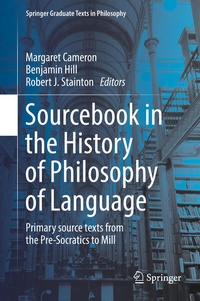
Sourcebook in the History of Philosophy of Language
Primary source texts from the Pre-Socratics to Mill
Published on 8. September 2016
XXI, 1102 pages
978-3-319-26908-5 (ISBN)
Description

For the first time in English, this anthology offers a comprehensive selection of primary sources in the history of philosophy of language. Beginning with a detailed introduction contextualizing the subject, the editors draw out recurring themes, including the origin of language, the role of nature and convention in fixing form and meaning, language acquisition, ideal languages, varieties of meanings, language as a tool, and the nexus of language and thought, linking them to representative texts. The handbook moves on to offer seminal contributions from philosophers ranging from the pre-Socratics up to John Stuart Mill, preceding each major historical section with its own introductory assessment. With all of the most relevant primary texts on the philosophy of language included, covering well over two millennia, this judicious, and generous, selection of source material will be an indispensable research tool for historians of philosophy, as well as for philosophers of language,in the twenty-first century. A vital tool for researchers and contemporary philosophers, it will be a touchstone for much further research, with coverage of a long and varied tradition that will benefit today's scholars and enhance their awareness of earlier contributions to the field.
Reviews / Votes
"This is a novel and fascinating book, which traces many contemporary issues still haunting philosophers of language today, back to their historical roots. . for anyone who reads it, it could very well play a role in making that person more aware of the insular and presentist approach in current philosophy of language, which has the potential to have a profound effect on how philosophy of language is currently practiced." (Heidi Savage, Metascience, Vol. 26, 2017)More details
Series
Edition
1st ed. 2017
Language
English
Place of publication
Cham
Switzerland
Publishing group
Springer International Publishing
Target group
Professional and scholarly
Product notice
Reflowable
Illustrations
XXI, 1102 p.
File size
16,80 MB
ISBN-13
978-3-319-26908-5 (9783319269085)
DOI
10.1007/978-3-319-26908-5
Schweitzer Classification
Other editions
Additional editions
Margaret Cameron | Benjamin Hill | Robert J. Stainton
Sourcebook in the History of Philosophy of Language
Primary source texts from the Pre-Socratics to Mill
Book
09/2016
Springer
€160.49
Shipment within 10-15 days
Persons
Margaret Cameron: Margaret Cameron is Associate Professor and Canada Research Chair in the Aristotelian Tradition at the University of Victoria. She completed her PhD at the University of Toronto's Collaborative Program in Ancient and Medieval Philosophy in 2004. She has published on the history of the philosophy of language in the ancient and medieval traditions in various venues, including The Oxford Handbook to Medieval Philosophy (Oxford, 2013) and Linguistic Content (Oxford, 2015). She is editor of a number of volumes, including Philosophy of Mind in the Early and High Middle Ages (Routledge, forthcoming).
Benjamin Hill:Benjamin Hill is an Associate Professor of Philosophy at The University of Western Ontario. He earned his PhD at the University of Iowa in 2003. He focuses on sixteenth- and seventeenth-century philosophy and is most interested in contrasting the continuities and discontinuities in philosophical thought, especially epistemological thinking, from Francisco Suarez through John Locke and on to George Berkeley. He is editor (with Henrik Lagerlund) of The Philosophy of Francisco Suarez (Oxford, 2012) and Routledge Companion to Sixteenth Century Philosophy (Routledge, 2015).
Robert Stainton:
Robert Stainton was introduced to both philosophy and linguistics at Glendon College of York University, and continued to study in these areas at MIT, where he completed his Ph.D. in 1993. He was Canada Research Chair in Cognitive Science at Carleton University before taking up his current position at the University of Western Ontario, where he is presently Distinguished University Professor of Philosophy and Director of the Graduate Program in Linguistics. He is the editor or co-editor of many books, including Concise Encyclopedia of Philosophy of Language and Linguistics (Elsevier, 2010) and Contemporary Debates in Cognitive Science (Blackwell, 2006).
Benjamin Hill:Benjamin Hill is an Associate Professor of Philosophy at The University of Western Ontario. He earned his PhD at the University of Iowa in 2003. He focuses on sixteenth- and seventeenth-century philosophy and is most interested in contrasting the continuities and discontinuities in philosophical thought, especially epistemological thinking, from Francisco Suarez through John Locke and on to George Berkeley. He is editor (with Henrik Lagerlund) of The Philosophy of Francisco Suarez (Oxford, 2012) and Routledge Companion to Sixteenth Century Philosophy (Routledge, 2015).
Robert Stainton:
Robert Stainton was introduced to both philosophy and linguistics at Glendon College of York University, and continued to study in these areas at MIT, where he completed his Ph.D. in 1993. He was Canada Research Chair in Cognitive Science at Carleton University before taking up his current position at the University of Western Ontario, where he is presently Distinguished University Professor of Philosophy and Director of the Graduate Program in Linguistics. He is the editor or co-editor of many books, including Concise Encyclopedia of Philosophy of Language and Linguistics (Elsevier, 2010) and Contemporary Debates in Cognitive Science (Blackwell, 2006).
Content
1. Introduction.- 2. Pre-Socratics.- 3. Plato.- 4. Aristotle.- 5. Epicureanism.- 6. Stoics.- 7. Sextus.- 8. Proclus.- 9. Augustine.- 10. Boethius.- 11. Abelard.- 12. Anselm.- 13. Peter of Spain.- 14. Thomas Aquinas.- 15. Roger Bacon.- 16. Modistae.- 17. Peter of Ailly.- 18. William Ockham.- 19. John Buridan.- 20. Lorenzo Valla.- 21. Cajatan.- 22. John of Poinsot.- 23. Montaigne.- 24. Francis Bacon.- 25. Thomas Hobbes.- 26. Arnauld.- 27.Cordemoy.- 28. Locke.- 29. Berkeley.- 30. John Wilkins.- 31. Leibniz.- 32. Condiliac.- 33. Reid.- 34. Adam Smith.- 35. Diderot.- 36. Rousseau.- 37. Herder.- 38. Johann Hamann.- 39. Von Humbolt.- 40. Bolzano.- 41. J.S. Mill.-
