

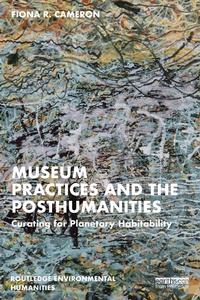
Museum Practices and the Posthumanities
Curating for Planetary Habitability
1st Edition
Published on 24. October 2023
312 pages
978-1-351-81456-0 (ISBN)
Description

This book critiques modern museologies and curatorial practices that have been complicit in emerging existential crises. It confidently presents novel, more-than-human curatorial visions, methods, frameworks, policies, and museologies radically refiguring the epistemological foundations of curatorial, museological thinking, and practice for a habitable planet.
Modern curatorial and museological practices are dominated by modern humanism in which capital growth, social, technological advancement, hubris, extraction, speciest logics, and colonial domination predominate, often without reflection. While history, science, and technology museums and their engagement with non-human worlds have always been ecological as an empirical reality, the human-centred frameworks and forms of human agency that institutions deploy tend to be non-cognizant of this reality. Museum Practices and the Posthumanities: Curating for Planetary Habitability reveals how these practices are ill-equipped to deal with the contemporary world of rapid digital transformations, post-Covid living, climate change, and its impacts among other societal changes, and it shows how museums might best meet these challenges by thinking with and in more-than-human worlds.
This book is aimed at museological scholars and museum professionals, and it will provide them with the inspiration to conduct research on and curate from a different ecological reference point to promote a world good enough for all things to thrive in radical co-existence.
Modern curatorial and museological practices are dominated by modern humanism in which capital growth, social, technological advancement, hubris, extraction, speciest logics, and colonial domination predominate, often without reflection. While history, science, and technology museums and their engagement with non-human worlds have always been ecological as an empirical reality, the human-centred frameworks and forms of human agency that institutions deploy tend to be non-cognizant of this reality. Museum Practices and the Posthumanities: Curating for Planetary Habitability reveals how these practices are ill-equipped to deal with the contemporary world of rapid digital transformations, post-Covid living, climate change, and its impacts among other societal changes, and it shows how museums might best meet these challenges by thinking with and in more-than-human worlds.
This book is aimed at museological scholars and museum professionals, and it will provide them with the inspiration to conduct research on and curate from a different ecological reference point to promote a world good enough for all things to thrive in radical co-existence.
Reviews / Votes
'There is now no doubt regarding the epochal, world-shaping significance of the curatorial practices of late eighteenth and nineteenth century museums. With a matching boldness of vision, Fiona Cameron now calls on museums to play a world-saving role by "curating for planet habitability." Better still, in identifying the intellectual and institutional challenges this entails, she also shows how these might best be met. A timely manifesto for the contribution museums might make to addressing the crises produced by our relations to the more-than-human worlds that press upon us with increasing force.'Tony Bennett, Emeritus Professor, Social and Cultural Theory, Institute for Culture and Society, Western Sydney University, Australia
'This book offers a timely posthumanist provocation for students of, and practitioners in, museums. A fierce critique of humanist museum practices and theories, the book challenges us to take account of emerging practices in museums in the 21st century. Neither what museums are nor what they are becoming remain the same after its reading. With a deep commitment to more-than-human worlds, the book offers theoretical grounding for museum activism in the face of climate and planetary crisis. This book is a testament to Fiona Cameron's longstanding engagement with difficult topics in museums and provide researchers, practitioners, and students alike with new tools for analyses and action.'
Brita Brenna, Professor of Museology, University of Oslo, Norway
'Museum Practices and the Posthumanities: Curating for Planetary Habitability is a deeply felt plea and argument for the need to get beyond our human centered approaches for dealing with ecological crisis. Museums, Cameron argues, are institutions that were central to the humanist project that produced the current ecological crisis. They are therefore also central to undoing that project. Doing so involves a radical rethinking of the central categories of thought that underpin modern society. In doing so, this book opens an alternative future by showing us what we need to overcome and how to go about it. Using the concept of viral contagion as both idea and reality, Cameron opens the possibility that we might be able to move beyond our humanist centered perspectives and productively deal with current threats to planetary wellbeing. This book is a magnificent tour de force in how museums might become part of a viral contagion that works to undo our current understandings of our place on this planet.'
Andrea Witcomb, Alfred Deakin Professor, Faculty of Arts and Education, Deakin University, Australia 'There is now no doubt regarding the epochal, world-shaping significance of the curatorial practices of late eighteenth and nineteenth century museums. With a matching boldness of vision, Fiona Cameron now calls on museums to play a world-saving role by 'curating for planet habitability.' Better still, in identifying the intellectual and institutional challenges this entails, she also shows how these might best be met. A timely manifesto for the contribution museums might make to addressing the crises produced by our relations to the more-than-human worlds that press upon us with increasing force.'
Tony Bennett, Emeritus Professor, Social and Cultural Theory, Institute for Culture and Society, Western Sydney University, Australia
'This book offers a timely posthumanist provocation for students of, and practitioners in, museums. A fierce critique of humanist museum practices and theories, the book challenges us to take account of emerging practices in museums in the 21st century. Neither what museums are nor what they are becoming remain the same after its reading. With a deep commitment to more-than-human worlds, the book offers theoretical grounding for museum activism in the face of climate and planetary crisis. This book is a testament to Fiona Cameron's longstanding engagement with difficult topics in museums and provides researchers, practitioners, and students alike with new tools for analyses and action.'
Brita Brenna, Professor of Museology, University of Oslo, Norway
'Museum Practices and the Posthumanities: Curating for Planetary Habitability is a deeply felt plea and argument for the need to get beyond our human centered approaches for dealing with ecological crisis. Museums, Cameron argues, are institutions that were central to the humanist project that produced the current ecological crisis. They are therefore also central to undoing that project. Doing so involves a radical rethinking of the central categories of thought that underpin modern society. In doing so, this book opens an alternative future by showing us what we need to overcome and how to go about it. Using the concept of viral contagion as both idea and reality, Cameron opens the possibility that we might be able to move beyond our humanist centered perspectives and productively deal with current threats to planetary wellbeing. This book is a magnificent tour de force in how museums might become part of a viral contagion that works to undo our current understandings of our place on this planet.'
Andrea Witcomb, Alfred Deakin Professor, Faculty of Arts and Education, Deakin University, Australia
More details
Series
Edition
1. Auflage
Language
English
Place of publication
London
United Kingdom
Publishing group
Taylor & Francis Ltd
Target group
College/higher education
Illustrations
3 Line drawings, black and white; 16 Halftones, black and white; 19 Illustrations, black and white
ISBN-13
978-1-351-81456-0 (9781351814560)
Copyright in bibliographic data and cover images is held by Nielsen Book Services Limited or by the publishers or by their respective licensors: all rights reserved.
Schweitzer Classification
Other editions
Additional editions
Book
10/2023
1st Edition
Routledge
€196.70
Shipment within 15-20 days
Book
10/2023
1st Edition
Routledge
€60.20
Shipment within 15-20 days
Person
Fiona R. Cameron is Associate Professor, Principal Research Fellow, Contemporary Museologies at the Institute for Culture and Society, Western Sydney University, Australia. Fiona is also Professor Dr. at the Rachel Carson Center, Ludwig Maximilian University of Munich, Germany and visiting Professor, Linkoeping University, Sweden.
Content
1. Introduction: Curating for planetary habitability 2. Technospheric heritage: Curating more-than-digital heritages in and for planetary durations 3. Collections and eco-curating human-non-human climates 4. Museums, climate policy frameworks, and the problem of humanist-driven solutions 5. Communitarian design: Eco-curating climate change in attunement 6. Viral museologies: Curating human-species-viral worlds in sympoiesis 7. Curating sustaining practices in and for more-than-human worlds 8. Conclusion: More-than-human museologies
