

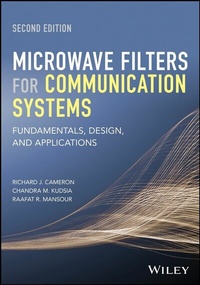
Microwave Filters for Communication Systems
Description

Thoroughly revised and expanded, this second edition of the popular reference addresses the many important advances that have taken place in the field since the publication of the first edition and includes new chapters on Multiband Filters, Tunable Filters and a chapter devoted to Practical Considerations and Examples.
One of the chief constraints in the evolution of wireless communication systems is the scarcity of the available frequency spectrum, thus making frequency spectrum a primary resource to be judiciously shared and optimally utilized. This fundamental limitation, along with atmospheric conditions and interference have long been drivers of intense research and development in the fields of signal processing and filter networks, the two technologies that govern the information capacity of a given frequency spectrum. Written by distinguished experts with a combined century of industrial and academic experience in the field, Microwave Filters for Communication Systems:
* Provides a coherent, accessible description of system requirements and constraints for microwave filters
* Covers fundamental considerations in the theory and design of microwave filters and the use of EM techniques to analyze and optimize filter structures
* Chapters on Multiband Filters and Tunable Filters address the new markets emerging for wireless communication systems and flexible satellite payloads and
* A chapter devoted to real-world examples and exercises that allow readers to test and fine-tune their grasp of the material covered in various chapters, in effect it provides the roadmap to develop a software laboratory, to analyze, design, and perform system level tradeoffs including EM based tolerance and sensitivity analysis for microwave filters and multiplexers for practical applications.
Microwave Filters for Communication Systems provides students and practitioners alike with a solid grounding in the theoretical underpinnings of practical microwave filter and its physical realization using state-of-the-art EM-based techniques.
More details
Other editions
Additional editions
Persons
Richard J. Cameron, isthe formerTechnical Director at COM DEV International. Visiting Professor at the University of Leeds (UK), and is a Fellow of IEE and IEEE.
Chandra M. Kudsia, PhD, is an Adjunct Professor at the University of Waterloo and former Chief Scientist, COM DEV International. He is a Fellow of IEEE, AIAA, CAE, EIC and IETE.
Raafat R. Mansour, PhD, is a Professor at the University of Waterloo and a former Director of R&D at COM DEV International. He is a Fellow of IEEE, CAE and EIC.
Content
Preface xxiii
1 Radio Frequency (RF) Filter Networks for Wireless Communications-The System Perspective 1
Part I Introduction to a Communication System, Radio Spectrum, and Information 1
1.1 Model of a Communication System 1
1.2 Radio Spectrum and its Utilization 6
1.3 Concept of Information 8
1.4 Communication Channel and Link Budgets 10
Part II Noise in a Communication Channel 15
1.5 Noise in Communication Systems 15
1.6 Modulation-Demodulation Schemes in a Communication System 32
1.7 Digital Transmission 39
Part III Impact of System Design on the Requirements of Filter Networks 50
1.8 Communication Channels in a Satellite System 50
1.9 RF Filters in Cellular Systems 62
1.10 Ultra Wideband (UWB) Wireless Communication 66
1.11 Impact of System Requirements on RF Filter Specifications 68
1.12 Impact of Satellite and Cellular Communications on Filter Technology 72
Summary 72
References 72
Appendix 1A 74
Intermodulation Distortion Summary 74
2 Fundamentals of Circuit Theory Approximation 75
2.1 Linear Systems 75
2.2 Classification of Systems 76
2.3 Evolution of Electrical Circuits: A Historical Perspective 77
2.4 Network Equation of Linear Systems in the Time Domain 78
2.5 Network Equation of Linear Systems in the Frequency-Domain Exponential Driving Function 80
2.6 Steady-State Response of Linear Systems to Sinusoidal Excitations 83
2.7 Circuit Theory Approximation 84
Summary 85
References 86
3 Characterization of Lossless Lowpass Prototype Filter Functions 87
3.1 The Ideal Filter 87
3.2 Characterization of Polynomial Functions for Doubly Terminated Lossless Lowpass Prototype Filter Networks 88
3.3 Characteristic Polynomials for Idealized Lowpass Prototype Networks 93
3.4 Lowpass Prototype Characteristics 95
3.5 Characteristic Polynomials versus Response Shapes 96
3.6 Classical Prototype Filters 98
3.7 Unified Design Chart (UDC) Relationships 108
3.8 Lowpass Prototype Circuit Configurations 109
3.9 Effect of Dissipation 113
3.10 Asymmetric Response Filters 115
Summary 118
References 119
Appendix 3A 121
Unified Design Charts 121
4 Computer-Aided Synthesis of Characteristic Polynomials 129
4.1 Objective Function and Constraints for Symmetric Lowpass Prototype Filter Networks 129
4.2 Analytic Gradients of the Objective Function 131
4.3 Optimization Criteria for Classical Filters 134
4.4 Generation of Novel Classes of Filter Functions 136
4.5 Asymmetric Class of Filters 138
4.6 Linear Phase Filters 142
4.7 Critical Frequencies for Selected Filter Functions 143
Summary 144
References 144
Appendix 4A 145
5 Analysis of Multiport Microwave Networks 147
5.1 Matrix Representation of Two-Port Networks 147
5.2 Cascade of Two Networks 160
5.3 Multiport Networks 167
5.4 Analysis of Multiport Networks 169
Summary 174
References 175
6 Synthesis of a General Class of the Chebyshev Filter Function 177
6.1 Polynomial Forms of the Transfer and Reflection Parameters S21(S) and S11(S) for a Two-port network 177
6.2 Alternating Pole Method for the Determination of the Denominator Polynomial E(S) 186
6.3 General Polynomial Synthesis Methods for Chebyshev Filter Functions 189
6.4 Predistorted Filter Characteristics 200
6.5 Transformation for Symmetric Dual-Passband Filters 208
Summary 211
References 211
Appendix 6A 212
Complex Terminating Impedances in Multiport Networks 212
6A.1 Change of Termination Impedance 213
References 213
7 Synthesis of Network-Circuit Approach 215
7.1 Circuit Synthesis Approach 216
7.2 Lowpass Prototype Circuits for Coupled-Resonator Microwave Bandpass Filters 221
7.3 Ladder Network Synthesis 229
7.4 Synthesis Example of an Asymmetric (4-2) Filter Network 235
Summary 244
References 245
8 Synthesis of Networks: Direct Coupling Matrix Synthesis Methods 247
8.1 The Coupling Matrix 247
8.2 Direct Synthesis of the Coupling Matrix 258
8.3 Coupling Matrix Reduction 261
8.4 Synthesis of the N + 2 Coupling Matrix 268
8.5 Even- and Odd-Mode Coupling Matrix Synthesis Technique: the Folded Lattice Array 282
Summary 292
References 293
9 Reconfiguration of the Folded Coupling Matrix 295
9.1 Symmetric Realizations for Dual-Mode Filters 295
9.2 Asymmetric Realizations for Symmetric Characteristics 300
9.3 "Pfitzenmaier" Configurations 301
9.4 Cascaded Quartets (CQs): Two Quartets in Cascade for Degrees Eight and Above 304
9.5 Parallel-Connected Two-Port Networks 306
9.6 Cul-de-Sac Configuration 311
Summary 321
References 321
10 Synthesis and Application of Extracted Pole and Trisection Elements 323
10.1 Extracted Pole Filter Synthesis 323
10.2 Synthesis of Bandstop Filters Using the Extracted Pole Technique 335
10.2.1 Direct-Coupled Bandstop Filters 338
10.2.1.1 Cul-de-Sac Forms for the Direct-Coupled Bandstop Matrix 341
10.3 Trisections 343
10.4 Box Section and Extended Box Configurations 361
Summary 371
References 371
11 Microwave Resonators 373
11.1 Microwave Resonator Configurations 373
11.2 Calculation of Resonant Frequency 376
11.3 Resonator Unloaded Q Factor 383
11.4 Measurement of Loaded and Unloaded Q Factor 387
Summary 393
References 393
12 Waveguide and Coaxial Lowpass Filters 395
12.1 Commensurate-Line Building Elements 395
12.2 Lowpass Prototype Transfer Polynomials 396
12.3 Synthesis and Realization of the Distributed Stepped Impedance Lowpass Filter 401
12.4 Short-Step Transformers 410
12.5 Synthesis and Realization of Mixed Lumped/Distributed Lowpass Filters 411
Summary 425
References 426
13 Waveguide Realization of Single- and Dual-Mode Resonator Filters 427
13.1 Synthesis Process 428
13.2 Design of the Filter Function 428
13.3 Realization and Analysis of the Microwave Filter Network 434
13.4 Dual-Mode Filters 440
13.5 Coupling Sign Correction 442
13.6 Dual-Mode Realizations for Some Typical Coupling Matrix Configurations 444
13.7 Phase- and Direct-Coupled Extracted Pole Filters 447
13.8 The "Full-Inductive" Dual-Mode Filter 450
Summary 454
References 454
14 Design and Physical Realization of Coupled Resonator Filters 457
14.1 Circuit Models for Chebyshev Bandpass Filters 459
14.2 Calculation of Interresonator Coupling 463
14.3 Calculation of Input/Output Coupling 467
14.4 Design Example of Dielectric Resonator Filters Using the Coupling Matrix Model 468
14.5 Design Example of a Waveguide Iris Filter Using the Impedance Inverter Model 475
14.6 Design Example of a Microstrip Filter Using the J-Admittance Inverter Model 478
Summary 483
References 484
15 Advanced EM-Based Design Techniques for Microwave Filters 485
15.1 EM-Based Synthesis Techniques 485
15.2 EM-Based Optimization Techniques 486
15.3 EM-Based Advanced Design Techniques 496
Summary 513
References 514
16 Dielectric Resonator Filters 517
16.1 Resonant Frequency Calculation in Dielectric Resonators 517
16.2 Rigorous Analyses of Dielectric Resonators 521
16.3 Dielectric Resonator Filter Configurations 524
16.4 Design Considerations for Dielectric Resonator Filters 528
16.5 Other Dielectric Resonator Configurations 531
16.6 Cryogenic Dielectric Resonator Filters 534
16.7 Hybrid Dielectric/Superconductor Filters 536
16.8 Miniature Dielectric Resonators 538
Summary 542
References 543
17 Allpass Phase and Group Delay Equalizer Networks 545
17.1 Characteristics of Allpass Networks 545
17.2 Lumped-Element Allpass Networks 547
17.3 Microwave Allpass Networks 551
17.4 Physical Realization of Allpass Networks 554
17.5 Synthesis of Reflection-Type Allpass Networks 557
17.6 Practical Narrowband Reflection-Type Allpass Networks 558
17.7 Optimization Criteria for Allpass Networks 561
17.8 Dissipation Loss 566
17.9 Equalization Tradeoffs 567
Summary 567
References 568
18 Multiplexer Theory and Design 569
18.1 Background 569
18.2 Multiplexer Configurations 571
18.3 RF Channelizers (Demultiplexers) 575
18.4 RF Combiners 581
18.5 Transmit-Receive Diplexers 601
Summary 606
References 607
19 Computer-Aided Diagnosis and Tuning of Microwave Filters 609
19.1 Sequential Tuning of Coupled Resonator Filters 610
19.2 Computer-Aided Tuning Based on Circuit Model Parameter Extraction 615
19.3 Computer-Aided Tuning Based on Poles and Zeros of the Input Reflection Coefficient 619
19.4 Time-Domain Tuning 622
19.5 Filter Tuning Based on Fuzzy Logic Techniques 627
19.6 Automated Setups for Filter Tuning 637
Summary 639
References 640
20 High-Power Considerations in Microwave Filter Networks 643
20.1 Background 643
20.2 High-Power Requirements in Wireless Systems 643
20.3 High-Power Amplifiers (HPAs) 645
20.4 Gas Discharge 645
20.5 Multipaction Breakdown 651
20.6 High-Power Bandpass Filters 662
20.7 Passive Intermodulation (PIM) Consideration for High-Power Equipment 670
Summary 674
Acknowledgment 675
References 675
21 Multiband Filters 679
21.1 Introduction 679
21.2 Approach I: Multiband Filters Realized by Having Transmission Zeros Inside the Passband of a Bandpass Filter 681
21.3 Approach II: Multiband Filters Employing Multimode Resonators 683
21.4 Approach III: Multiband Filters Using Parallel Connected Filters 700
21.5 Approach IV: Multiband Filter Implemented Using Notch Filters Connected in Cascade with a Wideband Bandpass 701
21.6 Use of Dual-Band Filters in Diplexer and Multiplexer Applications 703
21.7 Synthesis of Multiband Filters 705
Summary 727
References 728
22 Tunable Filters 731
22.1 Introduction 731
22.2 Major Challenges in Realizing High-Q 3D Tunable Filters 733
22.3 Combline Tunable Filters 734
22.4 Tunable Dielectric Resonator Filters 752
22.5 Waveguide Tunable Filters 772
22.6 Filters with Tunable Bandwidth 776
Summary 778
References 779
23 Practical Considerations and Design Examples 785
Chandra M. Kudsia, Vicente E. Boria, and Santiago Cogollos
23.1 System Considerations for Filter Specifications in Communication Systems 785
23.2 Filter Synthesis Techniques and Topologies 796
23.3 Multiplexers 827
23.4 High-Power Considerations 839
23.5 Tolerance and Sensitivity Analysis in Filter Design 851
Summary 858
Acknowledgments 858
Appendix 23A 858
Thermal Expansion 858
References 859
A Physical Constants 861
B Conductivities of Metals 863
C Dielectric Constants and Loss Tangents of Some Materials 865
D Rectangular Waveguide Designation 867
E Impedance and Admittance Inverters 869
E.1 Filter Realization with Series Elements 869
E.2 Normalization of the Element Values 872
E.3 General Lowpass Prototype Case 873
E.4 Bandpass Prototype 874
References 878
Index 879
Preface
Three new chapters are introduced in the second edition. Chapters on multiband filters and tunable filters are added to reflect the emerging markets for wireless systems. The third chapter is devoted to the practical aspects of design and implementation of microwave filters and multiplexing networks. Chapters from edition 1 have undergone a thorough review and minor revisions. New sections have been added in Chapters 1, 6, 8, 16, and 20.
The book begins with a simple model of a communication system. It addresses the issues on: (i) whether there is a limitation on the available bandwidth for a wireless communication system, (ii) what the limitations are for transmitting information in the available bandwidth, and (iii) what the cost-sensitive parameters of a communication system are. Each issue is then addressed to gain understanding of various system parameters with emphasis on the role and requirements of filter networks in different parts of the communication system. This sets the stage to address the fundamentals of filter design based on circuit theory approximation. It continues with a description of classical filters. This is followed by the development of computer-aided techniques to generate a general class of prototype filter functions, exhibiting a symmetrical or asymmetrical frequency response. This general formulation is accomplished by incorporating hypothetical frequency invariant reactive (FIR) elements in the lowpass prototype filter design. The FIR elements show up as frequency offsets of resonant circuits in real bandpass or bandstop filters. Absence of FIR elements represents the classical filter function that gives rise to symmetrical frequency response. From this general formulation of the filter function, synthesis techniques are described to realize the equivalent lumped parameter circuit model of filter networks. The next step in the synthesis procedure is to translate the circuit model of the filter into its equivalent microwave structure. As a first approximation, this can be achieved by making use of the extensive existing data that relates circuit models to the physical dimensions and properties of structures used for microwave filters. For more accurate determination of physical dimensions, modern electromagnetic (EM)-based techniques and tools are described to determine filter dimensions with near-arbitrary accuracy. This knowledge is carried through in the design of multiplexing networks having arbitrary bandwidths and channel separations.
Separate chapters are devoted to computer-aided tuning and high-power considerations in filter design. Our goal has been to give the reader a broad view of filter requirements and design and sufficient depth to follow continuing advances in this field. Throughout the book, emphasis has been on fundamentals and practical considerations in filter design. Distinct features of the book include (i) system considerations in the design of filters, (ii) the general formulation and synthesis of filter functions including the FIR elements, (iii) synthesis techniques for lowpass prototype filters exhibiting symmetrical or asymmetrical frequency response in a variety of topologies, (iv) application of EM techniques to optimize physical dimensions of microwave filter structures, (v) design and tradeoffs of various multiplexer configurations, (vi) computer-aided filter tuning techniques, and (vii) high-power considerations for terrestrial and space applications. The material in the book is organized in 23 chapters:
- Chapter 1 is devoted to an overview of communication systems, more specifically to the relationship between the communication channel and other elements of the system. The intent here is to provide the reader with sufficient background to be able to appreciate the critical role and requirements of radio frequency (RF) filters in communication systems.
- In the second edition, Digital Transmission, The Channelizer Section, Frequency Plan, and Limitations of Microwave Filter Technology have been revised. The section on RF Filters for Cellular Systems is modified to reflect the requirement of additional frequency bands to meet the explosive growth in wireless services. A section has been added on Ultra Wideband (UWB) Wireless Communication. The summary at the end of the chapter has been revised to reflect the changes.
- The principles that unify communication theory and circuit theory approximations are explained in Chapter 2. It highlights the essential assumptions and the success of the frequency analysis approach that we take for granted in analyzing electrical networks.
- Chapter 3 describes the synthesis of the characteristic polynomials to realize the classical maximally flat, Chebyshev, and elliptic function lowpass prototype filters. It includes a discussion of FIR elements and their inclusion to generate filter functions with asymmetrical frequency response. This leads to transfer function polynomials (with certain restrictions) with complex coefficients, a distinct departure from the more familiar characteristic polynomials with rational and real coefficients. This provides a basis to analyze the most general class of filter functions in the lowpass prototype domain, including minimum and nonminimum phase filters, exhibiting a symmetrical or asymmetrical frequency response.
- Chapter 4 presents the synthesis of characteristic polynomials of lowpass prototype filters with arbitrary amplitude response using computer-aided optimization technique. The key lies in making sure that the optimization procedure is highly efficient. This is accomplished by determining the gradients of the objective function analytically and linking it directly to the desired amplitude response shape. It includes minimum phase and nonminimum phase filters exhibiting a symmetrical or asymmetrical frequency response. To demonstrate the flexibility of this method, examples of some unconventional filters are included.
- Chapter 5 provides a review of the basic concepts used in the analysis of multiport microwave networks. These concepts are important for filter designers since any filter or multiplexer can be divided into smaller two-, three-, or N-port networks connected together. Five matrix representations of microwave networks are described, namely, [Z], [lY], [ABCD], [S], and [T] matrices. These matrices are interchangeable, where the elements of any matrix can be written in terms of those of the other four matrices. Familiarity with the concepts of these matrices is essential in understanding the material presented in this book.
- Chapter 6 begins with a review of some important scattering parameter relations that are relevant for the synthesis of filter networks. This is followed by a discussion of the general kind of Chebyshev function and its application in generating the transfer and reflection polynomials for the equi-ripple class of filter characteristics with an arbitrary distribution of the transmission zeros. In the final part of this chapter, the special cases of predistorted and dual-band filtering functions are discussed.
- The second edition has two added features: a section for finding the positions of the in-band reflection maxima and the out-of-band transmission maxima of the generalized Chebyshev prototype filter and an appendix extending the two-port S-parameter analysis and synthesis to multiport networks with complex terminations. A section has been added describing the relationship between the characteristic polynomials, S-parameters, short-circuit admittance, and [ABCD] transfer matrix parameters.
- In Chapter 7, filter synthesis based on the [ABCD] matrix is presented. The synthesis procedure is broken down into two stages. The first stage involves lumped element lossless inductors, capacitors, and FIR elements. The second stage includes the immitance inverters. Use of such inverters allows for the prototype electrical circuit in a form suitable for realization with intercoupled microwave resonators. The technique is applicable for synthesizing lowpass prototype filters with symmetrical or asymmetrical response, in ladder form, as well as cross-coupled topologies. A further generalization is introduced to allow the synthesis of singly terminated filters. The synthesis process described in this chapter represents the most general technique for synthesizing lumped element, lowpass prototype filter networks.
- In Chapter 8, the concept of N × N coupling matrix for the synthesis of bandpass prototype filters is introduced. The procedure is modified by including FIR elements to allow synthesis of asymmetric filter response as well. The procedure is then extended to N + 2 coupling matrix by separating out the purely resistive and purely reactive portions of the N × N matrix. The N + 2 coupling matrix allows multiple couplings with respect to the input and output ports, in addition to the main input/output couplings to the first and last resonators as envisaged in the N × N coupling matrix. This allows synthesis of fully canonical filters and simplifies the process of similarity transformations to realize other filter topologies. This synthesis process yields the general coupling matrix with finite entries for all the couplings. The next step in the process is to derive topologies with a minimum number of couplings, referred to as canonical forms. This is achieved by applying similarity transformations to the coupling matrix. Such transformations preserve the eigenvalues and eigenvectors of the matrix, thus ensuring that the...
