

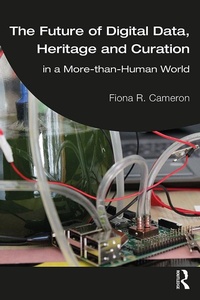
The Future of Digital Data, Heritage and Curation
in a More-than-Human World
1st Edition
Published on 30. March 2021
308 pages
978-1-000-36817-8 (ISBN)
Description

The Future of Digital Data, Heritage and Curation critiques digital cultural heritage concepts and their application to data, developing new theories, curatorial practices and a more-than-human museology for a contemporary and future world.
Presenting a diverse range of case examples from around the globe, Cameron offers a critical and philosophical reflection on the ways in which digital cultural heritage is currently framed as societal data worth passing on to future generations in two distinct forms: digitally born and digitizations. Demonstrating that most perceptions of digital cultural heritage are distinctly western in nature, the book also examines the complicity of such heritage in climate change, and environmental destruction and injustice. Going further still, the book theorizes the future of digital data, heritage, curation and the notion of the human in the context of the profusion of new types of societal data and production processes driven by the intensification of data economies and through the emergence of new technologies. In so doing, the book makes a case for the development of new types of heritage that comprise AI, automated systems, biological entities, infrastructures, minerals and chemicals - all of which have their own forms of agency, intelligence and cognition.
The Future of Digital Data, Heritage and Curation is essential reading for academics and students engaged in the study of museums, archives, libraries, galleries, archaeology, cultural heritage management, information management, curatorial studies and digital humanities.
Presenting a diverse range of case examples from around the globe, Cameron offers a critical and philosophical reflection on the ways in which digital cultural heritage is currently framed as societal data worth passing on to future generations in two distinct forms: digitally born and digitizations. Demonstrating that most perceptions of digital cultural heritage are distinctly western in nature, the book also examines the complicity of such heritage in climate change, and environmental destruction and injustice. Going further still, the book theorizes the future of digital data, heritage, curation and the notion of the human in the context of the profusion of new types of societal data and production processes driven by the intensification of data economies and through the emergence of new technologies. In so doing, the book makes a case for the development of new types of heritage that comprise AI, automated systems, biological entities, infrastructures, minerals and chemicals - all of which have their own forms of agency, intelligence and cognition.
The Future of Digital Data, Heritage and Curation is essential reading for academics and students engaged in the study of museums, archives, libraries, galleries, archaeology, cultural heritage management, information management, curatorial studies and digital humanities.
Reviews / Votes
'In this highly prescient and original account, Fiona Cameron interrogates the vexed future custodianship of digital data. By bringing her incisive cultural heritage studies knowledge to bear on our rapidly increasing entanglement with the born-digital archive of objects, data and media, The Future of Digital Data, Heritage and Curation advances a powerful conceptual framework for the curation and conservation of potentially every utterance of our private and public worlds: "Strikingly, digital data as heritage is not just the new fabric of human life, it is radically embedded in the vast and sprawling ecological circumstances of life itself."'Hannah Lewi, The University of Melbourne, Australia
"This book offers an innovative new approach to digital cultural heritage. This is a fast moving but under-examined topic, but Fiona Cameron's approach is different, focusing right in on central contemporary issues, using an up to the minute conceptual framework, engaging closely with museum theory and practice, and enlivened by lots of illustrations, examples, case studies and useful applications, everything from AI, Trump's tweets, and sex bots to digitisation, informatics and museum CMS. In contrast to old fashioned humanist, materialist, Eurocentric approaches, Cameron argues that we have to understand digital cultural heritage through a lens which is ecological, post-humanist, and 'more than human'. The idea of 'eco-curating' is a striking environmentalist/relational/networked reformulation of conventional curating as we know it."
Conal McCarthy, Victoria University of Wellington, New Zealand
More details
Edition
1. Auflage
Language
English
Place of publication
London
United Kingdom
Publishing group
Taylor & Francis Ltd
Target group
College/higher education
Illustrations
25 Halftones, black and white; 25 Illustrations, black and white
ISBN-13
978-1-000-36817-8 (9781000368178)
Copyright in bibliographic data and cover images is held by Nielsen Book Services Limited or by the publishers or by their respective licensors: all rights reserved.
Schweitzer Classification
Other editions
Additional editions
Book
03/2021
1st Edition
Routledge
€179.51
Shipment within 15-20 days
Book
03/2021
1st Edition
Routledge
€61.80
Shipment within 15-20 days
Person
Fiona R. Cameron is Senior Research Fellow at the Institute for Culture and Society, Western Sydney University, Australia. Her research is directed to the figuration of museum and digital cultural heritage theory and curatorial practice for a more-than-human world.
Content
1. Introduction: Refiguring digital cultural heritage and curation; 2. The official birth of digital data as universal heritage; 3. Digital data as the heritage of the modern world; 4. Object concepts in digital cultural heritage; 5. From objects to ecological formations; 6. Digital data and artifactual production; 7. Curating inside the archive and out in the world; 8. The rise of more-than-human digital heritage in the Technosphere; 9. Conclusion: Framing a more-than-human digital museology
