

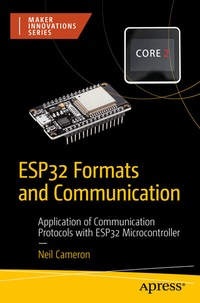
ESP32 Formats and Communication
Description

Although Wi-Fi communication is incorporated in many internet-based applications, knowledge of alternative communication protocols is vital for optimal project development with a microcontroller, such as the ESP32. This book focuses on communication protocols for the ESP32 microcontroller with illustrative projects ranging from a Bluetooth Low Energy beacon communicating with your smart wristwatch to Long Range (LoRa) communication between microsatellites circling 550km above the Earth and an ESP32 microcontroller in your home.
Just as there are different communication protocols, there are different ESP32 microcontroller formats. You'll examine the features of several ESP32 microcontroller formats, which enable the optimal combination of communication protocol and ESP32 format to achieve the requirements of a project. Several of the communication protocols and ESP32 formats have only been available in the last few months or years, making the book very relevant.Eachchapter focuses on a communication protocol and is stand-alone, so they can be read without having to start from the beginning of the book. The chapters are loosely grouped into short- and long-range communication, image management for transmission to a webpage or a remote LCD screen, and the required apps and IoT techniques for remote control of an ESP32-CAM robot vehicle. The advantages of each communication protocol correspond to different project types.
What You'll Learn
- Study the MESH communication protocol and the ESP-NOW protocol with communication between ESP32 microcontrollers without a Wi-Fi connection
- Review email communication projects with an ESP32 and generation of quick response codes to instruct an ESP32 to control a connected device.
- Look at the ESP32-CAM module built around a 2M-pixel camera for streaming images with the WebSocket protocol to a remote ESP32
- Control an ESP32-CAM robot car through remote communication over the internet with image streaming to an Android tablet or mobile phone.
More details
Other editions
Additional editions
Person
Neil Cameron is an experienced analyst and programmer with a deep interest in understanding the application of electronics. Neil wrote the books Arduino Applied: Comprehensive Projects for Everyday Electronics and Electronics Projects with the ESP8266 and ESP32: Building Web Pages, Applications, and WiFi Enabled Devices , which are published by Apress. He has previously taught at University of Edinburgh and Cornell University.
Content
Chapter 1: ESP32 Microcontroller.- Chapter 2: I2S Audio.- Chapter 3: Mesh Communication.- Chapter 4: TTGO T-Watch V.- Chapter 5: BLE Beacons.- Chapter 6: LORA and Microsatellites.- Chapter 7: Email and GR Codes.- Chapter 8: Websocket, Webserial, and Webdashboard.- Chapter 9: MQTT.- Chapter 10: Managing Images.- Chapter 11: ESP32-Cam Camera.- Chapter 12: Control Apps.- Chapter 13: Remote Control Motors.- Chapter 14: Remote Control ESP32-Cam Robot Car.
