

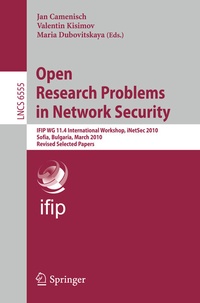
Open Research Problems in Network Security
IFIP WG 11.4 International Workshop, iNetSec 2010, Sofia, Bulgaria, March 5-6, 2010, Revised Selected Papers
Published on 10. February 2011
VIII, 172 pages
978-3-642-19228-9 (ISBN)
Description

This book constitutes the refereed post-conference proceedings of the IFIP WG 11.4 International Workshop, iNetSec 2010, held in Sofia, Bulgaria, in March 2010. The 14 revised full papers presented together with an invited talk were carefully reviewed and selected during two rounds of refereeing. The papers are organized in topical sections on scheduling, adversaries, protecting resources, secure processes, and security for clouds.
More details
Other editions
Additional editions

Jan Camenisch | Valentin Kisimov | Maria Dubovitskaya
Open Research Problems in Network Security
IFIP WG 11.4 International Workshop, iNetSec 2010, Sofia, Bulgaria, March 5-6, 2010, Revised Selected Papers
Book
02/2011
Springer
€53.49
Shipment within 7-9 days
Content
- Title
- Preface
- Table of Contents
- Invited Talk and Scheduling
- Securing the Internet: Fact or Fiction?
- Introduction
- What Do We Mean by ``Securing'' the Internet?
- The Ideal Interpretation
- The Realistic Interpretation
- An Overview of Recent Cyber Crime Statistics
- The Sophos Security Threat Report - 2009 (Soph09)
- The CISCO White Paper (CIS09)
- The UK Cybercrime Report 2009 (UKC09)
- CISCO Annual Security Report 2009 (CIS09a)
- T3.com (T309)
- The Washington Post (WP08)
- Securing the Internet Is Fiction - It Is Just Not Possible
- The Malicious Software (Malware) and Spoofing Threats
- The Threat of an Insufficient Legal Infrastructure for Curtailing Cyber Crime
- The Threat of Error Prone Software Being Rolled Out
- Final Conclusion
- So What About the Future?
- The End
- References
- Open Research Questions of Privacy-Enhanced Event Scheduling
- Introduction
- Requirements
- Related Work
- DSCP/DCOP
- E-Voting
- Specific Prior Work
- Open Research Questions
- Security Definition and Formal Proof of Correctness
- Predefined Complex Selection Rules
- Specifying Preferences
- Prevent "Legal-but-Selfish Votes"
- Automatic Poll Termination
- Dynamic Insertion and Deletion of Time Slots
- Updating and Revoking Votes
- Conclusion
- References
- Adversaries
- Event Handoff Unobservability in WSN
- Introduction
- Related Work
- System and Adversary Model
- Open Issue 1: A Non-linear Adversary Gain
- Open Issue 2: Proportional Adversary Gain Means Losing Unobservability
- Open Issue 3: An Enhanced Privacy Property $\^k$-anonymity
- Open Issue 4: Trajectory's Anatomy
- Open Issue 5: A Metric for Privacy and Energy Consumption
- Conclusion
- References
- Emerging and Future Cyber Threats to Critical Systems
- Introduction
- Critical System: Modelling and Specifics
- Modelling a Critical System
- Specifics of Critical Systems
- Example Scenario
- The Attack and Its Consequences
- Related Threats
- Discussion
- Emerging and Future Threats to Critical Systems
- Use of Commercial-Off-The-Shelf Components
- Retrofitting Security to Legacy Systems
- The Insider Threat
- Safety Takes Priority over Security
- Unforeseen Cascading Effects
- User Interface
- Sensor Networks
- Wireless Communications in Industrial Environments
- Hidden Functionality
- Next Generation Networks
- Conclusion
- References
- Adversarial Security: Getting to the Root of the Problem
- The General Security Problem
- Adversarial Security Design
- Framework
- Approaches
- Concluding Remarks
- References
- Practical Experiences with Purenet, a Self-Learning Malware Prevention System
- Introduction
- Background
- Purenet as Concept
- Purenet Approach and Architecture
- Data Stream Manager (DSM)
- New eThreat Detection Module (NeDM)
- Detection Plug-ins
- Risk Weighting
- Purenet Testbed
- Findings and Recommendations
- Latency Impact
- Analysis of Malware over Multiple Protocols
- Support for More File Types and Platforms
- Integration with Cloud Anti-Malware Solutions
- Reporting
- Future of Purenet
- Conclusion
- References
- A Biometrics-Based Solution to Combat SIM Swap Fraud
- Online Banking
- Online Banking Fraud
- The Online Banking EFT Transaction Process
- Attack Vectors
- SIM Swap Fraud
- What Is SIM Swap Fraud?
- ProblemAnalysis
- ProposedSolution
- The BIO-Swap System in a Nutshell
- The BIO-Swap System Architecture
- Pros and Cons
- Pros
- Cons
- Summary and Conclusion
- References
- Are BGP Routers Open to Attack? An Experiment
- Introduction
- BGPBasics
- Attacks against BGP
- Attacks from a Trusted Peer
- Attack Which Do Not Need Control of a Trusted BGP Router
- Scanning the Internet for BGP Routers
- Scanning Tools
- Probing BGP Routers
- Results
- Filtering Potential Honeypot Networks
- Areas of Attack
- Areas of Defense
- Related Work
- Conclusions
- References
- Secure Processes
- Securing the Core University Business Processes
- Introduction
- Method for Selection of Core Business Processes Needing High Security
- Extended Certification Authority
- Secure eDocument Management Architecture
- Secure Process: Delegation of Exam Permissions to Lecturers
- Secure Process: Recording Exam Marks
- Secure Process: Exchange Management Documents
- Conclusions
- References
- Some Technologies for Information Security Protection in Weak-Controlled Computer Systems and Their Applicability for eGovernment Services Users
- eGovernment Users Evolution and Risks for Their Information Security
- Technologies for Client-Side Protection for Lost or Stolen Computer Systems and for Stand-Alone Data Leakage Prevention
- Protection of Lost or Stolen Computer Systems and Data Devices
- Standalone Endpoint Data Leakage Prevention
- Applicability of Technologies for eGovernment Users Information Security Protection
- References
- Real-Time System for Assessing the Information Security of Computer Networks
- The Problem
- Actuality
- Goal and Tasks of the Investigation
- The Main Goal
- Main Tasks
- Work Definitions
- Analysis of Information Attacks
- Malware
- Malattacks
- Work Platforms, Environments and Places
- Work Platforms
- Experimental Work Places
- Work Places
- Used Methods
- Possibilities of the Real-Time System
- Conclusions and Recommendations
- References
- Evidential Notions of Defensibility and Admissibility with Property Preservation
- Motivation
- Directions
- Notions
- Primitive Properties
- Defensibility
- Admissibility
- Exemplification
- Integrity and Linkability
- Provenance, Weight of Evidence and Property Preservation
- Remarks
- References
- Security for Clouds
- Cloud Infrastructure Security
- Introduction to Cloud Computing Basics
- Cloud Computing Definition
- Cloud Computing Categories
- Cloud Deployment Models
- Risks and Security Concerns with Cloud Computing
- Cloud Security Principles
- Identity Security
- Information Security
- Security Compromises between the Three Cloud Deployment Models
- Infrastructure Security
- Infrastructure Security - The Network Level
- Infrastructure Security - The Host Level
- Infrastructure Security - The Application Level
- Conclusion
- References
- Security and Privacy Implications of Cloud Computing - Lost in the Cloud
- Introduction
- Security Implications
- Privacy Concerns
- Conclusions
- References
- The Need for Interoperable Reputation Systems
- Introduction
- Preliminaries
- Interoperability of Reputation Systems
- Interoperability with Applications
- Interoperability with Trust Management
- Interoperability with Identity Management
- Resulting Infrastructure
- Conclusion
- References
- Author Index
