

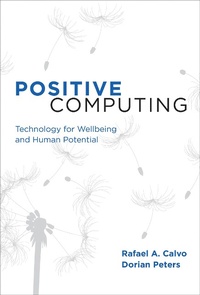
Positive Computing
Description

On the eve of Google's IPO in 2004, Larry Page and Sergey Brin vowed not to be evil. Today, a growing number of technologists would go further, trying to ensure that their work actively improves people's lives. Technology, so pervasive and ubiquitous, has the capacity to increase stress and suffering; but it also has the less-heralded potential to improve the well-being of individuals, society, and the planet. In this book, Rafael Calvo and Dorian Peters investigate what they term "positive computing”—the design and development of technology to support psychological well-being and human potential.
Calvo and Peters explain that technologists' growing interest in social good is part of a larger public concern about how our digital experience affects our emotions and our quality of life—which itself reflects an emerging focus on humanistic values in many different disciplines. Synthesizing theory, knowledge, and empirical methodologies from a variety of fields, they offer a rigorous and coherent foundational framework for positive computing. Sidebars by experts from psychology, neuroscience, human-computer interaction, and other disciplines supply essential context. Calvo and Peters examine specific well-being factors, including positive emotions, self-awareness, mindfulness, empathy, and compassion, and explore how technology can support these factors. Finally, they offer suggestions for future research and funding.
Sidebars Timothy N. Bickmore, Jeremy Bailenson, danah boyd, Jane Burns, David R. Caruso, Mihaly Csikszentmihalyi, Felicia Huppert, Mary-Helen Immordino-Yang, Adele Krusche and J. Mark G. Williams, Jane McGonigal, Jonathan Nicholas, Don Norman, Yvonne Rogers
More details
Other editions
Additional editions
Persons
Dorian Peters is user experience designer and online strategist for the Faculty of Education and Social Work at the University of Sydney and Creative Leader of the Positive Computing Lab there.
