

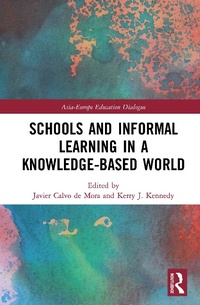
Schools and Informal Learning in a Knowledge-Based World
1st Edition
Published on 19. September 2019
238 pages
978-0-429-66619-3 (ISBN)
Description

This book has two purposes: To open up the debate on the role of informal education in schooling systems and to suggest the kind of school organizational environment that can best facilitate the recognition of informal learning. Successive chapters explore what is often seen as a duality between informal and formal learning. This duality is particularly so because education systems expend so much time and effort in certifying formal knowledge often expressed in school subjects reflecting academic disciplines.Recognizing the contribution informal learning can make to young people's understanding and development does not negate the importance of valued social knowledge: That complements it. Students come to school with knowledge learnt from their families, peers, the community and both traditional and social media. They should not have to "unlearn" this in order to enter the world of formal learning. Rather, students' different learning "worlds" should be integrated so that each informs the other. In a knowledge-based society, all learning needs to be valued.
Some contributors to this book reflect on how new educational systems could be created in a move away from top-down authoritarian and bureaucratic management. Such open systems are seen to be more welcoming in acknowledging the importance of informal learning. Others provide practical examples of how informal learning is currently recognized. Some attention is also paid to the evaluation of informal learning. A key objective of the work presented here is to stimulate debate about the role of informal learning in knowledge-based societies and to stimulate thinking about the kind of reforms needed to create more open and more democratic school learning environments.
Some contributors to this book reflect on how new educational systems could be created in a move away from top-down authoritarian and bureaucratic management. Such open systems are seen to be more welcoming in acknowledging the importance of informal learning. Others provide practical examples of how informal learning is currently recognized. Some attention is also paid to the evaluation of informal learning. A key objective of the work presented here is to stimulate debate about the role of informal learning in knowledge-based societies and to stimulate thinking about the kind of reforms needed to create more open and more democratic school learning environments.
Reviews / Votes
'This book adds to our understanding of the role of informal learning as a critical contributor to the future of schooling in a wired global context. The authors show how informal learning deepens and broadens what is learned formally and also contributes to student growth and development while helping solve local and global challenges.' - Karen E. Watkins, Professor and Associate Department Head, Department of Lifelong Education, Administration, and Policy (Adult Education, Learning and Organization), The University of Georgia, USA "This book adds to our understanding of the role of informal learning as a criticalcontributor to the future of schooling in a wired global context. The authors show how
informal learning deepens and broadens what is learned formally and also contributes to
student growth and development while helping solve local and global challenges."
Karen E. Watkins, The University of Georgia
More details
Series
Edition
1. Auflage
Language
English
Place of publication
London
United Kingdom
Publishing group
Taylor & Francis Ltd
Target group
College/higher education
Professional and scholarly
Illustrations
7 Tables, black and white; 15 Line drawings, black and white; 4 Halftones, black and white; 19 Illustrations, black and white
ISBN-13
978-0-429-66619-3 (9780429666193)
Copyright in bibliographic data and cover images is held by Nielsen Book Services Limited or by the publishers or by their respective licensors: all rights reserved.
Schweitzer Classification
Other editions
Additional editions
Javier Calvo de Mora | Kerry J. Kennedy
Schools and Informal Learning in a Knowledge-Based World
Book
06/2021
1st Edition
Routledge
€63.00
Shipment within 10-20 days
Javier Calvo de Mora | Kerry J. Kennedy
Schools and Informal Learning in a Knowledge-Based World
Book
09/2019
1st Edition
Routledge
€206.40
Shipment within 15-20 days
Persons
Javier Calvo De Mora is a Professor of School Organisation at the University of Granada, Spain. His main research interest is in policy, institutional collaboration and leadership studies. He is currently coordinator of the European Network on Research on Citizenship Education.
Kerry J. Kennedy is a Professor Emeritus, Advisor (Academic Development) and Senior Research Fellow in the Centre for Governance and Citizenship at The Education University of Hong Kong. He is also a Distinguished Visiting Professor at the University of Johannesburg.
Kerry J. Kennedy is a Professor Emeritus, Advisor (Academic Development) and Senior Research Fellow in the Centre for Governance and Citizenship at The Education University of Hong Kong. He is also a Distinguished Visiting Professor at the University of Johannesburg.
Content
Series editor's note
Figures and tables
Contributors
1.Towards a new educational contract (JAVIER CALVO DE MORA)
PART I. Schools and Informal Learning: Shaping the Future
2. What we really learn in school? (ROGER C SCHANK)
3. Exploring the foundations of informal learning (JUDITH LLOYD YERO)
4. Inventing a public education system for the 21st Century (JOHN H. FALK)
5. The relationship between formal and informal learning (DANIEL A. TILLMAN, SONG A. AN AND WILLIAM H. ROBERTSON)
PART II. Case Studies of Informal Leaning's Potential
6. Asian students' informal civic learning: Can it enhance civic knowledge and values? (KERRY J KENNEDY and XIAOXUE KUANG)
7. The Shanghai model for global geography education (OSVALDO MUNIZ SOLARI and LIANFEI JIANG)
8. Academic family and educational Compadrazgo: Implementing cultural values to create educational relationships for informal learning and persistence for Latinx undergraduates (ALBERTA M. GLORIA, JEANETT CASTELLANOS, MARY DUENAS, & VERONICA FRANCO)
9. Formal-informal, exclusion-inclusion: An empirical investigation of Swedish music education (CECILIA WALLERSTEDT )
PART III. Informal learning as lifelong learning and its evaluation
10. Governance of informal learning as a pathway for the development of young adults' agency for sustainability (VALERIJS MAKEREVICS & DZINTRA ILISKO)
11. Integrating formal and informal learning to develop self-management skills: Challenges and opportunities for higher education in the university-to-work transition (AMELIA MANUTI)
12. Informal learning assessment (JAVIER CALVO DE MORA)
13. Is an "avant-garde" assessment? The certification of competencies in the Italian higher education system (SERAFINA PASTORE)
14. Conclusion: Open schools and shared responsibilities: Integrating informal and formal learning in 21st-century schools (JAVIER CALVO DE MORA and KERRY J KENNEDY)
Index
Figures and tables
Contributors
1.Towards a new educational contract (JAVIER CALVO DE MORA)
PART I. Schools and Informal Learning: Shaping the Future
2. What we really learn in school? (ROGER C SCHANK)
3. Exploring the foundations of informal learning (JUDITH LLOYD YERO)
4. Inventing a public education system for the 21st Century (JOHN H. FALK)
5. The relationship between formal and informal learning (DANIEL A. TILLMAN, SONG A. AN AND WILLIAM H. ROBERTSON)
PART II. Case Studies of Informal Leaning's Potential
6. Asian students' informal civic learning: Can it enhance civic knowledge and values? (KERRY J KENNEDY and XIAOXUE KUANG)
7. The Shanghai model for global geography education (OSVALDO MUNIZ SOLARI and LIANFEI JIANG)
8. Academic family and educational Compadrazgo: Implementing cultural values to create educational relationships for informal learning and persistence for Latinx undergraduates (ALBERTA M. GLORIA, JEANETT CASTELLANOS, MARY DUENAS, & VERONICA FRANCO)
9. Formal-informal, exclusion-inclusion: An empirical investigation of Swedish music education (CECILIA WALLERSTEDT )
PART III. Informal learning as lifelong learning and its evaluation
10. Governance of informal learning as a pathway for the development of young adults' agency for sustainability (VALERIJS MAKEREVICS & DZINTRA ILISKO)
11. Integrating formal and informal learning to develop self-management skills: Challenges and opportunities for higher education in the university-to-work transition (AMELIA MANUTI)
12. Informal learning assessment (JAVIER CALVO DE MORA)
13. Is an "avant-garde" assessment? The certification of competencies in the Italian higher education system (SERAFINA PASTORE)
14. Conclusion: Open schools and shared responsibilities: Integrating informal and formal learning in 21st-century schools (JAVIER CALVO DE MORA and KERRY J KENNEDY)
Index
