

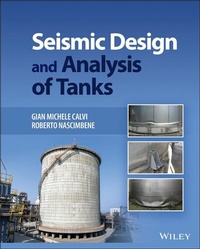
Seismic Design and Analysis of Tanks
Description

A detailed view on the effects of seismic activity on tank structures
As the use of above-ground and underground storage tanks (ASTs and USTs) continues to grow--with approximately 545,000 in the USA alone--the greatest threat to ASTs and USTs is earthquakes, causing the contamination of groundwater, a vital source of drinking water throughout the world. These tanks suffer a great deal of strain during an earthquake, as a complicated pattern of stress affects them, such that poorly designed tanks have leaked, buckled, or even collapsed during seismic events. Furthermore, in oil and gas industrial plants, the risk of damage is even more critical due to the effects of explosion, collapse, and air or soil contamination by chemical fluid spillages.
Seismic Design and Analysis of Tanks provides the first in-depth discussion of the principles and applications of shell structure design and earthquake engineering analyses focused on tank structures, and it explains how these methodologies can help prevent the destruction of ASTs and USTs during earthquakes. Providing a thorough examination of the design, analysis, and performance of steel, reinforced concrete, and precast tanks, this book takes a look at tanks that are above-ground, underground, or elevated, anchored and unanchored, and rigid or flexible, and evaluates the efficacy of each method during times of seismic shaking--and it does so without getting bogged down in impenetrable mathematics and theory.
Seismic Design and Analysis of Tanks readers will also find:
* A global approach to the best analytical and practical solutions available in each region:
* discussion of the latest US codes and standards from the American Society of Civil Engineers (ACSE 7), the American Concrete Institute (ACI 350,3, 371.R), the American Water Works Association (AWWA D100, D110, D115), and the American Petroleum Institute (API 650)
* an overview of the European codes and standards, including Eurocode 8-4 and CEN-EN 14015
* Hundreds of step-by-step equations, accompanied by illustrations
* Photographs illustrating real-world damage to tanks caused by seismic events
Perfect for practising structural engineers, geotechnical engineers, civil engineers, and engineers of all kinds who are responsible for the design, analysis, and performance of tanks and their foundations--as well as students studying engineering--Seismic Design and Analysis of Tanks is a landmark text, the first work of its kind to deal with the seismic engineering performance of all types of storage tanks.
More details
Other editions
Additional editions
Persons
Gian Michele Calvi, PhD, is a Full Professor of Structural Engineering at the IUSS Pavia, Italy, and Adjunct Professor at North Carolina State University, USA, in the Department of Civil, Construction, and Environmental Engineering. He is also the founder of the EUCENTRE Foundation for Training and Research in Earthquake Engineering and is currently the Director of the International Association of Earthquake Engineering.
Roberto Nascimbene, PhD, is an Associate Professor of Structural Engineering at the IUSS Pavia, Italy, and Adjunct Professor at the University of Pavia, Italy, in the Department of Civil Engineering and Architecture. He is also a National Committee Member of the European UNI/CT 021/SC 03 "Steel Structures" and a member of the Project Team SC8.T5 - Evolution of EN 1998-4 and EN 1998-6 "M/515 Phase 3 or 4."
Content
Preface xi
Acknowledgments xiii
Introduction xv
1 Appealing shell structures 1
1.1 Beams and arches . . . . . . . . . . . . . . . . . . . . . . . . . . . 1
1.2 Plates and vaults . . . . . . . . . . . . . . . . . . . . . . . . . . . 6
1.3 Rectangular and cylindrical tanks . . . . . . . . . . . . . . . . . . 12
1.4 Seismic behaviour of tanks . . . . . . . . . . . . . . . . . . . . . 23
1.5 Field observation of damage to tanks induced by seismic events 38
1.6 Design consideration . . . . . . . . . . . . . . . . . . . . . . . . . 48
1.7 A simplified description of seismic response of tanks . . . . . . . 57
1.8 Discussion on existing codes . . . . . . . . . . . . . . . . . . . . . 60
1.9 Content of the book . . . . . . . . . . . . . . . . . . . . . . . . . 66
2 Above ground anchored rigid tanks 67
2.1 Introduction . . . . . . . . . . . . . . . . . . . . . . . . . . . . . . 67
2.2 Circular vertical anchored tanks . . . . . . . . . . . . . . . . . . . 68
2.2.1 Impulsive pressure component . . . . . . . . . . . . . 71
2.2.2 Convective pressure component . . . . . . . . . . . . 81
2.2.3 Effects of vertical component of the seismic action . 89
vii
2.2.4 Effects of tank inertia . . . . . . . . . . . . . . . . . . 92
2.2.5 Periods of vibration . . . . . . . . . . . . . . . . . . . 93
2.2.6 Effects of liquid viscosity . . . . . . . . . . . . . . . . 99
2.2.7 Effects of inhomogeneous liquids . . . . . . . . . . . 102
2.2.8 Convective wave displacement and pressure . . . . . 111
2.2.9 Combination of pressures and behavior factor . . . . 118
2.2.10 Tank forces and stresses . . . . . . . . . . . . . . . . 124
2.2.11 Effects of rocking motion . . . . . . . . . . . . . . . . 131
2.3 Rectangular anchored tanks . . . . . . . . . . . . . . . . . . . . . 136
2.3.1 Impulsive and convective pressure components . . . 136
2.3.2 Periods of vibration . . . . . . . . . . . . . . . . . . . 141
2.3.3 Convective wave displacement . . . . . . . . . . . . . 143
2.3.4 Tank forces and stresses . . . . . . . . . . . . . . . . 143
3 Above ground unanchored rigid tanks 149
3.1 Introduction . . . . . . . . . . . . . . . . . . . . . . . . . . . . . . 149
3.2 Vertical cylindrical tanks . . . . . . . . . . . . . . . . . . . . . . . 153
3.2.1 Axial membrane stress in shell wall . . . . . . . . . . 161
3.2.2 Shell uplift . . . . . . . . . . . . . . . . . . . . . . . . 165
3.2.3 Radial membrane stress at base . . . . . . . . . . . . 167
3.2.4 Plastic rotation at base . . . . . . . . . . . . . . . . . 168
3.3 Rectangular tanks . . . . . . . . . . . . . . . . . . . . . . . . . . . 170
4 Elevated tanks 175
viii
4.1 Introduction . . . . . . . . . . . . . . . . . . . . . . . . . . . . . . 175
4.2 Single lumped-mass model . . . . . . . . . . . . . . . . . . . . . . 182
4.3 Two uncoupled mass model . . . . . . . . . . . . . . . . . . . . . 186
4.4 Two coupled masses model . . . . . . . . . . . . . . . . . . . . . 190
5 Flexible tanks 201
5.1 Introduction . . . . . . . . . . . . . . . . . . . . . . . . . . . . . . 201
5.2 Impulsive pressure component . . . . . . . . . . . . . . . . . . . . 205
5.2.1 Vertical cylindrical tanks . . . . . . . . . . . . . . . . 205
5.2.2 Rectangular tanks . . . . . . . . . . . . . . . . . . . . 219
5.3 Effects of vertical component of the seismic action . . . . . . . 226
5.4 Periods of vibration . . . . . . . . . . . . . . . . . . . . . . . . . . 231
5.5 Combination of pressures . . . . . . . . . . . . . . . . . . . . . . 246
5.6 Tank forces and stresses . . . . . . . . . . . . . . . . . . . . . . . 255
5.6.1 Vertical cylindrical tanks . . . . . . . . . . . . . . . . 257
5.6.2 Rectangular tanks . . . . . . . . . . . . . . . . . . . . 270
5.7 Effects of rocking motion . . . . . . . . . . . . . . . . . . . . . . 272
6 Other peculiar principles 277
6.1 Introduction . . . . . . . . . . . . . . . . . . . . . . . . . . . . . . 277
6.2 Effects of soil-structure interaction . . . . . . . . . . . . . . . . . 278
6.3 Flow-dampening devices . . . . . . . . . . . . . . . . . . . . . . . 288
6.4 Base-isolation devices . . . . . . . . . . . . . . . . . . . . . . . . 302
6.5 Underground rigid tanks . . . . . . . . . . . . . . . . . . . . . . . 313
ix
6.6 Horizontal tanks . . . . . . . . . . . . . . . . . . . . . . . . . . . . 317
6.7 Conical tanks . . . . . . . . . . . . . . . . . . . . . . . . . . . . . 324
7 General design principles 333
7.1 Introduction . . . . . . . . . . . . . . . . . . . . . . . . . . . . . . 333
7.2 Requirements for steel tanks . . . . . . . . . . . . . . . . . . . . 334
7.2.1 Base plate . . . . . . . . . . . . . . . . . . . . . . . . 335
7.2.2 Sidewall . . . . . . . . . . . . . . . . . . . . . . . . . . 339
7.2.3 Openings . . . . . . . . . . . . . . . . . . . . . . . . . 348
7.2.4 Roof . . . . . . . . . . . . . . . . . . . . . . . . . . . . 353
7.2.5 Foundation . . . . . . . . . . . . . . . . . . . . . . . . 362
7.2.6 Stiffeners . . . . . . . . . . . . . . . . . . . . . . . . . 373
7.2.7 Buckling limit state . . . . . . . . . . . . . . . . . . . 406
7.3 Requirements for concrete tanks . . . . . . . . . . . . . . . . . . 423
7.3.1 Serviceability limit state . . . . . . . . . . . . . . . . 425
7.3.2 Ultimate limit state . . . . . . . . . . . . . . . . . . . 435
7.3.3 Detailing and particular rules . . . . . . . . . . . . . . 436
A Dimensionless design charts 463
A.1 Introduction . . . . . . . . . . . . . . . . . . . . . . . . . . . . . . 463
B Codes, Manuals, Recommendations, Guidelines, Reports 471
B.1 Introduction . . . . . . . . . . . . . . . . . . . . . . . . . . . . . . 471
Bibliography . . . . . . . . . . . . . . . . . . . . . . . . . . . . . . . . . 486
1
Appealing Shell Structures
After reading this chapter you should be able to:
- List the main subsectors and components of a tank's design and analysis
- Explain the function of each element
- Identify the behaviour related to seismic and static performance
1.1 Beams and Arches
The structural design process has traditionally been, and still is, essentially carried out for elements subjected to bending actions (beams and slabs), generally controlled by a flexural behaviour, upon which the design is based. Once flexural resistance has been ensured, these members are verified to prevent excessive deformation or shear failure. In the case of members loaded by a combination of bending moments and axial compressive loads (columns or walls), the preliminary design is often based on the axial component only and the combination with flexural action is then verified (in the case of tanks, bending is sometimes considered just to check the possibility of buckling).
These simplified approaches assume the presence of structural components able to resist either tensile or compressive stresses, such as concrete and steel bars in reinforced concrete elements. The design is thus based on an estimate of the loads to be carried by each member, and subsequently on the design of sections where the maximum resulting bending moment is expected. As an example, consider a beam where the moment acting on a section is estimated as , where is the applied load per unit length, is the length of the element and is a coefficient that depends on the end constraints. This acting moment has to be balanced by a couple, estimated as the result of internal tensile and compressive actions, equal to each other and multiplied by the distance between their approximate points of application to compute a resisting moment.
It is thus quite understandable that in ancient times the material mainly used for roofing systems was timber, combined in boards, joists, beams, and girders with progressively increasing capacity.
The only viable, though more complex, alternative was to resort to an arch, which was able to cover long spans using materials able to resist only compressive actions, such as brick or stone masonry. Though widely applied in ancient times, it was Robert Hooke1 in 1675 who first clearly expressed the basic concept that allows the design of a fully compressed arch. His statement was simple, though very comprehensive: a perfectly compressed arch shall have a shape in reverse and identical to that which a suspended cable would assume under the same load combination. For example, under a uniformly distributed load, the cable would assume a parabolic shape, with an upward concavity and that should be the geometry of a compressed arch, with the concavity oriented downward.
As stated, this conceptual solution does not offer a relevant clue as to how to design an arch when several different load configurations are considered, nor takes into account the effects of abutment constraints, etc. The problem is thus far more complex and, as common in the past (and present) building engineering practice, crucial simplifications were adopted for sizing and preliminary design, e.g. assuming that the horizontal reaction at the abutment () can be approximated by the equation applicable to a three-hinged arch case:
(1.1)where and are the load per unit length and the span length, and represents the height of the arch.
It is interesting to compare an arch and a beam used to span a similar length supporting similar weights. Consider thus a three-hinged arch, assume the horizontal forces are eliminated at the abutments by means of some horizontal tie, and compare it to a beam of equal span, simply supported at both ends, assuming that it is made by an elastic material with a similar behaviour in tension and in compression.
Immediately one notes that the same external moment induced at midspan by the applied loads (, assuming a uniformly distributed load per unit length), must be equilibrated by internal action couples characterized by quite different arms. For the case of an arch, the internal couple results from forces located in the centre of the mass of the arch (compression) and of the tie (tension), while for the case of a elastic beam, they are applied at points located at a distance of two-thirds of the beam height. When a fully plastic response is assumed, and thus a constant value is assumed for both tensile and compressive stresses, the distance between the resultant forces is one half of the section depth (, Figure 1.1(a)). In this case, the beam's internal action would be:
(1.2)Consequently, assuming an identical strength in compression and in tension, , and a given width of the beam section, , the required section depth () could be derived as::
(1.3)For the sake of simplicity, assume now that the arch and the tie are also made with materials with the same compression capacity (the arch) and tensile capacity (the tie). Assuming that both compression and tensile forces will act at the centre of the corresponding element, each force can be derived from Equation (1.1), and consequently the required depth of arch () and tie () would be:
(1.4)Figure 1.1 (a) Three-hinged arch with a uniform load on top; (b) two-hinged parabolic arch and simply supported beam.
Assuming that all considered elements have the same width (), then the depth of the arch and the tie can be computed as a function of the depth of the beam, combining Equations (1.3) and (1.4):
(1.5)It can immediately be verified that for reasonable values of the rise of the arch compared to its span (, e.g. ) and of the height of the beam, compared to its span (, e.g. ), the depth required for the arch and the tie is at least 10 times less than the one required for the beam.
Applying the same uniform load on a two-hinged parabolic arch (as shown in Figure 1.1(b)) and on a simply supported beam with the same span (both with a rectangular section ), the deflection of the arch at the keystone (Point A) and of the beam at midspan (Point B) can be calculated as follows:
(1.6a) (1.6b)The apparent overall stiffness differs by two or three orders of magnitude.
This rather trivial example is just a first case study in which the superiority of curved geometry structures is shown in terms of the required material to obtain similar strength or deformation capacities under gravity loads, when compared to similar structures based on straight geometry. The more complex case of cylindrical vs. rectangular tanks will offer more, possibly not as trivial, evidence.
1.2 Plates and Vaults
As already mentioned, a common technology to cover a rectangular area was based on the properties of timber, a material readily available, easy to work, and structurally attractive. This technology is made by a combination of linear elements, overlaying girders, beams and joists, until reasonable span dimensions are achieved to apply boards of reasonable thickness.
Covering the same area using a single plate would require some homogeneous material capable of carrying shear and bending moments in two directions. Clearly this is feasible, though impossible in practical terms, using a steel plate, but became a viable alternative only with the advent of reinforced concrete. Its potential for an isotropic (or rather orthotropic) behaviour, the possibility of shaping its geometry and tapering its thickness, the separation of the internal elements countering compression and tensile stresses, appear to be an ideal combination to build an efficient horizontal slab.
Consider first a simple comparison between a simply supported beam and a similar one-way slab of indefinite width. The bending moment will be expressed by the same equation, while the slab stiffness will increase because of the hindered transversal dilatation. This effect will be accounted for by a correction factor to be applied to the beam stiffness equal to , where is the Poisson coefficient, in the range of 0.15 for concrete. The correction will thus be in the range of 2% not as relevant.
A much more relevant effect will become evident if comparing a one-way and a two-way response, particularly when the two sides of the slab will not differ much.
Take the example of a simply supported square plate, with a uniform load , and assume an isotropic elastic response (i.e. in the case of concrete, neglecting any cracking phenomenon). In the case of a two-way response, the maximum bending moment and the deflection at the centre of the plate will be calculated as:
(1.7a) (1.7b)where is the side of the plate, its thickness and its flexural stiffness.
Considering the same geometry and the same load, but hinged supports on two opposite sides only, the bending moment and flexural deflection will be those of a simply supported beam (possibly with the minor stiffness correction mentioned above, not applied in the equations):
(1.8a) (1.8b)The values of bending moments and deflection calculated for the beam are thus approximately three times those obtained for the bidirectional plate.
It is easy to observe that a barrel vault sustained by...
