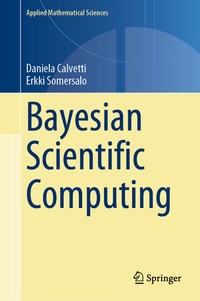
Bayesian Scientific Computing
Description

The once esoteric idea of embedding scientific computing into a probabilistic framework, mostly along the lines of the Bayesian paradigm, has recently enjoyed wide popularity and found its way into numerous applications. This book provides an insider's view of how to combine two mature fields, scientific computing and Bayesian inference, into a powerful language leveraging the capabilities of both components for computational efficiency, high resolution power and uncertainty quantification ability. The impact of Bayesian scientific computing has been particularly significant in the area of computational inverse problems where the data are often scarce or of low quality, but some characteristics of the unknown solution may be available a priori. The ability to combine the flexibility of the Bayesian probabilistic framework with efficient numerical methods has contributed to the popularity of Bayesian inversion, with the prior distribution being the counterpart of classical regularization. However, the interplay between Bayesian inference and numerical analysis is much richer than providing an alternative way to regularize inverse problems, as demonstrated by the discussion of time dependent problems, iterative methods, and sparsity promoting priors in this book. The quantification of uncertainty in computed solutions and model predictions is another area where Bayesian scientific computing plays a critical role. This book demonstrates that Bayesian inference and scientific computing have much more in common than what one may expect, and gradually builds a natural interface between these two areas.
Reviews / Votes
"The book is presented in a logical order, with good writing style. One of the notable features is that the topics are well illustrated with graphs and figures." (John Masson Noble, Mathematical Reviews, September, 2024)
More details
Other editions
Additional editions