

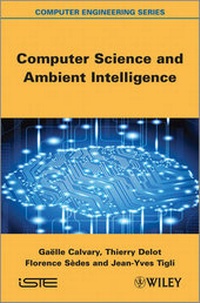
Computer Science and Ambient Intelligence
Published on 24. January 2013
352 pages
978-1-118-57820-9 (ISBN)
Description

This book focuses on ambient intelligence and addresses various issues related to data management, networking and HCI in this context. Taking a holistic view, it covers various levels of abstraction, ranging from fundamental to advanced concepts and brings together the contributions of various specialists in the field.
Moreover, the book covers the key areas of computer science concerned with the emergence of ambient intelligence (e.g. interaction, middleware, networks, information systems, etc.). It even goes slightly beyond the borders of computer science with contributions related to smart materials and ethics. The authors cover a broad spectrum, with some chapters dedicated to the presentation of basic concepts and others focusing on emerging applications in various fields such as health, transport and tourism.
More details
Other editions
Additional editions
Gaelle Calvary | Thierry DELOT | Florence Sedes
Computer Science and Ambient Intelligence
Book
12/2012
1st Edition
Wiley-ISTE
€206.42
Shipment within 15-20 days
Persons
Gaelle Calvary is Professor in Computer Science at the Ensimag software engineering school of the Grenoble Institute of Technology, Grenoble, France.
Thierry Delot is Associate professor, University of Valenciennes, France.
Florence Sèdes is Professor, Université Paul Sabatier, Toulouse, France.
Jean-Yves Tigli is Associate professor, University of Nice Sophia Antipolis - France.
Thierry Delot is Associate professor, University of Valenciennes, France.
Florence Sèdes is Professor, Université Paul Sabatier, Toulouse, France.
Jean-Yves Tigli is Associate professor, University of Nice Sophia Antipolis - France.
Content
- Intro
- Title Page
- Contents
- Preface
- Chapter 1. Ambient Intelligence: Science or Fad?
- 1.1. Ambient intelligence: still young at 20 years
- 1.2. A step forward in the evolution of informatics
- 1.2.1. Fifty years ago: the computer as an isolated critical resource
- 1.2.2. Thirty years ago: the user at the center of design
- 1.2.3. The past decade: combining physical, social, and digital worlds
- 1.3. Extreme challenges
- 1.3.1. Multi-scale
- 1.3.2. Heterogeneity
- 1.3.3. Dynamic adaptation
- 1.4. Conclusion
- 1.5. Bibliography
- Chapter 2. Thinking about Ethics
- 2.1. Ethics and fundamental rights
- 2.2. Ethics and values
- 2.3. Ethics and future perspectives
- 2.4. Bibliography
- Chapter 3. Sensor Networks
- 3.1. MAC layers for wireless sensor networks
- 3.1.1. Challenges atMAClevel
- 3.1.2. Energy consumption
- 3.1.3. Parameters for evaluating a MAClayer
- 3.1.4. MAC Protocols
- 3.2. Topology control
- 3.2.1. Range adjustment
- 3.2.2. Spanning
- 3.3. Routing
- 3.3.1. Broadcast
- 3.3.2. Classic routing
- 3.3.3. Geographic routing
- 3.4. Deployment of sensor networks
- 3.4.1. Knowing the hardware
- 3.4.2. Development process
- 3.4.3. Ensuring stability
- 3.4.4. Preparing for deployment
- 3.5. Bibliography
- Chapter 4. Smart Systems, Ambient Intelligence and Energy Sources: Current Developments and Future Applications
- 4.1. Introduction
- 4.2. Did you say "smart systems"?
- 4.2.1. Smart materials
- 4.2.2. Sensors and actuators
- 4.2.3. Command and control unit
- 4.2.4. Managing data and security
- 4.3. Energy harvesting2
- 4.3.1. Initial applications
- 4.3.2. Second generation
- 4.3.3. Managing systems, processes and energy
- 4.4. Wearable computers and smart fibers
- 4.5. Other applications
- 4.6. Conclusion
- 4.7. Bibliography
- Chapter 5. Middleware in Ubiquitous Computing
- 5.1. Middleware
- 5.2. Development of middleware with new computer environments
- 5.2.1. Distribution
- 5.2.2. Mobility
- 5.2.3. Context awareness and adaptation
- 5.2.4. Ubiquitous computing
- 5.3. Main properties of middleware in ubiquitous computing
- 5.3.1. Heterogeneity and interoperability
- 5.3.2. Scalability
- 5.3.3. Mobility
- 5.3.4. Variability, unpredictability, extensibility, and spontaneous interactions
- 5.3.5. Dynamic adaptation
- 5.3.6. Context awareness
- 5.3.7. Security
- 5.3.8. Adapted and controlled response times
- 5.4. Bibliography
- Chapter 6. WComp, Middleware for Ubiquitous Computing and System Focused Adaptation
- 6.1. Service infrastructure in devices
- 6.1.1. Interoperability
- 6.1.2. Event communication
- 6.1.3. Appearance and disappearance
- 6.1.4. Decentralized dynamic discovery
- 6.1.5. WSOAD
- 6.2. Dynamic service composition
- 6.2.1. Composition of services for devices: LCA
- 6.2.2. Distributed composition: SLCA
- 6.3. Dynamic adaptation of applications to variations in their infrastructure
- 6.3.1. The principles of AOPs
- 6.3.2. Transverse adaptation
- 6.3.3. Summary
- 6.4. Bibliography
- Chapter 7. Data Access and Ambient Computing
- 7.1. Introduction
- 7.2. General context
- 7.2.1. Devices
- 7.2.2. Communication
- 7.2.3. Mobility
- 7.3. Types of queries
- 7.3.1. Location queries
- 7.3.2. Continuous queries
- 7.4. Data access models
- 7.4.1. The Pull model
- 7.4.2. The Push model
- 7.5. Query optimization
- 7.6. Sensitivity to context
- 7.7. Conclusion
- 7.8. Bibliography
- Chapter 8. Security and Ambient Systems: A Study on the Evolution of Access Management in Pervasive Information Systems
- 8.1. Introduction
- 8.2. Managing access in pervasive information systems
- 8.2.1. Basic access control models
- 8.2.2. Managing service-oriented access: the XACML standard
- 8.3. The evolution of context-aware RBAC models
- 8.3.1. Examples of context-aware models
- 8.3.2. Summary
- 8.4. Conclusion
- 8.5. Bibliography
- Chapter 9. Interactive Systems and User-Centered Adaptation: The Plasticity of User Interfaces
- 9.1. Introduction
- 9.2. The problem space of UI plasticity
- 9.2.1. Plasticity and elasticity
- 9.2.2. Adaptation capacity and its problem space
- 9.2.3. Context of use
- 9.2.4. Meta-UI and user control
- 9.2.5. Utility, usability and value
- 9.2.6. Summary
- 9.3. The CAMELEON reference framework for rational development of plastic UI
- 9.3.1. Relationships between models
- 9.3.2. Development process
- 9.4. The CAMELEON-RT run time infrastructure
- 9.4.1. Functional decomposition of CAMELEON-RT
- 9.4.2. Situation identifier
- 9.4.3. Evolution engine
- 9.4.4. Component manager
- 9.4.5. Adaptation producer
- 9.5. Our principles for implementing plasticity
- 9.6. Conclusion: lessons learned and open challenges
- 9.7. Appendices
- 9.7.1. There is plasticity and there is plasticity!
- 9.7.2. Implementation tools
- 9.8. Bibliography
- Chapter 10. Composition of User Interfaces
- 10.1. Problem
- 10.2. Case study
- 10.2.1. Description of the available services
- 10.2.2. Examples of services built by composition
- 10.3. Issues
- 10.4. State of the art in UI composition
- 10.4.1. Composition: a shared concern
- 10.4.2. UIs composition
- 10.4.3. The development process of UIs
- 10.4.4. Generation of UIs
- 10.4.5. Plasticity of UIs
- 10.4.6. Summary of the state of the art in UI composition
- 10.5. Two examples of approaches
- 10.5.1. Composition driven by the UI and the context of use: Compose
- 10.5.2. A resolution driven by the functional core: Alias
- 10.6. Key statements and propositions
- 10.7. Bibliography
- Chapter 11. Smart Homes for People Suffering from Cognitive Disorders
- 11.1. Introduction
- 11.2. The impact of cognitive disorders on society
- 11.2.1. Cognitive deficits have high human, social and economic costs
- 11.2.2. Cognitive assistance and remote monitoring: a source of hope
- 11.3. Cognitive disorders, relevant clients and research at DOMUS
- 11.3.1. Manifestations of cognitive difficulties in affected people
- 11.3.2. Fostering autonomy and aging in place
- 11.3.3. Accompanying caregivers
- 11.4. The objectives of the research program conducted at DOMUS
- 11.4.1. Benefits for individuals and society
- 11.4.2. Transforming the habitat of people with cognitive deficits
- 11.4.3. Building bridges between research, practice and users
- 11.5. Pervasive computing and ambient intelligence
- 11.6. An integrated and interdisciplinary approach to research
- 11.6.1. Guidelines and ethical lines that should not be crossed
- 11.6.2. Multidisciplinary solutions
- 11.6.3. Leaving the laboratory to evaluate, validate and transfer solutions
- 11.6.4. A concrete example of the research approach applied at DOMUS
- 11.7. Transforming a residence into an intelligent habitat
- 11.8. Research activities
- 11.8.1. Cognitive ortheses and remote monitoring
- 11.8.2. Cognitive assistance in the home
- 11.8.3. Cognitive assistance outside the home
- 11.8.4. Remote monitoring and organization of work between caregivers
- 11.8.5. The interactive AMELIS calendar: portal to an intelligent habitat
- 11.8.6. Accompanied social networking
- 11.8.7. Risk detection
- 11.8.8. Ambient intelligence: ubiquity, activity recognition and context awareness
- 11.8.9. Advanced user interfaces
- 11.8.10. Medical monitoring: gathering ecological data and physiological data
- 11.8.11. Cognitive modeling and personalization
- 11.8.12. Heterogeneous networks, distributed systems and use in real life
- 11.8.13. Identification, localization, simulation and artificial intelligence
- 11.8.14. Private life, security and reliability
- 11.8.15. Design and ergonomics
- 11.8.16. Clinical studies, usability studies
- 11.9. Conclusion
- 11.10. Bibliography
- Chapter 12. Pervasive Games and Critical Applications
- 12.1. Introduction
- 12.2. Pervasive games
- 12.2.1. "PSM: the game where you are the network"
- 12.3. Critical ubiquitous applications
- 12.3.1. Distributed black box
- 12.3.2. Safeguarding heritage
- 12.3.3. Summary
- 12.4. Conclusion
- 12.5. Bibliography
- Chapter 13. Intelligent Transportation Systems
- 13.1. Introduction
- 13.2. Software architecture
- 13.2.1. For what sort of applications?
- 13.2.2. Importance of the context
- 13.2.3. Services provided by the platform
- 13.2.4. Example of a platform
- 13.3. Dedicated transportation services and mode of communication
- 13.3.1. Transportation-oriented services that use an infrastructure
- 13.3.2. Exchange services between vehicles
- 13.4. Public transportation services
- 13.4.1. ICAU
- 13.4.2. Internet access on trains
- 13.5. Conclusion
- 13.6. Bibliography
- Chapter 14. Sociotechnical Ambient Systems: From Test Scenario to Scientific Obstacles
- 14.1. Introduction
- 14.2. Definitions and characteristics
- 14.3. Real-life scenario: Ambient Campus
- 14.4. Intuitive architectures
- 14.4.1. The building blocks of the Ambient Campus scenario
- 14.4.2. Limitations of simplistic infrastructures
- 14.4.3. Context and role bubbles
- 14.5. Scientific challenges
- 14.5.1. AmID
- 14.5.2. Network level
- 14.5.3. Middleware level
- 14.5.4. User service level
- 14.6. Conclusion
- 14.7. Acknowledgments
- 14.8. Bibliography
- List of Authors
- Index
