

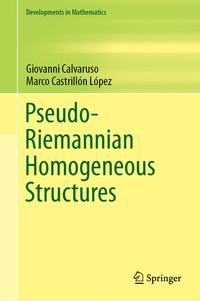
Pseudo-Riemannian Homogeneous Structures
Description

This book provides an up-to-date presentation of homogeneous pseudo-Riemannian structures, an essential tool in the study of pseudo-Riemannian homogeneous spaces. Benefiting from large symmetry groups, these spaces are of high interest in Geometry and Theoretical Physics.
Since the seminal book by Tricerri and Vanhecke, the theory of homogeneous structures has been considerably developed and many applications have been found. The present work covers a gap in the literature of more than 35 years, presenting the latest contributions to the field in a modern geometric approach, with special focus on manifolds equipped with pseudo-Riemannian metrics.
This unique reference on the topic will be of interest to researchers working in areas of mathematics where homogeneous spaces play an important role, such as Differential Geometry, Global Analysis, General Relativity, and Particle Physics.
Reviews / Votes
"There are several reasons to read this book. One is to have a modern point of view for the study of homogeneous structures with a special attention on holonomy. Both classical and recent results are presented and this aspect will lead the reader to a better perception of these notions. Another reason to have this book on the reading list is that it is self-contained and describes the notions to everybody having a basic knowledge of smooth manifolds, Lie groups and theory of representations." (Marian Ioan Munteanu, zbMATH 1437.53002, 2020)
More details
Other editions
Additional editions
Persons
Giovanni Calvaruso is Professore Associato at the Università del Salento. His research is in pseudo-Riemannian Geometry, with a particular focus on homogeneity questions.
Marco Castrillón López is Profesor Titular de Universidad at the Universidad Complutense de Madrid. His research is at the interface between Differential Geometry and Theoretical Physics, mainly in the context of Classical Field Theories.
