

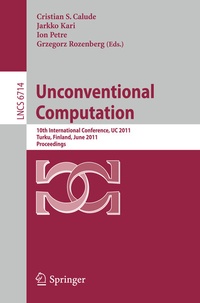
Unconventional Computation
10th International Conference, UC 2011, Turku, Finland, June 6-10, 2011. Proceedings
Published on 12. June 2011
X, 247 pages
978-3-642-21341-0 (ISBN)
Description

This book constitutes the refereed proceedings of the 10th International Conference on Unconventional Computation, UC 2011, held in Turku, Finland, in June 2011. The 17 revised full papers presented together with 6 extended abstracts of invited talks, and 3 extended abstracts of tutorials were carefully reviewed and selected from 33 initial submissions. The papers are devoted to all aspects of unconventional computation theory as well as experiments and applications. Typical topics are: natural computing including quantum, cellular, molecular, membrane, neural, and evolutionary computing, as well as chaos and dynamical system-based computing, and various proposals for computational mechanisms that go beyond the Turing model.
More details
Other editions
Additional editions
Cristian S. Calude | Jarkko Kari | Ion Petre
Unconventional Computation
10th International Conference, UC 2011, Turku, Finland, June 6-10, 2011. Proceedings
Book
05/2011
Springer
€53.49
Shipment within 7-9 days
Content
- Title Page
- Preface
- Organization
- Table of Contents
- Invited Lectures and Tutorials
- The Logic and Topology of Non-locality and Contextuality
- A Framework for Multiscale and Multiscience Modeling and Numerical Simulations
- Introduction
- The Complex Automata Approach
- The Scale Separation Map
- Submodel Execution Loop and Coupling Templates
- Conclusion
- References
- Unconventional Optimizer Development
- A Formal Framework for Bioprocesses in Living Cells
- Quantum Information - A Tutorial
- Introduction
- Bell Inequalities
- Von Neumann and Shannon Entropy
- Quantum Cryptography
- References
- Weighted Finite Automata: Computing with Different Topologies
- Introduction
- Preliminaries
- Computing the Parabola
- A Monster Function
- References
- Tutorial on Cellular Automata
- References
- Membrane Computing at Twelve Years(Back to Turku)
- References
- Membrane Computing (Tutorial)
- References
- Regular Contributions
- Von Neumann Normalisation and Symptoms of Randomness: An Application to Sequences of Quantum Random Bits
- Introduction
- Notation
- Von Neumann Normalisation
- Infinite Von Neumann Normalisation
- Role of Probability Spaces for QRNGs
- Conclusions
- References
- Robustness of Cellular Automata in the Light of Asynchronous Information Transmission
- Introduction
- Asynchronous Cellular Automata
- Cellular Automata
- Asynchronism as a Disruption of Cell Activity
- Models studied
- Qualitative observations
- The Game of Life
- Elementary Cellular Automata
- Study of Phase Transitions
- The Game of Life
- Elementary Cellular Automata
- Discussion
- References
- Hidden Variables Simulating Quantum Contextuality Increasingly Violate the Holevo Bound
- Introduction
- Language Defined by the Experiment
- The Experiment
- The Formal Language
- Hidden Variables and the Holevo Bound
- Memory-Factoring Abstract Generating Automata
- A Lower Bound for the Peres-Mermin Square
- Scaling
- References
- Can Anything from Noether's Theorem Be Salvaged for Discrete Dynamical Systems?
- Introduction
- Energy Conservation
- Noether's Theorem
- The Ising Playground
- Why Call It Energy?
- Additivity
- Generator of the Dynamics
- Raising the Kinematics Bar
- Space- and Time-Dependent Dynamics
- Conclusions
- References
- On Normal Forms for Networks of Evolutionary Processors
- Introduction
- Definitions
- Simplifying the Filters
- Transformations into (Weak) Normal Form
- References
- Geometrical Accumulations and Computably Enumerable Real Numbers
- Introduction
- Definitions
- Abstract Geometrical Computation
- c.e. and d-c.e. Real Numbers
- Only (d-)c.e. Coordinates
- Controlled Shrinking Structure
- Control/Inner Structure
- Outer Structure
- Controls for d-c.e.
- Accumulating at a c.e. Time
- Accumulating at a d-c.e. Spatial Position
- Conclusion
- References
- Heterotic Computing
- Introduction
- Motivating Examples
- Cluster State Computing
- Classical NMR Computing
- Heterotic Framework
- Computational Framework
- Semantic Framework
- Refinement Framework
- NMR Computing within the Framework
- Classical NMR Variables
- Analysis of Classical and Quantum Layers in NMR Computation
- Stressing the Framework with Continuous Variable Computing
- Discussion and Conclusions
- References
- A Formal Approach to Unconditional Security Proofs for Quantum Key Distribution
- Introduction
- Preliminaries
- Automation of the Transformation Step
- Quantum Programming Language
- Formalization of BB84
- Rewriting Rules
- Properties of the Rewriting System
- Protocol Rules
- Formal Verification of EDP-Based Protocol
- Quantum Hoare Logic
- Formal Verification in the Quantum Hoare Logic
- Discussion
- Related Work
- Conclusion
- References
- Geometric Computations by Broadcasting Automata on the Integer Grid
- Introduction
- Broadcasting Automata Model on Z^2
- Computational Primitives for Broadcasting Automata
- Nodal Patterns of Discrete Interference
- Nodal Patterns with Two Sequential Transmitters
- Geometric Problems on the Digital Disc
- Conclusion and Discussion
- References
- Computations with Uncertain Time Constraints: Effects on Parallelism and Universality
- Introduction
- Dynamic Time Constraints
- Background
- Dynamic Time Requirements on Data Acquisition
- Dynamic Time Requirements on Data Output
- Conclusion
- References
- BFS Solution for Disjoint Paths in P Systems
- Introduction
- Preliminary
- Disjoint Paths
- Disjoint Paths in P Systems
- Distributed BFS-Based Strategy
- Rules for Edge-Disjoint Paths
- Rules for Node-Disjoint Paths
- Performance of BFS-Based Solutions
- Conclusions
- References
- The Key Elements of Logic Design in Ternary Quantum-Dot Cellular Automata
- Introduction
- tQCA Overview
- The Functionally Complete Set
- Implementation of the tQCA Characteristic Functions
- Conclusion
- References
- A Universal Flying Amorphous Computer
- Introduction
- Flying Amorphous Computer
- Simulation
- Setup
- Communication
- Conclusion
- References
- Computation with Narrow CTCs
- Introduction
- Preliminaries
- Our Model
- Postselection and Narrow CTCs
- Weak Deterministic Models with Narrow CTCs
- Concluding Remarks and Open Questions
- References
- Extended Watson-Crick L Systems with Regular Trigger Languages
- Introduction
- Preliminaries
- Uni-transitional Watson-Crick E0L systems
- Construction
- Proof of Language Equivalence
- Weak Derivation Watson-Crick E0L Systems
- Watson-Crick ET0L Systems with Bounded Complementary Transitions
- References
- Computing with Planar Toppling Domino Arrangements
- Introduction
- Previous Work
- Challenges
- Domino Interactions and Boolean Algebra
- One Way Line
- Single Line Crossover
- Both Mechanism
- Dual-Rail Boolean Algebra
- Logic Functions and Planar Crossover
- Conclusion
- References
- Increasing Fault-Tolerance in Cellular Automata-Based Systems
- Introduction
- Cellular Automata
- General Description of Cellular Automata
- Notable Inherent Properties and Problems
- Fault-Tolerance in Cellular Automata
- Proposed Approach
- The Experiments
- The Benchmark Problems
- The Experimental Setup
- Results
- Conclusion
- References
- Author Index
