

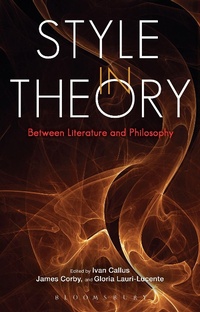
Style in Theory
Between Literature and Philosophy
1st Edition
Published on 6. December 2012
288 pages
978-1-4411-5900-7 (ISBN)
Description

'What, in theory, is style? How has style been rethought in literary theory?'
Drawing together leading academics working within and across the disciplines of English, philosophy, literary theory, and comparative literature, Style in Theory: Between Philosophy and Literature sets out to rethink the important but all-too-often-overlooked issue of style, exploring in particular how the theoretical humanities open conceptual spaces that afford and encourage reflection on the nature of style, the ways in which style is experienced and how style allows disciplinary boundaries to be both drawn and transgressed.
Offering incisive reflections on style from a diverse and contemporary range of theoretical and methodological perspectives, the essays contained in this volume critically revisit and challenge accepted accounts of style, and provide fresh and compelling readings of the relevance in any rethinking of style of specific works by the likes of Shakespeare, Petrarch, Kant, Nietzsche, Heidegger, Deleuze, Blanchot, Derrida, Nancy, Cixous and Meillassoux.
Drawing together leading academics working within and across the disciplines of English, philosophy, literary theory, and comparative literature, Style in Theory: Between Philosophy and Literature sets out to rethink the important but all-too-often-overlooked issue of style, exploring in particular how the theoretical humanities open conceptual spaces that afford and encourage reflection on the nature of style, the ways in which style is experienced and how style allows disciplinary boundaries to be both drawn and transgressed.
Offering incisive reflections on style from a diverse and contemporary range of theoretical and methodological perspectives, the essays contained in this volume critically revisit and challenge accepted accounts of style, and provide fresh and compelling readings of the relevance in any rethinking of style of specific works by the likes of Shakespeare, Petrarch, Kant, Nietzsche, Heidegger, Deleuze, Blanchot, Derrida, Nancy, Cixous and Meillassoux.
Reviews / Votes
Does style matter? It is a question that goes right to the heart of the traditionally fraught relationship between literature and philosophy. Style in Theory: Between Literature and Philosophy is an important and timely collection of essays that answers this question with an emphatic and compelling 'yes'. Offering an impressive range of profound and engaging reflections on the question of style in its various literary and philosophical manifestations, Style in Theory shows us why we ought to be thinking about style differently. [T]he volume makes a valuable contribution to the study of style at the intersection of literature and philosophy. Summing Up: Recommended. Graduate students and researchers/faculty. * CHOICE *More details
Edition
1. Auflage
Language
English
Place of publication
New York
United States
Publishing group
Bloomsbury Publishing PLC (Digital)
ISBN-13
978-1-4411-5900-7 (9781441159007)
Copyright in bibliographic data and cover images is held by Nielsen Book Services Limited or by the publishers or by their respective licensors: all rights reserved.
Schweitzer Classification
Other editions
Additional editions
Book
01/2013
Bloomsbury Academic USA
€48.50
Shipment within 15-20 days
Persons
Gloria Lauri-Lucente is Director of the Institute of Anglo-Italian Studies, Head of the Department of Italian and Deputy Dean of the Faculty of Arts at the University of Malta, Malta.
Content
Acknowledgements
Notes on Contributors
Introduction: 'Style in Theory and Practice: Literature, Philosophy, and Writing the Space Between' Ivan Callus, James Corby, Gloria Lauri-Lucente
1. Style in Theory - Styling Theory Jean-Michel Rabate (University of Pennsylvania)
2. Style in Deconstruction Laurent Milesi (Cardiff University)
3. Style and History in Diderot and Winckelmann Saul Anton (The New School & Pratt)
4. Petrarch and the Birth of Style Gloria Lauri-Lucente (University of Malta)
5. Style, Rhetoric and Identity in Shakespearean Soliloquy Stuart Sillars (University of Bergen)
6. Theory ... For Life Stefan Herbrechter (Coventry University)
7. Style is the Man: Meillassoux, Heidegger and Finitude James Corby (University of Malta)
8. Style and Arrogance: The Ethics of Heidegger's Style Chris Muller (Cardiff University)
9. Nietzsche, Style, Body Douglas Burnham (Staffordshire University)
10. Style in communication: The Hip Swing of Helio Oiticica's Parangoles Fiona Hughes (University of Essex)
11. Writing without (Re)Styl(e)(ing) : Helene Cixous on the Path of Error Janice Sant (Cardiff University)
12. Deleuze or the V-Effect: Philosophy on a Mobile Cusp Marie-Dominique Garnier (Universite de Paris-8 Vincennes-a-St-Denis)
13. 'This song to come, this reader to become': Reading Blanchot's Style of Paradox in 'Rene Char' Mario Aquilina (Durham University)
14. Learning to Style Finally: Lateness in Theory Ivan Callus (University of Malta)
Afterword Giuseppe Mazzotta (Yale)
Notes
Bibliography
Index
Notes on Contributors
Introduction: 'Style in Theory and Practice: Literature, Philosophy, and Writing the Space Between' Ivan Callus, James Corby, Gloria Lauri-Lucente
1. Style in Theory - Styling Theory Jean-Michel Rabate (University of Pennsylvania)
2. Style in Deconstruction Laurent Milesi (Cardiff University)
3. Style and History in Diderot and Winckelmann Saul Anton (The New School & Pratt)
4. Petrarch and the Birth of Style Gloria Lauri-Lucente (University of Malta)
5. Style, Rhetoric and Identity in Shakespearean Soliloquy Stuart Sillars (University of Bergen)
6. Theory ... For Life Stefan Herbrechter (Coventry University)
7. Style is the Man: Meillassoux, Heidegger and Finitude James Corby (University of Malta)
8. Style and Arrogance: The Ethics of Heidegger's Style Chris Muller (Cardiff University)
9. Nietzsche, Style, Body Douglas Burnham (Staffordshire University)
10. Style in communication: The Hip Swing of Helio Oiticica's Parangoles Fiona Hughes (University of Essex)
11. Writing without (Re)Styl(e)(ing) : Helene Cixous on the Path of Error Janice Sant (Cardiff University)
12. Deleuze or the V-Effect: Philosophy on a Mobile Cusp Marie-Dominique Garnier (Universite de Paris-8 Vincennes-a-St-Denis)
13. 'This song to come, this reader to become': Reading Blanchot's Style of Paradox in 'Rene Char' Mario Aquilina (Durham University)
14. Learning to Style Finally: Lateness in Theory Ivan Callus (University of Malta)
Afterword Giuseppe Mazzotta (Yale)
Notes
Bibliography
Index
