
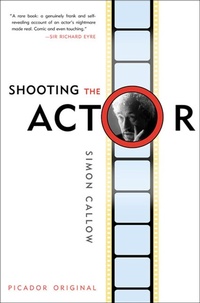
Shooting the Actor
Description
Alles über E-Books | Antworten auf Fragen rund um E-Books, Kopierschutz und Dateiformate finden Sie in unserem Info- & Hilfebereich.
When Simon Callow met the Yugoslav film director Dusan Makavejev to discuss his new film Manifesto, they both greatly looked forward to working together. Only months later the two were barely speaking. A companion volume to Being An Actor, Shooting the Actor is a funny and disastrous account of a film made in the former Yugoslavia, together with new essays on film and film acting including Callow's work in Amadeus and Four Weddings and a Funeral. Shooting the Actor reveals more about the process of filmmaking and the highly complex nature of the role of both actor and director than any formal guide could ever provide.
More details
Other editions
Additional editions

Person
In addition to his distinguished career in the theater, Simon Callow has appeared in the films Amadeus, A Room with A View, and Four Weddings and a Funeral. He is also the author of Charles Laughton: A Difficult Actor, Shooting the Actor, and Orson Welles. He lives in London, England.

System requirements
File format: ePUB
Copy protection: Watermark-DRM (Digital Rights Management)
System requirements:
- Computer (Windows; MacOS X; Linux): Use a reading software that can process the file format ePUB: e.g., Adobe Digital Editions or FBReader – both free (see eBook Help).
- Tablet/Smartphone (Android; iOS): Before downloading, install the free app Adobe Digital Editions (see eBook Help).
- E-reader: Bookeen, Kobo, Pocketbook, Sony, Tolino and many more (not Kindle).
The file format ePUB works well for novels and non-fiction books – i.e., „flowing” text without complex layout. On an e-reader or smartphone, line and page breaks automatically adjust to fit the small displays.
This eBook uses Watermark-DRM, a „soft” copy protection. This means that there are no technical restrictions to prevent illegal distribution. However, there is a personalised watermark embedded in the eBook that can be used to identify the purchaser of the eBook in the event of misuse and to provide evidence for legal purposes.
For more information, see our eBook Help page.