

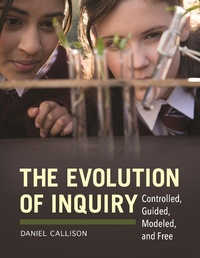
The Evolution of Inquiry
Controlled, Guided, Modeled, and Free
1st Edition
Published on 26. May 2015
272 pages
979-8-216-08205-7 (ISBN)
Description

Defining the progression toward inquiry learning, this book provides an extensive overview of the past five decades and the evolution of inquiry in science, history, language arts, and information literacy studies.
Information inquiry is a basic skill for those who examine information as a science, and its principles can be applied across the K-12 curriculum. Built around reflective reviews of more than two dozen articles from School Library (Media Activities) Monthly, this helpful book shows the evolution, adoption, and application of the inquiry learning process to the school library teaching/learning environment. Four levels of inquiry-controlled, guided, open, and free-are explored in association with the emerging national Common Core curriculum and the Standards for the 21st-Century Learner from the American Association of School Librarians.
With the growing interest in the concept of inquiry and inquiry learning, you may find yourself needing to distinguish between the existing models and their applications. To help you do that, the book provides you with rich, historical context that clarifies the models, and it also projects future applications of inquiry and learner-centered teaching through school information literacy programs. These new applications, such as graphic inquiry, argumentation for inquiry, and the student as information scientist, offer tangible examples you can use to enrich the expanding information literacy curriculum.
Information inquiry is a basic skill for those who examine information as a science, and its principles can be applied across the K-12 curriculum. Built around reflective reviews of more than two dozen articles from School Library (Media Activities) Monthly, this helpful book shows the evolution, adoption, and application of the inquiry learning process to the school library teaching/learning environment. Four levels of inquiry-controlled, guided, open, and free-are explored in association with the emerging national Common Core curriculum and the Standards for the 21st-Century Learner from the American Association of School Librarians.
With the growing interest in the concept of inquiry and inquiry learning, you may find yourself needing to distinguish between the existing models and their applications. To help you do that, the book provides you with rich, historical context that clarifies the models, and it also projects future applications of inquiry and learner-centered teaching through school information literacy programs. These new applications, such as graphic inquiry, argumentation for inquiry, and the student as information scientist, offer tangible examples you can use to enrich the expanding information literacy curriculum.
More details
Edition
1. Auflage
Language
English
Place of publication
New York
United States
Publishing group
Bloomsbury Publishing Plc
Target group
Interest Age: From 7 to 17 years
ISBN-13
979-8-216-08205-7 (9798216082057)
Copyright in bibliographic data and cover images is held by Nielsen Book Services Limited or by the publishers or by their respective licensors: all rights reserved.
Schweitzer Classification
Other editions
Additional editions
Book
05/2015
Libraries Unlimited Inc
€53.20
Shipment within 3-4 weeks
Person
Daniel Callison, EdD, is professor emeritus in school media and instructional systems technology, and dean emeritus in online adult education and distance continuing studies at Indiana University, Bloomington, IN.
Content
CONTENTS
Preface
Acknowledgments
SECTION I: INQUIRY: CONTROLLED, GUIDED, MODELED, AND FREE
Chapter 1 : Key Artifacts Reflecting Progression and Evolution Toward Inquiry
Chapter 2 : Evolution of Controlled Inquiry
Chapter 3: Guided, Modeled, and Mentored Inquiry Enhanced by Cognitive Apprenticeship
Chapter 4: Free Inquiry and Student-Centered Learning
Chapter 5: Various Perceptions of Inquiry
SECTION II: INFORMATION INQUIRY: LEARNING PRACTICES FROM SCHOOL LIBRARY MONTHLY
Bibliography of Inquiry Articles from School Library Monthly 1997û2014
Callison, D. and A. Lamb. "Authentic Learning"
Callison, D. "The Student Information Scientist, Part I"
Callison, D. "The Student Information Scientist, Part 2"
Lamb, A. and D. Callison. "Graphic Inquiry for All Learners"
SECTION III: INFORMATION INQUIRY ACROSS THE CURRICULUM: ARTICLES FROM SCHOOL LIBRARY MONTHLY
Chapter 6: Inquiry in Science and Math
Chapter 7: Inquiry in Language Arts
Chapter 8: Inquiry in History
Chapter 9: Inquiry and the Argument Curriculum
Chapter 10: Inquiry and Communication
SECTION IV: ADDITIONAL RESEARCH REVIEWS
Chapter 11: Challenges & Opportunities for Collaboration, Expanded Roles, and Future Facilities
Chapter 12: Research on Inquiry Learning and Teaching Techniques
Chapter 13: Student Online Searching and Evaluating Information
Chapter 14: A Timeline for the Progression Through Information Literacy to Inquiry
Index
Preface
Acknowledgments
SECTION I: INQUIRY: CONTROLLED, GUIDED, MODELED, AND FREE
Chapter 1 : Key Artifacts Reflecting Progression and Evolution Toward Inquiry
Chapter 2 : Evolution of Controlled Inquiry
Chapter 3: Guided, Modeled, and Mentored Inquiry Enhanced by Cognitive Apprenticeship
Chapter 4: Free Inquiry and Student-Centered Learning
Chapter 5: Various Perceptions of Inquiry
SECTION II: INFORMATION INQUIRY: LEARNING PRACTICES FROM SCHOOL LIBRARY MONTHLY
Bibliography of Inquiry Articles from School Library Monthly 1997û2014
Callison, D. and A. Lamb. "Authentic Learning"
Callison, D. "The Student Information Scientist, Part I"
Callison, D. "The Student Information Scientist, Part 2"
Lamb, A. and D. Callison. "Graphic Inquiry for All Learners"
SECTION III: INFORMATION INQUIRY ACROSS THE CURRICULUM: ARTICLES FROM SCHOOL LIBRARY MONTHLY
Chapter 6: Inquiry in Science and Math
Chapter 7: Inquiry in Language Arts
Chapter 8: Inquiry in History
Chapter 9: Inquiry and the Argument Curriculum
Chapter 10: Inquiry and Communication
SECTION IV: ADDITIONAL RESEARCH REVIEWS
Chapter 11: Challenges & Opportunities for Collaboration, Expanded Roles, and Future Facilities
Chapter 12: Research on Inquiry Learning and Teaching Techniques
Chapter 13: Student Online Searching and Evaluating Information
Chapter 14: A Timeline for the Progression Through Information Literacy to Inquiry
Index
