

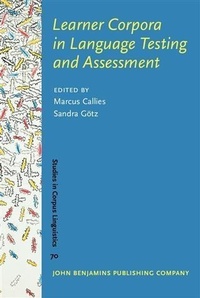
Learner Corpora in Language Testing and Assessment
1st Edition
Published on 15. May 2015
VI, 218 pages
978-90-272-6870-9 (ISBN)
Description

The aim of this volume is to highlight the benefits and potential of using learner corpora for the testing and assessment of L2 proficiency in both speaking and writing, reflecting the growing importance of learner corpora in applied linguistics and second language acquisition research. Identifying several desiderata for future research and practice, the volume presents a selection of original studies, covering a variety of different languages. It features studies that present very thoroughly compiled new corpus resources which are tailor-made and ready for analysis in LTA, new tools for the automatic assessment of proficiency levels, and new methods of (self-)assessment with the help of learner corpora. Other studies suggest innovative research methodologies of how proficiency can be operationalized through learner corpus data. The volume is of particular interest to researchers in (applied) corpus linguistics, learner corpus research, language testing and assessment, as well as for materials developers and language teachers.
More details
Other editions
Additional editions
Marcus Callies | Sandra Goetz
Learner Corpora in Language Testing and Assessment
Book
04/2015
John Benjamins Publishing Co
€95.40
Shipment within 10-15 days
Persons
Content
- Learner Corpora in Language Testing and Assessment
- Editorial page
- Title page
- LCC data
- Table of contents
- Learner corpora in language testing and assessment: Prospects and challenges
- Acknowledgements
- References
- Section I. New corpus resources, tools and methods
- The Marburg Corpus of Intermediate Learner English (MILE)
- 1. Introduction
- 2. Learner corpora in the light of the CEFR
- 2.1 The raw data
- 2.2 The annotation
- 3. MILE - design and compilation
- 4. Conclusion
- References
- Avalingua: Natural language processing for automatic error detection
- 1. Introduction
- 2. Automatic error detection and correction
- 2.1 Previous research
- 2.2 Applications
- 3. Avalingua
- 3.1 Target
- 3.2 Motivations
- 3.3 The system
- 3.3.1 Lexical module
- 3.3.2 Spelling module
- 3.3.3 Syntactic module
- 3.3.4 Language identification
- 3.3.5 Student model
- 4. System evaluation
- 4.1 A specific implementation
- 4.2 The learner corpora
- 4.3 Evaluation protocol
- 4.4 Results
- 4.5 Error analysis and discussion
- 5. Conclusions
- References
- Data commentary in science writing: Using a small, specialized corpus for formative assessment practices
- 1. Background and aims
- 2. Approaching data commentary from a pedagogical perspective: The case for small, specialized corpora annotated for discourse moves in the ESP classroom
- 3. A small, specialized corpus of data commentaries
- 4. The discourse annotation model
- 5. Self-assessment and the role of the corpus
- 5.1 Towards corpus-informed formative self-assessment activities
- 5.1.1 Teacher-designed activities on moves in data commentaries
- 5.1.2 Teacher-designed peer-assessment activities of master's thesis corpus data
- 5.1.3 Teacher- and student-initiated activities involving students' own writing
- 6. Final remarks and outlook
- Acknowledgement
- References
- First steps in assigning proficiency to texts in a learner corpus of computer-mediated communication
- 1. Introduction
- 2. The CMC Learner Corpus
- 2.1 CMC in the classroom
- 2.2 The CMC corpora
- 3. Criteria for assigning proficiency
- 3.1 Following established practice
- 3.2 Practicality and ease of implementation
- 3.3 Reference native-speaker norms
- 4. Method
- 4.1 Performance decision trees
- 4.2 Sequence of PDTs
- 4.3 PDT for accuracy
- 4.4 PDT for fluency
- 4.5 PDT for complexity
- 5. Results
- 5.1 Preliminary results of proficiency ratings
- 5.2 Descriptive statistics
- 5.3 Vocabulary level
- 6. Discussion
- 6.1 Validity of the proficiency measurement tool
- 6.2 PDT proficiency levels and institutional status
- 6.3 PDT proficiency levels and individual variation
- 6.4 Limitations of the proposed measurement tool
- 7. Conclusion
- References
- Appendix
- Section II. Data-driven approaches to the assessment of proficiency
- The English Vocabulary Profile as a benchmark for assigning levels to learner corpus data
- 1. Introduction
- 2. Developmental indices and language proficiency
- 3. The CEFR and reference level descriptions
- 4. The English Profile and criterial features
- 5. The English Vocabulary Profile
- 6. Vocabulary and language proficiency
- 7. The study
- 7.1 Rationale
- 7.2 Data
- 7.3 Tagging
- 7.4 Assigning CEFR levels by raters
- 7.5 Statistical analysis
- 7.6 Results
- 8. Discussion
- 9. Conclusions
- References
- A multidimensional analysis of learner language during story reconstruction in interviews
- 1. Introduction
- 2. Picture-cued story reconstruction in L2 research and assessment
- 2.1 Picture-cued story reconstruction in L2 assessment
- 2.2 Picture-cued story reconstruction in L2 research
- 3. Methodology
- 3.1 Data sets
- 3.2 Method of analysis
- 4. Results
- 4.1 Native speakers
- 4.2 Non-native speakers
- 5. Discussion
- Acknowledgements
- References
- Appendix
- Article use and criterial features in Spanish EFL writing: A pilot study from CEFR A2 to B2 levels
- 1. Introduction
- 2. Measuring and evaluating EFL writing: The article system
- 2.1 Correct and incorrect uses of the article system: Measures
- 2.2 Grouping students according to levels: The article system and the CEFR
- 3. Article use by Spanish EFL learners
- 4. Methodology
- 5. Results and discussion
- 5.1 Article use and misuse: Frequency counts
- 5.1.1 Incorrect uses of the article system: Examples
- 5.2 Accuracy of use of the article system
- 5.2.1 Accuracy of use of the article system: A pseudo-longitudinal analysis
- 5.2.2 Accuracy order of article use: Cross-sectional analyses
- 6. Conclusions
- References
- Tense and aspect errors in spoken learner English: Implications for language testing and assessment
- 1. Introduction
- 2. Developing data-based descriptor scales to assess accuracy in spoken language
- 2.1 From 'can-do- statements' towards learner-corpus-informed descriptions of proficiency levels
- 2.2 Errors and error analysis in LCR
- 2.3 Computer-aided error analysis (CEA)
- 3. LINDSEI-GE, an error-tagged spoken learner corpus
- 4. Findings
- 4.1 Total number of errors
- 4.2 Error categories in the LINDSEI-GE
- 4.3 GVT-related errors as criterial features
- 4.4 Implications for language testing and assessment
- 5. Conclusion and outlook
- References
- Authors
- Subject index
