
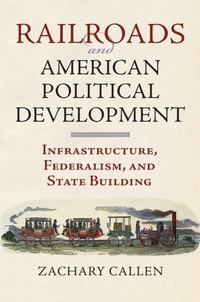
Railroads and American Political Development
Description
Alles über E-Books | Antworten auf Fragen rund um E-Books, Kopierschutz und Dateiformate finden Sie in unserem Info- & Hilfebereich.
America's founders envisioned a federal government of limited and enumerated powers. What they could not envision, of course, was the vast and complex infrastructure that the growing nation would demand?a demand that became ever clearer as the power and importance of railroads emerged. The requirements of a nationwide rail network, it also became clear, far exceeded the resources of state and local government and private industry. The consequences, as seen in this book, amounted to state building from the ground up. In Railroads and American Political Development Zachary Callen tells the story of the federal government's role in developing a national rail system?and the rail system's role in expanding the power of the federal government. The book reveals how state building, so often attributed to an aggressive national government, can also result from local governments making demands on the national state?a dynamic that can still be seen at work every time the US Congress takes up a transportation bill.
Though many states invested in their local railroads, and many quite successfully, others were less willing or less capable?so rail development necessarily became a federal concern. Railroads and American Political Development shows how this led to the Land Grant Act of 1850, a crucial piece of legislation in the building of both the nation's infrastructure and the American state. Chronicling how this previously local issue migrated to the federal state, and how federal action then altered American rail planning, the book offers a new perspective on the exact nature of federalism. In the case of rail development, we see how state governments factor into the American state building process, and how, in turn, the separation of powers at the federal level shaped that process. The result is a fresh view of the development of the American rail system, as well as a clearer picture of the pressures and political logic that have altered and expanded the reach of American federalism.
All prices
More details
Other editions
Additional editions
Person
Content
Acknowledgments
1. The Problem of Federalism and State Building
2. Rail Promotion, Diffusion, and State Inaction
3. Railroads and Interstate Connectivity
4. International Comparison and American Rail Quality
5. Local Limits, Vertical Federalism, and Congressional Intervention
6. Executive Power, the Courts, and National Rail Aid
7. The Impact of Federal Rail Grants on American Railroads
8. Federalism's Role in State Building
Notes
References
Index

System requirements
File format: ePUB
Copy protection: Adobe-DRM (Digital Rights Management)
System requirements:
- Computer (Windows; MacOS X; Linux): Install the free reader Adobe Digital Editions prior to download (see eBook Help).
- Tablet/smartphone (Android; iOS): Install the free app Adobe Digital Editions or the app PocketBook before downloading (see eBook Help).
- E-reader: Bookeen, Kobo, Pocketbook, Sony, Tolino and many more (not Kindle).
The file format ePub works well for novels and non-fiction books – i.e., „flowing” text without complex layout. On an e-reader or smartphone, line and page breaks automatically adjust to fit the small displays.
This eBook uses Adobe-DRM, a „hard” copy protection. If the necessary requirements are not met, unfortunately you will not be able to open the eBook. You will therefore need to prepare your reading hardware before downloading.
Please note: We strongly recommend that you authorise using your personal Adobe ID after installation of any reading software.
For more information, see our ebook Help page.
File format: PDF
Copy-Protection: Adobe-DRM (Digital Rights Management)
System requirements:
- Computer (Windows; MacOS X; Linux): Install the free reader Adobe Digital Editions prior to download (see eBook Help).
- Tablet/smartphone (Android; iOS): Install the free app Adobe Digital Editions or the app PocketBook before downloading (see eBook Help).
- E-reader: Bookeen, Kobo, Pocketbook, Sony, Tolino and many more (only limited: Kindle).
The file format PDF always displays a book page identically on any hardware. This makes PDF suitable for complex layouts such as those used in textbooks and reference books (images, tables, columns, footnotes). Unfortunately, on the small screens of e-readers or smartphones, PDFs are rather annoying, requiring too much scrolling.
This eBook uses Adobe-DRM, a „hard” copy protection. If the necessary requirements are not met, unfortunately you will not be able to open the eBook. You will therefore need to prepare your reading hardware before downloading.
Please note: We strongly recommend that you authorise using your personal Adobe ID after installation of any reading software.
For more information, see our eBook Help page.
File format: ePUB
Copy protection: Watermark-DRM (Digital Rights Management)
System requirements:
- Computer (Windows; MacOS X; Linux): Use a reading software that can process the file format ePUB: e.g., Adobe Digital Editions or FBReader – both free (see eBook Help).
- Tablet/Smartphone (Android; iOS): Before downloading, install the free app Adobe Digital Editions (see eBook Help).
- E-reader: Bookeen, Kobo, Pocketbook, Sony, Tolino and many more (not Kindle).
The file format ePUB works well for novels and non-fiction books – i.e., „flowing” text without complex layout. On an e-reader or smartphone, line and page breaks automatically adjust to fit the small displays.
This eBook uses Watermark-DRM, a „soft” copy protection. This means that there are no technical restrictions to prevent illegal distribution. However, there is a personalised watermark embedded in the eBook that can be used to identify the purchaser of the eBook in the event of misuse and to provide evidence for legal purposes.
For more information, see our eBook Help page.
