

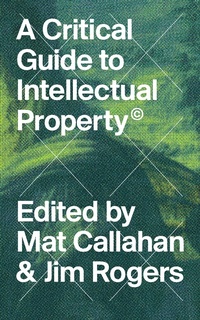
A Critical Guide to Intellectual Property
1st Edition
Published on 15. October 2017
292 pages
978-1-78699-116-4 (ISBN)
Description

Ours is an era when human genes can be copied and patented. From genetically modified foods to digital piracy, the concept of intellectual property (IP) and the laws upholding it play a foundational role in our society, but its political and ideological dimensions have rarely been understood outside of specialist circles. This collection cuts through the legal jargon that so often surrounds IP, to provide both a comprehensive history and analysis that explores the corporate interests that shape its conception and the movements that are developing alternatives.
As the nature of industry changes, we might ask: what are the wider implications of the concept of IP, be it for agribusiness and pharmaceutical companies or the film and music industries? Has IP law has been used to safeguard and assert the ownership of ideas and creativity, or is it an essential foundation of our culture?
Today, with mounting challenges from the growth of free software and open source movements, this collection provides an accessible and alternative guide to IP, exploring its significance within the wider struggle between capital and the commons.
As the nature of industry changes, we might ask: what are the wider implications of the concept of IP, be it for agribusiness and pharmaceutical companies or the film and music industries? Has IP law has been used to safeguard and assert the ownership of ideas and creativity, or is it an essential foundation of our culture?
Today, with mounting challenges from the growth of free software and open source movements, this collection provides an accessible and alternative guide to IP, exploring its significance within the wider struggle between capital and the commons.
Reviews / Votes
Unwraps intellectual property's supposed enigma in an accessible fashion. Power, profits, piracy: all are explored here with real arguments and facts. Provocative. * Alan Story, University of Kent (retd) * Combining analytical and narrative approaches, this book is an excellent way to get to grips with the current political economy of intellectual property. * Christopher May, Lancaster University * The idea of Intellectual Property is, quite literally, an attempt to monopolize ideas. In this exciting volume, the ideological basis of IP is critiqued, and the options for resistance examined. * John Quiggin, University of Queensland * A Critical Guide... is as much a handbook that suggests radical thought and action as it is an intellectuals' guide to intellectual property. * Jonah Raskin, Socialism and Democracy * Callahan and Rogers have put together a critical guide that tells the truth about intellectual property. Everybody should read it. * Peter Drahos, Australian National University *More details
Edition
1. Auflage
Language
English
Place of publication
London
United Kingdom
Publishing group
Bloomsbury Publishing PLC
Target group
College/higher education
Professional and scholarly
ISBN-13
978-1-78699-116-4 (9781786991164)
Copyright in bibliographic data and cover images is held by Nielsen Book Services Limited or by the publishers or by their respective licensors: all rights reserved.
Schweitzer Classification
Other editions
Additional editions
Mat Callahan | Jim Rogers
A Critical Guide to Intellectual Property
Book
10/2017
Zed Books Ltd
€106.66
Article exhausted; check different version
Persons
Mat Callahan is a musician and author. He founded seminal world-beat band, Looters, the artists' collective, Komotion International, and produced the revival of James Connolly's "Songs of Freedom". He's authored four books, Sex, Death and the Angry Young Man (1993); Testimony (2000); The Trouble With Music (2005); and The Explosion of Deferred Dreams (2017).
Jim Rogers is a lecturer in communications at the School of Communications, Dublin City University, Ireland. His research interests centre on the political economy of the media. His first book, The Death and Life of the Music Industry in the Digital Age was published in 2013. Beyond this, his research has been published in a host of international peer-review journals and various edited collections.
Jim Rogers is a lecturer in communications at the School of Communications, Dublin City University, Ireland. His research interests centre on the political economy of the media. His first book, The Death and Life of the Music Industry in the Digital Age was published in 2013. Beyond this, his research has been published in a host of international peer-review journals and various edited collections.
Content
1. Why Intellectual Property? Why Now? - Mat Callahan and Jim Rogers
2. Running Through the Jungle: My Introduction to Intellectual Property - Mat Callahan
Part I: Historical Context and Conceptual Frameworks
3. Intellectual Property Rights and their Diffusion around the World: Towards a Global History - Colin Darch
4. The Political Economy of Intellectual Property - Michael Perelman
5. I Am Because I Own vs. I Am Because We Are - Mat Callahan
Part II: Terrains of Conflict and Terms of Engagement
6. Owning up to Owning Traditional Knowledge of Medicinal Plants - Josef A. Brinckmann
7. Using Human Rights to Move Beyond Reformism to Radicalism: A2K for Schools, Libraries and Archives - Caroline B. Ncube
8. Meet the New Boss, Same as the Old Boss: Copyright and Continuity in the Contemporary Music Economy - Jim Rogers
9. Free Software and Open Source Movements from Digital Rebellion to Aaron Swartz: Responses to Government and Corporate Attempts at Suppression and Enclosure - Paul McKimmy (with a coda by Bob Jolliffe)
Part III: Law, Policy and Jurisdiction
10. Rethinking the World Intellectual Property Organization - Deborah J. Halbert
11. What is Intellectual Property? - Blayne Haggart
12. Piracy, States and the Legitimation of Authority - Mat Callahan
13. Summary and Concluding Remarks - Mat Callahan and Jim Rogers
2. Running Through the Jungle: My Introduction to Intellectual Property - Mat Callahan
Part I: Historical Context and Conceptual Frameworks
3. Intellectual Property Rights and their Diffusion around the World: Towards a Global History - Colin Darch
4. The Political Economy of Intellectual Property - Michael Perelman
5. I Am Because I Own vs. I Am Because We Are - Mat Callahan
Part II: Terrains of Conflict and Terms of Engagement
6. Owning up to Owning Traditional Knowledge of Medicinal Plants - Josef A. Brinckmann
7. Using Human Rights to Move Beyond Reformism to Radicalism: A2K for Schools, Libraries and Archives - Caroline B. Ncube
8. Meet the New Boss, Same as the Old Boss: Copyright and Continuity in the Contemporary Music Economy - Jim Rogers
9. Free Software and Open Source Movements from Digital Rebellion to Aaron Swartz: Responses to Government and Corporate Attempts at Suppression and Enclosure - Paul McKimmy (with a coda by Bob Jolliffe)
Part III: Law, Policy and Jurisdiction
10. Rethinking the World Intellectual Property Organization - Deborah J. Halbert
11. What is Intellectual Property? - Blayne Haggart
12. Piracy, States and the Legitimation of Authority - Mat Callahan
13. Summary and Concluding Remarks - Mat Callahan and Jim Rogers
