

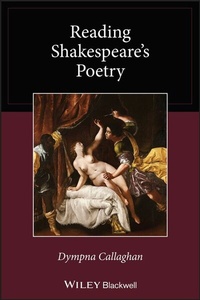
Reading Shakespeare's Poetry
Description

A lively exploration of Shakespeare's poems and how they speak to readers
Reading Shakespeare's Poetry presents a fresh interpretation of Shakespeare's non-dramatic poems, providing insights into the individual poems, their themes and composition, and their relation to the cultural context of Shakespeare's world. Dympna Callaghan considers what makes Shakespeare's language poetic and shows how his poetry is comprised not only of lyrical intensity but also of the language of everyday life.
Presented chronologically, lucidly-written chapters examine Venus and Adonis, Lucrece, The Phoenix and the Turtle, the Sonnets, and A Lover's Complaint. Special attention is paid to the distinctive ways in which lineation, rhyme, verse forms, and meter serve to delineate or erase the boundaries of Shakespeare's poetry. Throughout the book, the author explains how Shakespeare's language is influenced by predecessors such as Ovid and Petrarch while highlighting how ideas about the social and cultural function of poetry permeate Shakespeare's works.
* Offers an eminently readable yet scholarly exploration of the literary importance of Shakespeare's poems
* Explains the technical features of Shakespeare's poetic language
* Addresses the significance of the material form in which Shakespeare's poems appear
* Includes a discussion of songs, poems, and sonnets embedded in Shakespeare's dramatic verse
Reading Shakespeare's Poetry is both a fresh and indispensable guide to the poems and a significant critical intervention. This is a must-have book for scholars, students, and general readers alike.
More details
Other editions
Additional editions
Person
Dympna Callaghan is University Professor and William L. Safire Professor of Modern Letters in the Department of English at Syracuse University and past President of the Shakespeare Association of America. She has authored, edited, and co-edited fourteen books and is the editor of the Arden Shakespeare Language and Writing series, the co-editor of the Palgrave Shakespeare Studies series, and an editor of the Asian Shakespeare Intercultural Archive (A/S/I/A), a collaborative online archive of performance materials.
Content
Acknowledgments viii
Introduction 1
1 Venus and Adonis 25
2 Lucrece 82
3 The Phoenix and the Turtle 129
4 Shakespeare's Sonnets 159
5 A Lover's Complaint 209
Conclusion 240
Bibiography 251
Index 262
1
Venus and Adonis
In Book 4 of Ovid's Metamorphoses, in a rather typical Ovidian scenario, Hermaphroditus is enjoying the feeling of the cool water from a spring on his feet when he decides to take a plunge: "[S]treight he stripped quight/His garments from his tender skin" (IV. 425-6). Seeing "His naked beauty" (IV. 426), the nymph Salmacis is overcome with lust, and even knowing that he has repulsed her on prior occasions, she strips off, jumps in after him, overpowers him, and arguably succeeds in compelling the unresponsive youth to copulate with her against his will:
And therewithal in all post hast she having lightly throwne
Her garments off, flew to the Poole and cast hir thereinto
And caught him fast between her arms, for aught that he could doe:
Yet maugre [in spite of] all his wrestling and his struggling to and fro
She held him still, and kissed him and hundred times and mo[re].
Metamorphoses (4. 441-5)
For many of Shakespeare's rigidly Protestant fellow countrymen, Ovid was salacious, immoral, and a byword for the dangers of poetry itself, and his unapologetically transgressive and erotic stories show why. Ovid was, however, Shakespeare's favorite poet, and the key ingredients of lines quoted above, namely beautiful naked bodies and sexual assault by a woman upon a man, were also major themes of Shakespeare's racy narrative poem, Venus and Adonis, which was first printed as a pamphlet in 1593. That poem concerns the unrequited love of Venus, goddess of love, for the mortal boy, Adonis, and her comically unsuccessful attempts to seduce him before his untimely death in a boar-hunting accident.
Some eight years before Venus and Adonis was published, an outraged Member of Parliament had roundly condemned Ovid's poetry, which was, he complained, "sold openly and read in the schools."1 Ovid's Elizabethan successors too, the MP argued, had with their "idle pamphlets, lewd and wanton discourse of love," caused "the corruption of manners" not to mention "the expense of time" that would otherwise have been spent on reading the scripture and "other good treatise of morality."2 Given the enormous success of Shakespeare's poem it seems clear that the speech did not have the desired effect. However, the oration remains symptomatic of a vehement hostility towards Ovid and to his Elizabethan imitators that persisted through the entire course of the sixteenth century. It is important to acknowledge this moral censure and the politicized opposition to Ovidian poetry because, especially prior to the sea change that was the advent of feminist and new historicist engagement with Shakespeare, earlier twentieth-century criticism tended to dismiss Venus and Adonis as a work of highly polished, but essentially thoughtless frivolity. For example, F.T. Prince, the Arden editor of The Poems (1960), opined that the poem was only valuable in so far as it might shed light on Shakespeare as a playwright: "Nothing else. is likely even now, to win an attentive reading of these poems.Few English or American readers will respond to such happily wanton fancies as Venus and Adonis."3 Another then pervasive line of reasoning claimed that had it not been for the fact that theatres were closed on account of the outbreak of plague, Shakespeare would not have troubled himself to compose Venus and Adonis in 1593 or to seek patronage for it from Henry Wriothesley, third Earl of Southampton. In fact, however, Venus and Adonis represents an eloquent and daring rebuttal to the strict Protestant sexual morality widely promulgated in Elizabethan England. Far from being the casual work of a playwright in the off-season, Venus and Adonis inaugurated a literary career throughout the entire course of which, as Patrick Cheney has definitively demonstrated, non-dramatic poetry remained a vital component.4 Indeed, there is nothing accidental or tangential about Shakespeare's poems.5 We noted in the Introduction that Francis Meres famously observed in Palladis Tamia (1598): "[T]he sweet and witty soul of Ovid lives in mellifluous & honey-tongued Shakespeare, witness his Venus and Adonis."6 However, Shakespeare's readers not only heard a distinctly Ovidian sound in Venus and Adonis, they also witnessed a profoundly Ovidian - and therefore transgressive - poetics. Indeed, in its every line, Venus and Adonis implicitly - and often explicitly - resisted the repressive forces, both social and legal, that sought to contain poetic expression.
*
Ovid
The trouble with Ovid had begun long before the Elizabethans. In his own lifetime, Ovid's poetry provoked imperial displeasure. He was exiled from Rome, on account of carmen et error, a poem and a mistake, and his banishment was probably an attempt on the part of the Emperor Augustus to quash political turbulence. Ovid had also parodied Augustus in the Metamorphoses, and no doubt that was a significant factor leading to his expulsion. However, the official story at the time was that Augustus sought to contain the poet's promotion of sexual indecency in another work, namely the Ars Amatoria, The Art of Love. Fearing that exile was but a prelude to assassination by Augustus's henchmen, in Tristia 2 Ovid responded to the accusations made against him. In that poem, he claims, albeit via a very ingenious reading, that the imperial Aeneid of his lauded predecessor, Vergil, was essentially a poem about adulterous love.7 Thus, Augustus's politically-motivated attempts to curb perceived immorality and to institute the ancestral "family values" of monogamy, chastity, and piety,8 though they occurred centuries before the early modern debate about poetry in England, were nonetheless uncannily mirrored in the more repressive aspects of Elizabethan Protestantism, which were preoccupied with containing Ovidian lubricity.
Ovid's name, then, was almost synonymous with the poetry of sexual transgression, and Shakespeare's first major foray into non-dramatic verse makes his debt to Ovid quite explicit. Indeed, the very first words an Elizabethan reader would have encountered upon opening his 1593 pamphlet were not Shakespeare's own but those of his illustrious Roman predecessor, and what is more they are from Ovid's own poetic debut, the Amores (Love Poems):
Vilia miretur vulgus: mihi flavus Apollo
Pocula Castalia plena ministret aqua.
Let the common herd be amazed by worthless things; but for me let
golden Apollo provide cups full of the water of the Muses,
Amores (1.15.35-6)9
By means of this reference to Apollo, the Roman god of poetry and to the fountain on Mount Parnassus held sacred to Apollo and the Muses, Shakespeare inaugurated a new literary phase in his career. In doing so, he informed his patron, the Earl of Southampton, that Venus and Adonis was "the first heir [offspring] of my invention." The Ovidian epigraph, then, permits him to express rather more lofty aspirations as a writer than those of someone who was merely the "poet" (as playwrights were called) for a public playhouse. Thus, ventriloquizing his Roman forebear, Shakespeare asserts that he has imbibed divine inspiration from the purest and most exalted source. However, he may not be entirely solemn or pious in this declaration. More likely, Shakespeare's use of this epigraph is poised between sincere pronouncement and tongue-in-cheek boast. That tone of comic-seriousness accurately foreshadows the content of the poem itself, suspended as it is between humorous ebullience and somber gravity. Indeed, this is precisely the Ovidian tone - not always serious when solemn - and conversely, often profound when superficially comic and apparently trivial.10
The story the poem tells is a much-expanded version of the account of Venus and Adonis in Book 10 of Ovid's Metamorphoses, which had been translated into English by Arthur Golding in 1567.11 Importantly, while Shakespeare found his inspiration in Ovid, he made key alterations to the story. Shakespeare retains the central metamorphic aspect of his Ovidian source so that Adonis is killed in a boar hunt and transformed into a purple flower, the anemone. However, the focus in Ovid and in all earlier renditions of the story was on the tragic death of Adonis and Venus's consequent bereavement. Instead, Shakespeare devotes the majority of the poem to the courtship, or more accurately, to Venus's sexual harassment of Adonis, whose advances he continually repulses. This reframing of the story constitutes a sharp contrast with the myth as Shakespeare received it in the Metamorphoses where Venus and Adonis are lovers who share a mutual passion for one another and whose only tragedy is that the death of Adonis ends their love story. In the classical rendition of their relationship, its fundamental inequity was not, as it is in Shakespeare, Venus's unrequited love for Adonis, but that Venus was immortal, and Adonis was not. In these circumstances, the deity must, at some...
