

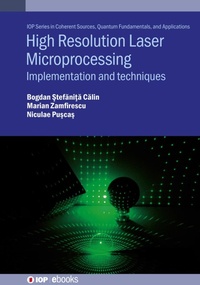
High Resolution Laser Microprocessing
Description

This book explores modern laser-based microprocessing techniques, combining theory with practical guidance on building and operating experimental setups. It begins with an introduction to optics, covering electromagnetic field theory, ray optics, and the Lorentz model. Core laser physics and ultrafast laser systems are discussed, along with hands-on measurement techniques. The book then covers optomechanical systems, including setup, alignment, and control. Advanced laser processing methods such as near-field ablation, two-photon polymerization, and laser-induced periodic surface structures are also presented. To support learning, Python scripts used for simulations and graphs are included, allowing readers to experiment and deepen their understanding of the concepts.
Key features: * Practical approach to university level physics, i.e. this book is a great tool for readers to develop skills in a laboratory environment * Presents and explains new and emerging laser processing technologies that show a growing presence in both the academic and industrial environments * Information presented in the theoretical parts are consistently linked to worked examples * The book contains step-by-step tutorials on how to build experimental set-ups for different applications
More details
Other editions
Additional editions
Persons
Bogdan - ¿tefani¿a Calin is a junior scientific researcher at the Center for Advanced Laser Technologies from the National Institute for Laser, Plasma and Radiation Physics in Magurele, Bucharest, Romania. He received an engineering degree in physical engineering, a master's degree in lasers and particle accelerators engineering, and a PhD in Physics, from University "Politehnica" of Bucharest, Romania. His current field is high resolution laser processing, micro-scale 3D printing and their applications in optics, particle acceleration and tissue engineering.
Marian Zamfirescu is a senior scientific researcher at the Center for Advanced Laser Technologies from the National Institute for Laser, Plasma and Radiation Physics in Magurele, Bucharest, Romania. He received an engineering degree in physical engineering and a master's degree in optics and nonconventional techniques using lasers and plasma, from University of Bucharest, Romania, and a PhD in physics from Blaise-Pascal University from Clermont-Ferrand, France. His scientific research activity is currently dealing with laser spectroscopy and laser micro- and nano-structuring using ultrafast pulsed lasers.
Niculae - Tiberiu Pu¿cä is an emeritus professor at the Department of Physics - University "Politehnica" of Bucharest, Romania. He received a bachelor's degree in physics from University "Babe¿ - Bolyai" of Cluj-Napoca, Romania, and a PhD in physics from University of Bucharest. His teaching and research activities include courses for laser physics and engineering, integrated optics and photonics, optical materials, and 37 research projects.
Content
- Optical physics for laser materials processing
- Principles of laser physics
- Laser systems for materials processing
- Optomechanical systems for laser microprocessing
- Laser-matter interaction for microprocessing
- Applications of high-resolution laser microprocessing
- Python scripts
