
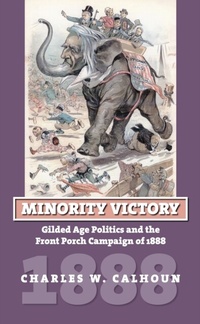
Minority Victory
Description
Alles über E-Books | Antworten auf Fragen rund um E-Books, Kopierschutz und Dateiformate finden Sie in unserem Info- & Hilfebereich.
During the run-up to the 1888 presidential election, Americans flocked to party rallies, marched in endless parades, and otherwise participated zealously in the political process. Although they faced a choice between two uncharismatic candidates?Republican challenger Benjamin Harrison and Democratic incumbent Grover Cleveland?voters took intense interest in the issues they espoused. And though Harrison became one of only four candidates to win the presidency while losing the popular vote, the lasting significance of the election was its foreshadowing of both the modern campaign and the modern presidency.
Charles W. Calhoun shows how this presidential contest not only exemplified Gilded Age politics but also marked a major shift from divisive sectional rhetoric to an emphasis on voters' economic concerns. Calhoun first explores Cleveland's rise to the presidency and explains why he turned to economic issues, especially tariff reduction, in framing his bid for reelection. He then provides a detailed analysis of the raucous Republican national convention and describes Harrison's effective front porch campaign, in which he proclaimed his views almost daily to visiting voters and reporters. Calhoun also explores the role of party organizations, business interests, labor, women, African Americans, and third parties in the campaign; discusses alleged fraud in the election; and analyzes the Democrats' suppression of black votes in the South.
The 1888 campaign marked an important phase in the evolution of American political culture and augured significant innovations in American politics and governance. The Republicans' performance, in particular, reflected the party's future winning strategies: emphasis on economic development, personal participation by the presidential candidate, a well-financed organization, and coordination with beneficiaries of the party's agenda.
Harrison set important precedents for campaigning and then, once in office, fashioned new leadership strategies and governing techniques?emphasizing legislative intervention, extensive travel, and a focus on foreign affairs?that would become the stock-in-trade of later presidents. His Republican successors built upon these transformations, making the GOP the majority party for a generation and putting the presidency at the center of American governance?where it has remained ever since.
All prices
More details
Other editions
Additional editions
Person
Charles W. Calhoun is professor of history at East Carolina University and author of Conceiving a New Republic: The Republican Party and the Southern Question, 1869?1900.
Content
Editors' Foreword
Author's Preface
Introduction
1. The Political Universe of the 1880s
2. ?Grover, Grover, Four More Years!?
3. The Republican Challenger: If Not Blaine, Who?
4. The Centennial Campaign for the White House
5. A Minority and a Mandate
Appendix A: Ballot Totals: Republican National Convention, 1888
Appendix B: 1888 General Election Results
Appendix C: Benjamin Harrison's Inaugural Address, March 4, 1889
Notes
Bibliographic Essay
Index

System requirements
File format: ePUB
Copy protection: Adobe-DRM (Digital Rights Management)
System requirements:
- Computer (Windows; MacOS X; Linux): Install the free reader Adobe Digital Editions prior to download (see eBook Help).
- Tablet/smartphone (Android; iOS): Install the free app Adobe Digital Editions or the app PocketBook before downloading (see eBook Help).
- E-reader: Bookeen, Kobo, Pocketbook, Sony, Tolino and many more (not Kindle).
The file format ePub works well for novels and non-fiction books – i.e., „flowing” text without complex layout. On an e-reader or smartphone, line and page breaks automatically adjust to fit the small displays.
This eBook uses Adobe-DRM, a „hard” copy protection. If the necessary requirements are not met, unfortunately you will not be able to open the eBook. You will therefore need to prepare your reading hardware before downloading.
Please note: We strongly recommend that you authorise using your personal Adobe ID after installation of any reading software.
For more information, see our ebook Help page.
File format: PDF
Copy-Protection: Adobe-DRM (Digital Rights Management)
System requirements:
- Computer (Windows; MacOS X; Linux): Install the free reader Adobe Digital Editions prior to download (see eBook Help).
- Tablet/smartphone (Android; iOS): Install the free app Adobe Digital Editions or the app PocketBook before downloading (see eBook Help).
- E-reader: Bookeen, Kobo, Pocketbook, Sony, Tolino and many more (only limited: Kindle).
The file format PDF always displays a book page identically on any hardware. This makes PDF suitable for complex layouts such as those used in textbooks and reference books (images, tables, columns, footnotes). Unfortunately, on the small screens of e-readers or smartphones, PDFs are rather annoying, requiring too much scrolling.
This eBook uses Adobe-DRM, a „hard” copy protection. If the necessary requirements are not met, unfortunately you will not be able to open the eBook. You will therefore need to prepare your reading hardware before downloading.
Please note: We strongly recommend that you authorise using your personal Adobe ID after installation of any reading software.
For more information, see our eBook Help page.
File format: ePUB
Copy protection: Watermark-DRM (Digital Rights Management)
System requirements:
- Computer (Windows; MacOS X; Linux): Use a reading software that can process the file format ePUB: e.g., Adobe Digital Editions or FBReader – both free (see eBook Help).
- Tablet/Smartphone (Android; iOS): Before downloading, install the free app Adobe Digital Editions (see eBook Help).
- E-reader: Bookeen, Kobo, Pocketbook, Sony, Tolino and many more (not Kindle).
The file format ePUB works well for novels and non-fiction books – i.e., „flowing” text without complex layout. On an e-reader or smartphone, line and page breaks automatically adjust to fit the small displays.
This eBook uses Watermark-DRM, a „soft” copy protection. This means that there are no technical restrictions to prevent illegal distribution. However, there is a personalised watermark embedded in the eBook that can be used to identify the purchaser of the eBook in the event of misuse and to provide evidence for legal purposes.
For more information, see our eBook Help page.
