

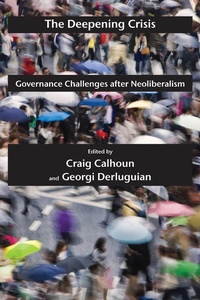
The Deepening Crisis
Governance Challenges After Neoliberalism
Published on 1. May 2011
277 pages
978-0-8147-7282-9 (ISBN)
Description

Response to financial meltdown is entangled with basic challenges to global governance. Environment, global security and ethnicity and nationalism are all global issues today. Focusing on the political and social dimensions of the crisis, contributors examine changes in relationships between the world's richer and poorer countries, efforts to strengthen global institutions, and difficulties facing states trying to create stability for their citizens.
Contributors include: William Barnes, Rogers Brubaker, Vincent Della Sala, Nils Gilman, David Held, Mary Kaldor, Adrian Pabst, Ravi Sundaram, Vadim Volkov, Michael Watts, and Kevin Young.
The Deepening Crisis is the second part of a trilogy comprised of the first three books in the Possible Future series.
Volume 1: Business as Usual
Volume 2: The Deepening Crisis
Volume 3: Aftermath
The three volumes are linked by a common introduction and can be purchased individually or as a set.
Contributors include: William Barnes, Rogers Brubaker, Vincent Della Sala, Nils Gilman, David Held, Mary Kaldor, Adrian Pabst, Ravi Sundaram, Vadim Volkov, Michael Watts, and Kevin Young.
The Deepening Crisis is the second part of a trilogy comprised of the first three books in the Possible Future series.
Volume 1: Business as Usual
Volume 2: The Deepening Crisis
Volume 3: Aftermath
The three volumes are linked by a common introduction and can be purchased individually or as a set.
Reviews / Votes
"Calhoun and Derluguians edited collection is the second volume of a two-part series that interrogates how the financial crisis exacerbated problems in regimes of global governance. Chief among the editors considerations is how the crisis threatens to & derail action on environmental concerns (p. 7). Leading the inquiry is the questions: will states work to create international regulatory systems as a framework for a new world order, or will they be locked into new patterns of global conflict? Contributors to The Deepening Crisis: Governance Challenges After Neoliberalism fashion responses by taking to task the nature of governance in the context of ecological politics, religion, ethnicity, offshoring, the European Union, and media piracy." (Critical Sociology) "A group of distinguished social scientists tackle some of the central governance challenges produced by the recent economic, political, and social crises. The topics they address-such as the environment, religion, nationalism, war, and the prospects for global governance-are essential to understanding the contemporary world." - Arne L. Kalleberg,author of Good Jobs, Bad Jobs: The Rise of Polarized and Precarious Employment Systems in the Uni "The nation state has been at the institutional heart of the last 200 years as it defined our economic and political lives. It is, however, an insufficient platform from which to face the challenges of the 21st Century. This excellent book provides a very useful schema with which to consider both the limits of our current institutions and the possible shape of their successors. I recommend it to scholars, policy makers, and anyone worried about the next crisis." - Miguel Angel Centeno,Author of Global Capitalism: A Sociological Approach "This volume unravels a complex web of connections around the current financial and economic crisis. Among its revelations are: the difficulty of a renewed Keynesian solution because of the gridlock of weak national and transnational institutions with inadequate authority and oversight; the irony that cap-and-trade solutions to environmental issues rely on the same bankers and traders at the core of the financial crisis; and the maneuvers of offshore capitalism in evading state regulation by instant electronic financial transfers under flags of convenience. This work peels back the skin of a rather sinister global beast." - Randall Collins,author of Macro-History: Sociology of the Long RunMore details
Series
Language
English
Place of publication
New York
United States
Target group
Professional and scholarly
ISBN-13
978-0-8147-7282-9 (9780814772829)
Copyright in bibliographic data and cover images is held by Nielsen Book Services Limited or by the publishers or by their respective licensors: all rights reserved.
Schweitzer Classification
Other editions
Additional editions
Book
05/2011
New York University Press
€36.50
Shipment within 15-20 days
Persons
Craig Calhoun is Director of the London School of Economics and Global Distinguished Professor of Sociology at New York University. His most recent book is The Roots of Radicalism: Tradition, the Public Sphere, and Early Nineteenth-Century Social Movements.
Georgi Derluguian is Associate Professor of International Studies and Sociology at Northwestern University and is the author of Bourdieu's Secret Admirer in the Caucasus: A World-System Biography.
Georgi Derluguian is Associate Professor of International Studies and Sociology at Northwestern University and is the author of Bourdieu's Secret Admirer in the Caucasus: A World-System Biography.
Content
Introduction Craig Calhoun and Georgi Derluguian1 Crises in Parallel Worlds: The Governance of Global Risks in Finance, Security, and the Environment David Held and Kevin Young2 Green Social Democracy or Barbarism: Climate Change and the End of High Modernism William Barnes and Nils Gilman3 Ecologies of Rule: African Environments and the Climate of Neoliberalism Michael J. Watts4 Economic Crisis, Nationalism, and Politicized Ethnicity Rogers Brubaker5 War and Economic Crisis Mary Kaldor6 A Less Close Union? The European Union's Search for Unity amid Crisis Vincent Della Sala7 The Paradox of Faith: Religion beyond Secularization and Desecularization Adrian Pabst8 Global Governance after the Analog Age: The World after Media Piracy Ravi Sundaram9 From Full to Selective Secrecy: The Offshore Realm after the Crisis Vadim Volkov Notes About the Contributors Index
