

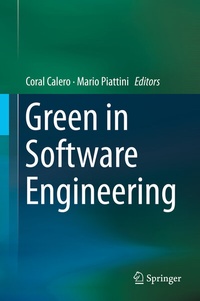
Green in Software Engineering
Description

This is the first book that presents a comprehensive overview of sustainability aspects in software engineering. Its format follows the structure of the SWEBOK and covers the key areas involved in the incorporation of green aspects in software engineering, encompassing topics from requirement elicitation to quality assurance and maintenance, while also considering professional practices and economic aspects.
The book consists of thirteen chapters, which are structured in five parts. First the "Introduction" gives an overview of the primary general concepts related to Green IT, discussing what Green in Software Engineering is and how it differs from Green by Software Engineering. Next "Environments, Processes and Construction" presents green software development environments, green software engineering processes and green software construction in general. The third part, "Economic and Other Qualities," details models for measuring how well software supports green software engineering techniques and for performing trade-off analyses between alternative green practices from an economic perspective. "Software Development Process" then details techniques for incorporating green aspects at various stages of software development, including requirements engineering, design, testing, and maintenance. In closing, "Practical Issues" addresses the repercussions of green software engineering on decision-making, stakeholder participation and innovation management.
The audience for this book includes software engineering researchers in academia and industry seeking to understand the challenges and impact of green aspects in software engineering, as well as practitioners interested in learning about the state of the art in Green in Software Engineering.
Reviews / Votes
"The book helps the reader understand the essential difference between green information technology (IT) and green software engineering. . the book is an outstanding first work that will likely serve as a basis for future research and guidance in the area of green software engineering." (Sandhya Jane, Computing Reviews, October, 2015)
"An overview of numerous green aspects of software engineering is provided in this book. . This is one of the first detailed overviews of green aspects in software engineering. . it can be recommended to all readers interested in the field regardless of previous knowledge." (M. Ivanovic, Computing Reviews, September, 2015)
More details
Other editions
Additional editions
Persons
Coral Calero is Full Professor at the Computer Science Department at the University of Castilla-La Mancha (UCLM, Spain). She is a member of the Alarcos Research Group and her research interests include: quality models, software measurement and software sustainability. She is the President of the Fundación Software y Sostenibilidad (Software and Sustainability Foundation).
Mario Piattini is Director of the Alarcos Research Group and Director of the Institute of Information Systems and Technologies at UCLM. Prior to this position, he worked as a consultant for various companies and organizations and was Founder and Director of Cronos Ibérica, S.A. He is among the 15 "Top scholars in the field of systems and software engineering (2004-2008)", according to a study published in The Journal of Systems and Software in 2011.