

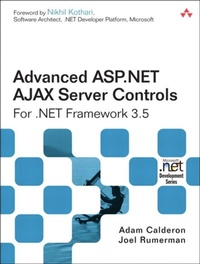
Advanced ASP.NET AJAX Server Controls For .NET Framework 3.5
1st Edition
Published on 26. June 2008
648 pages
978-0-13-270148-8 (ISBN)
Description

ASP.NET AJAX server controls can encapsulate even the most powerful AJAX functionality, helping you build more elegant, maintainable, and scalable applications. This is the first comprehensive, code-rich guide to custom ASP.NET AJAX server controls for experienced ASP.NET developers. Unlike other books on ASP.NET AJAX, this book focuses solely on server control development and reflects the significant improvements in ASP.NET 3.5 AJAX and the latest Visual Studio 2008 features for streamlining AJAX development
Adam Calderon and Joel Rumerman first review the core Microsoft AJAX Library and JavaScript techniques needed to support a rich client-side experience. Next, they build upon these techniques showing how to create distributable AJAX-enabled controls that include rich browser-independent JavaScript client-side functionality. The authors thoroughly explain both the JavaScript and .NET aspects of control development and how these two distinct environments come together to provide a foundation for building a rich user experience using ASP.NET AJAX.
Create object-oriented cross-browser JavaScript that supports .NET style classes, interfaces, inheritance, and method overloading
Work with components, behaviors, and controls, and learn how they relate to DOM elements
Learn Sys.Application and the part it plays in object creation, initialization, and events in the Microsoft AJAX Library
Build Extender and Script controls that provide integrated script generation for their corresponding client-side counterparts
Localize ASP.NET AJAX controls including client script
Discover ASP.NET AJAX client and server communication architecture and the new support for Windows Communication Foundation (WCF)
Understand ASP.NET AJAX Application Services
Create custom Application Services
Design controls for a partial postback environment
Understand the AJAX Control Toolkit architecture and the many features it provides
Develop highly interactive controls using the AJAX Control Toolkit
Understand AJAX Control Toolkit architecture and build controls that utilize the toolkit
Adam Calderon and Joel Rumerman first review the core Microsoft AJAX Library and JavaScript techniques needed to support a rich client-side experience. Next, they build upon these techniques showing how to create distributable AJAX-enabled controls that include rich browser-independent JavaScript client-side functionality. The authors thoroughly explain both the JavaScript and .NET aspects of control development and how these two distinct environments come together to provide a foundation for building a rich user experience using ASP.NET AJAX.
Create object-oriented cross-browser JavaScript that supports .NET style classes, interfaces, inheritance, and method overloading
Work with components, behaviors, and controls, and learn how they relate to DOM elements
Learn Sys.Application and the part it plays in object creation, initialization, and events in the Microsoft AJAX Library
Build Extender and Script controls that provide integrated script generation for their corresponding client-side counterparts
Localize ASP.NET AJAX controls including client script
Discover ASP.NET AJAX client and server communication architecture and the new support for Windows Communication Foundation (WCF)
Understand ASP.NET AJAX Application Services
Create custom Application Services
Design controls for a partial postback environment
Understand the AJAX Control Toolkit architecture and the many features it provides
Develop highly interactive controls using the AJAX Control Toolkit
Understand AJAX Control Toolkit architecture and build controls that utilize the toolkit
More details
Language
English
Place of publication
Boston
United States
Publishing group
Pearson Education (US)
Target group
Professional and scholarly
ISBN-13
978-0-13-270148-8 (9780132701488)
Copyright in bibliographic data and cover images is held by Nielsen Book Services Limited or by the publishers or by their respective licensors: all rights reserved.
Schweitzer Classification
Other editions
Additional editions
Adam Calderon | Joel Rumerman
Advanced ASP.NET AJAX Server Controls For .NET Framework 3.5
Book
07/2008
Addison Wesley
€45.79
Article exhausted; check different version
Persons
Adam Calderon is a C# MVP and the Application Development Practice Lead at InterKnowlogy. He is an accomplished software developer, author, teacher, and speaker with more than 14 years of experience designing and developing solutions on the Microsoft platform. His involvement with ASP.NET AJAX began in late 2005 with his participation in the ASP.NET ATLAS First Access program and later as a member of the UI Server Frameworks Advisory Council. Adam was one of the fortunate few who were able to work on a production application that utilized ASP.NET AJAX in its alpha form and experienced firsthand the trials and tribulations of working in "beta land" on this exciting technology. Visit Adam's blog at http://blogs.interknowlogy.com/adamcalderon.
Joel Rumerman is a Senior .NET Developer at the CoStar Group, where he develops ASP.NET applications to support the company's commercial real estate information business. He is an adept software developer with more than eight years of experience developing .NET applications and is active in the San Diego .NET community as an author and speaker. Joel has been working with ASP.NET AJAX since late 2005 when he started work on a large-scale application for a worldwide independent software vendor. This initial entry into the ASP.NET AJAX world provided him invaluable experience as he worked closely with Microsoft as a member of the ATLAS First Access program and participated in a Strategic Design Review of the technology. Joel has gone on to implement many more solutions using ASP.NET AJAX, including a Virtual Earth mash-up that maps commercial real estate properties. Visit Joel's blog at http://seejoelprogram.wordpress.com.
Joel Rumerman is a Senior .NET Developer at the CoStar Group, where he develops ASP.NET applications to support the company's commercial real estate information business. He is an adept software developer with more than eight years of experience developing .NET applications and is active in the San Diego .NET community as an author and speaker. Joel has been working with ASP.NET AJAX since late 2005 when he started work on a large-scale application for a worldwide independent software vendor. This initial entry into the ASP.NET AJAX world provided him invaluable experience as he worked closely with Microsoft as a member of the ATLAS First Access program and participated in a Strategic Design Review of the technology. Joel has gone on to implement many more solutions using ASP.NET AJAX, including a Virtual Earth mash-up that maps commercial real estate properties. Visit Joel's blog at http://seejoelprogram.wordpress.com.
Content
Foreword xxv
Preface xxvii
Acknowledgments xxxv
About the Authors xxxix
Part I: Client Code
Chapter 1: Programming with JavaScript 3
Chapter 2: Microsoft AJAX Library Programming 51
Part II: Controls
Chapter 3: Components 121
Chapter 4: Sys.Application 169
Chapter 5: Adding Client Capabilities to Server Controls 207
Chapter 6: ASP.NET AJAX Localization 255
Chapter 7: Control Development in a Partial Postback Environment 317
Part III: Communication
Chapter 8: ASP.NET AJAX Communication Architecture 371
Chapter 9: Application Services 425
Part IV: AJAX Control Toolkit
Chapter 10: ASP.NET AJAX Control Toolkit Architecture 481
Chapter 11: Adding Client Capabilities to Server Controls Using the ASP.NET AJAX Control Toolkit 513
Appendixes
Appendix A: JavaScript in Visual Studio 2008 547
Appendix B: Validating Method Parameters 555
Appendix C: ASP.NET Handlers and Modules 559
Appendix D: Client Error Handling Code 569
Index 577
Preface xxvii
Acknowledgments xxxv
About the Authors xxxix
Part I: Client Code
Chapter 1: Programming with JavaScript 3
Chapter 2: Microsoft AJAX Library Programming 51
Part II: Controls
Chapter 3: Components 121
Chapter 4: Sys.Application 169
Chapter 5: Adding Client Capabilities to Server Controls 207
Chapter 6: ASP.NET AJAX Localization 255
Chapter 7: Control Development in a Partial Postback Environment 317
Part III: Communication
Chapter 8: ASP.NET AJAX Communication Architecture 371
Chapter 9: Application Services 425
Part IV: AJAX Control Toolkit
Chapter 10: ASP.NET AJAX Control Toolkit Architecture 481
Chapter 11: Adding Client Capabilities to Server Controls Using the ASP.NET AJAX Control Toolkit 513
Appendixes
Appendix A: JavaScript in Visual Studio 2008 547
Appendix B: Validating Method Parameters 555
Appendix C: ASP.NET Handlers and Modules 559
Appendix D: Client Error Handling Code 569
Index 577
