

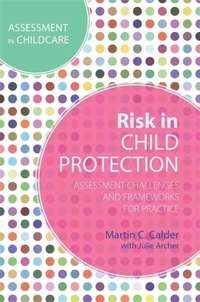
Risk in Child Protection
Assessment Challenges and Frameworks for Practice
Published on 21. December 2015
304 pages
978-0-85700-858-9 (ISBN)
Description

Assessing risk is a key challenge in child protection work. Martin C. Calder presents a clear and accessible guide to understanding risk and the part it plays.
This book considers what risk means and how risk assessments should be defined, it outlines the key challenges practitioners face day-to-day, and offers a helpful evidence-based assessment framework for use by frontline staff. Calder argues that risk now has to be reconceived as a multi-disciplinary activity which stretches beyond social work. As such, he highlights a need for a clearer shared terminology among professionals and encourages the social work profession to look to related disciplines, such as criminal justice, for ideas to improve practice.
Demystifying the complex debates around risk and showing how to deliver effective risk assessment, this is an essential reference for social workers and social work students, as well as lecturers.
This book considers what risk means and how risk assessments should be defined, it outlines the key challenges practitioners face day-to-day, and offers a helpful evidence-based assessment framework for use by frontline staff. Calder argues that risk now has to be reconceived as a multi-disciplinary activity which stretches beyond social work. As such, he highlights a need for a clearer shared terminology among professionals and encourages the social work profession to look to related disciplines, such as criminal justice, for ideas to improve practice.
Demystifying the complex debates around risk and showing how to deliver effective risk assessment, this is an essential reference for social workers and social work students, as well as lecturers.
Reviews / Votes
Risk is a core concept for professionals working with vulnerable children and their families. However, being able to assess risk and use this assessment to inform sound interventions is a complex task. This book provides an excellent resource for practitioners, explicitly linking theory and research with very practical guidance and advice - a rare achievement. Written in an accessible and engaging manner this book is to be commended for its usefulness. -- John Devaney, Research Director, Queen's University Belfast This book is very much written for the practitioner and the difficulties we face when dealing with the assessment and management of risk. The author highlights a wide array of models and theories that are easily adaptable to everyday use and will increase practitioners' abilities to make robust and sound judgments in regards to risk. For someone who makes decisions regarding risk on a day to day basis, this book is a valuable tool and an excellent reference for anyone working in the child protection field. -- Darren Shaw , Independent Social Worker and Interim Manager, DWS Social Work Solutions LtdMore details
Edition
Digital original
Language
English
Place of publication
London
United Kingdom
Target group
College/higher education
Professional and scholarly
Edition type
Digital original
File size
1,79 MB
ISBN-13
978-0-85700-858-9 (9780857008589)
Copyright in bibliographic data and cover images is held by Nielsen Book Services Limited or by the publishers or by their respective licensors: all rights reserved.
Schweitzer Classification
Other editions
Additional editions
Book
12/2015
Jessica Kingsley Publishers
€48.50
Shipment within 15-20 days
Persons
Martin C. Calder is Director of Calder Training and Consultancy Limited, which he established in 2005, having managed the child protection and domestic violence services for Salford. Martin trains extensively on frontline assessment issues and also where the practical becomes political. He continues to be driven to develop and deliver a range of evidence-based assessment tools for frontline staff. He is now involved in addressing issues facing frontline managers dealing with ever increasingly complex cases. Further details on his work and remit are available at www.caldertrainingandconsultancy.co.uk.
Julie Archer has been a social worker since 1987 and has spent her career working within child protection, both at grass roots and as a manager. Since 2006 Julie has been an independent trainer specialising in training staff to carry out effective section 47 enquiries and supporting managers in developing and embedding reflective supervision within social care.
Julie Archer has been a social worker since 1987 and has spent her career working within child protection, both at grass roots and as a manager. Since 2006 Julie has been an independent trainer specialising in training staff to carry out effective section 47 enquiries and supporting managers in developing and embedding reflective supervision within social care.
Content
- Intro
- Risk in Child Protection: Assessment challenges and frameworks for practice
- Standardised chapter guidance
- 1. Introduction: Policy Background
- Professionally dangerous practice
- Professional Accommodation Syndrome
- Positive pathways to protection
- Latent and active failures
- Building an Emotionally Competent Organisation
- Social Work Task Force (Gibb 2009)
- The preface to Munro and the battle to reclaim child protection
- Multiple Munro manuscripts and missed opportunities
- Working Together 2013: too little, too late
- 2. Ten Key Challenges for Practice
- The challenges of professionals working together
- Understanding communication
- Authority, and the challenges of partnerships with parents, carers and children
- Partnerships with men
- Partnerships with children
- Worker challenges from the work
- Hostage theory (Stanley and Goddard 1997)
- Leadership challenges
- Thresholds, eligibility criteria and assessment practice
- Barriers and blocks to identifying and managing risk
- The challenges of evidence-based practice
- What evidence can be brought before the court?
- Critical thinking
- Errors and their impact on workers and outcomes
- The exercise of professional judgments
- Defensible and sensible decision-making
- 3. Risk Unravelled
- The evolving nature of risk
- Risk definitions
- Eliminating or totally controlling risk in social work is impossible
- Risk deletion
- The omission of risk
- Risk in the multidisciplinary network
- Risk factors
- Subjective notions of risk
- Integrating not separating
- Static, stable and dynamic risk factors
- Rotational Risk (Calder 2007)
- Atomistic or holistic approaches
- Time and risk
- Risk to staff
- Young people's perceptions of risk
- Risk and gender
- 4. Risk Assessment
- What is assessment?
- The stepwise model to the framework for assessment
- Structured decision-making
- Case formulation
- The assessment framework - risk-averse and perpetrator friendly
- What is a risk assessment?
- Likelihood
- Strengths-based approaches
- Forensic not therapeutic
- Checklist of risk assessment information required
- A model for risk assessment (Brearley 1982)
- Chronology construction
- Interagency chronology
- Reassessment of risk
- How to judge whether a risk assessment tool is fit for purpose
- Essential ingredients of a risk assessment tool
- Evidence-based assessment
- Analysis
- Risk management
- 5. Risk Restoration: Frameworks for Practice
- From information collection to risk analysis
- Framework for analysis
- Risk and resistance
- Differentiating between challenging service users and dangerous service users
- Recognition of non-effective compliance
- Engaging males
- Messages from research
- The four categories of resistance
- Chronology of compliance
- Change
- Cautionary notes
- Why many interventions fail
- Strengths-based working and over-optimism (Pearson 2013)
- Motivation
- A scale for assessing the parent's motivation for problem-solving
- Resilience
- Resilience
- Vulnerability
- Adversity
- Protective factors
- Sample questions to gather the required information (Calder, Sneddon and McKinnon 2012)
- A resilience matrix for analysing information
- An integrated contemporary risk assessment framework
- Shifting risk to an interagency audience
- 6. Good Practice in Section 47 Inquiries
- Julie Archer
- Legal framework
- Engagement, hostility and resistance
- Role clarity and purpose
- Investigative strategy
- Investigative process and the links to stepwise
- Achieving best evidence
- The child's voice
- Reaching conclusions
- Supervision and managerial oversight
- Conclusion
- References
- Subject index
- Author index
