

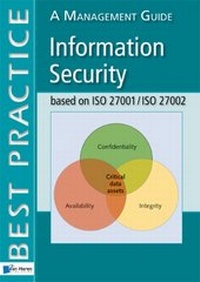
Information Security based on ISO 27001/ISO 27002
1st Edition
Published on 31. July 2009
102 pages
978-90-8753-542-1 (ISBN)
Description

Information is the currency of the information age and in many cases is the most valuable asset possessed by an organisation. Information security management is the discipline that focuses on protecting and securing these assets against the threats of natural disasters, fraud and other criminal activity, user error and system failure.
This Management Guide provides an overview of the two international information security standards, ISO/IEC 27001 and ISO 27002. These standards provide a basis for implementing information security controls to meet an organisation's own business requirements as well as a set of controls for business relationships with other parties.
This Guide provides:
An introduction and overview to both the standards
The background to the current version of the standards
Links to other standards, such as ISO 9001, BS25999 and ISO 20000
Links to frameworks such as CobiT and ITIL
Above all, this handy book describes how ISO 27001 and ISO 27002 interact to guide organizations in the development of best practice information security management systems.
More details
Other editions
Additional editions
E-Book
06/2020
Van Haren Publishing
€25.99
Available for download
Book
07/2009
2nd Edition
Van Haren Publishing BV
€45.99
Shipment within 10-15 days
Content
1 - 1 Introduction [Seite 12]
1.1 - 1.1Originating body: ISO/IEC JTC1/SC 27 [Seite 12]
1.2 - 1.2ISO/IEC 27001:2005 ('ISO 27001' or 'the Standard') [Seite 12]
1.3 - 1.3ISO/IEC 27002:2005 ('ISO 27002') [Seite 13]
1.4 - 1.4Definitions [Seite 13]
2 - 2 Information security [Seite 14]
2.1 - 2.1Risks to information assets [Seite 14]
2.2 - 2.2Information security [Seite 15]
2.3 - 2.3Information Security Management System [Seite 15]
3 - 3 Background to the Standards [Seite 16]
3.1 - 3.1First certification [Seite 16]
3.2 - 3.2ISO 17799:2000 [Seite 16]
3.3 - 3.3BS7799-2 [Seite 17]
3.4 - 3.4International adoption [Seite 17]
3.5 - 3.5Translations and sector schemes [Seite 18]
3.6 - 3.6ISO 27001:2005 [Seite 18]
4 - 4 Relationship between the Standards [Seite 20]
4.1 - 4.1Why develop an international code of practice? [Seite 20]
4.2 - 4.2Correspondence between the two Standards [Seite 21]
5 - 5 Use of the Standards [Seite 22]
5.1 - 5.1Specification compared to a Code of Practice [Seite 22]
5.2 - 5.2The ISMS [Seite 23]
5.3 - 5.3ISO 27001 as a model for the ISMS [Seite 23]
6 - 6 Certification process and [Seite 24]
6.1 - 6.1Certification bodies [Seite 24]
6.2 - 6.2Standards for certification bodies [Seite 24]
6.3 - 6.3The certification process [Seite 25]
6.4 - 6.4The formal audit [Seite 26]
6.5 - 6.5The audit report [Seite 26]
6.6 - 6.6Outcome of the audit [Seite 26]
7 - 7 Overview of ISO 27001 [Seite 28]
7.1 - 7.1Main clauses [Seite 28]
7.2 - 7.2ISMS building blocks: relationship between [Seite 7.2ISMS building blocks: relationship between ]
ISO/IEC 27001 Clauses 4-8, ISO/IEC 27001 - [Seite ISO/IEC 27001 Clauses 4-8, ISO/IEC 27001 ]
Annex A, and ISO/IEC 27002 - 29 [Seite 29]
7.3 - 7.3General requirements [Seite 30]
7.4 - 7.4Other content [Seite 31]
8 - 8 Summary of changes from [Seite 32]
8.1 - 8.1Greater clarity in specifications [Seite 32]
9 - 9 Overview of ISO 27002:2005 [Seite 34]
9.1 - 9.1The security categories [Seite 35]
9.2 - 9.2ISMS building blocks: relationship between the control [Seite 9.2ISMS building blocks: relationship between the control]
clauses of ISO/IEC 27002:2005 - 35 [Seite 35]
10 - 10 Summary of changes from ISO 27002:2000 [Seite 38]
10.1 - 10.1Clause changes [Seite 38]
10.2 - 10.2Layout of controls [Seite 38]
10.3 - 10.3Control changes [Seite 39]
11 - 11 ISO 27000 series in future [Seite 40]
11.1 - 11.1ISO 27001 [Seite 40]
11.2 - 11.2ISO 27002 [Seite 40]
11.3 - 11.3ISO 27003 [Seite 40]
11.4 - 11.4ISO 27004 [Seite 40]
11.5 - 11.5ISO/IEC 27005:2008 [Seite 41]
12 - 12 Compatibility and integration with other management systems [Seite 42]
12.1 - 12.1ISO 27001 Annex C and integration [Seite 42]
12.2 - 12.2The integrated management system [Seite 42]
12.3 - 12.3ISO 9001 [Seite 43]
12.4 - 12.4BS25999 [Seite 43]
13 - 13 Documentation requirements and record control [Seite 44]
13.1 - 13.1Document control requirements [Seite 44]
13.2 - 13.2Contents of the ISMS documentation [Seite 45]
13.3 - 13.3Record control [Seite 46]
13.4 - 13.4Annex A document controls [Seite 46]
14 - 14 Management responsibility [Seite 48]
14.1 - 14.1Management direction [Seite 48]
14.2 - 14.2Providing evidence of management commitment [Seite 48]
14.3 - 14.3Management-related controls [Seite 49]
14.4 - 14.4Requirement for management review [Seite 50]
15 - 15 Process approach and the PDCA cycle [Seite 52]
15.1 - 15.1PDCA and ISO 27001 [Seite 52]
15.2 - 15.2 PDCA applied at the tactical level [Seite 53]
15.3 - 15.3 PDCA cycle linked to the clauses of ISO 27001 [Seite 53]
16 - 16 Scope definition [Seite 56]
16.1 - 16.1The scoping exercise [Seite 56]
16.2 - 16.2Small organizations [Seite 56]
16.3 - 16.3 Larger organizations [Seite 57]
16.4 - 16.4 Legal and regulatory framework [Seite 57]
17 - 17 Policy definition [Seite 58]
17.1 - 17.1 Policy and business objectives [Seite 58]
17.2 - 17.2 Information security governance and the ISMS [Seite 59]
18 - 18 Risk assessment [Seite 60]
18.1 - 18.1 Links to other standards [Seite 60]
18.2 - 18.2 Objectives of risk treatment plans [Seite 60]
18.3 - 18.3 Risk assessment process [Seite 61]
18.4 - 18.4 Assets within the scope (4.2.1.d1) [Seite 61]
18.5 - 18.5 Asset owners [Seite 62]
18.6 - 18.6 Threats (4.2.1.d2) [Seite 62]
18.7 - 18.7 Vulnerabilities (4.2.1.d3) [Seite 63]
18.8 - 18.8 Impacts (4.2.1.d4) [Seite 63]
18.9 - 18.9 Risk assessment (4.2.1.e) [Seite 63]
18.10 - 18.10 Likelihood [Seite 64]
18.11 - 18.11 Calculate the risk level [Seite 64]
19 - 19 Risk treatment plan [Seite 66]
19.1 - 19.1Documenting the risk treatment plan [Seite 66]
19.2 - 19.2 Risk treatment plan and PDCA approach [Seite 67]
20 - 20 The Statement of Applicability [Seite 68]
20.1 - 20.1 Controls and Annex A [Seite 68]
20.2 - 20.2 Controls (4.2.1.f.1) [Seite 68]
20.3 - 20.3 Residual risks [Seite 69]
20.4 - 20.4 Control objectives [Seite 69]
20.5 - 20.5 Plan for security incidents [Seite 69]
21 - 21 Do - implement and operate the ISMS [Seite 72]
21.1 - 21.1 Implementation [Seite 72]
22 - 22 Check - monitor and review the ISMS [Seite 74]
22.1 - 22.1 Monitoring [Seite 74]
22.2 - 22.2 Auditing [Seite 74]
22.3 - 22.3 Reviewing [Seite 75]
23 - 23 Act - maintain and improve the ISMS [Seite 76]
23.1 - 23.1 Management review [Seite 76]
24 - 24 ISO 27001:2005 Annex A [Seite 78]
24.1 - 24.1 SoA and external parties [Seite 78]
24.2 - 24.2 Annex A clauses [Seite 78]
25 - 25 Annex A control areas and controls [Seite 80]
25.1 - 25.1 Clause A5: Security policy [Seite 80]
25.2 - 25.2 Clause A6: Organization of information security [Seite 80]
25.3 - 25.3 Clause A7: Asset management [Seite 81]
25.4 - 25.4 Clause A8: Human resources security [Seite 81]
25.5 - 25.5 Clause A9: Physical and environmental security [Seite 82]
25.6 - 25.6 Clause A10: Communications and operations [Seite 25.6 Clause A10: Communications and operations ]
management - 82 [Seite 82]
25.7 - 25.7 Clause A11: Access control [Seite 84]
25.8 - 25.8 Clause A12: Information systems acquisition, [Seite 25.8 Clause A12: Information systems acquisition, ]
development and maintenance - 85 [Seite 85]
25.9 - 25.9 Clause A13: Information security incident management [Seite 86]
25.10 - 25.10 Clause A14: Business continuity management [Seite 86]
25.11 - 25.11 Clause A15: Compliance [Seite 87]
26 - 26 ISO 27001 and CobiT [Seite 88]
26.1 - 26.1 Background to CobiT [Seite 88]
26.2 - 26.2 CobiT framework [Seite 88]
26.3 - 26.3 CobiT process DS5 [Seite 89]
26.4 - 26.4 Gaps and overlaps [Seite 89]
27 - 27 ISO 27001, ITIL and ISO 20000 [Seite 92]
27.1 - 27.1 ITIL [Seite 92]
27.2 - 27.2 Background to ITIL [Seite 92]
27.3 - 27.3 BS15000/ISO 20000 [Seite 93]
27.4 - 27.4 ITIL Security Management [Seite 93]
27.5 - 27.5 ISO 27001, ITIL and CobiT [Seite 93]
28 - Appendix A Bibliography of related standards and guides [Seite 94]
29 - Appendix B Accredited certification and other bodies [Seite 96]
1.1 - 1.1Originating body: ISO/IEC JTC1/SC 27 [Seite 12]
1.2 - 1.2ISO/IEC 27001:2005 ('ISO 27001' or 'the Standard') [Seite 12]
1.3 - 1.3ISO/IEC 27002:2005 ('ISO 27002') [Seite 13]
1.4 - 1.4Definitions [Seite 13]
2 - 2 Information security [Seite 14]
2.1 - 2.1Risks to information assets [Seite 14]
2.2 - 2.2Information security [Seite 15]
2.3 - 2.3Information Security Management System [Seite 15]
3 - 3 Background to the Standards [Seite 16]
3.1 - 3.1First certification [Seite 16]
3.2 - 3.2ISO 17799:2000 [Seite 16]
3.3 - 3.3BS7799-2 [Seite 17]
3.4 - 3.4International adoption [Seite 17]
3.5 - 3.5Translations and sector schemes [Seite 18]
3.6 - 3.6ISO 27001:2005 [Seite 18]
4 - 4 Relationship between the Standards [Seite 20]
4.1 - 4.1Why develop an international code of practice? [Seite 20]
4.2 - 4.2Correspondence between the two Standards [Seite 21]
5 - 5 Use of the Standards [Seite 22]
5.1 - 5.1Specification compared to a Code of Practice [Seite 22]
5.2 - 5.2The ISMS [Seite 23]
5.3 - 5.3ISO 27001 as a model for the ISMS [Seite 23]
6 - 6 Certification process and [Seite 24]
6.1 - 6.1Certification bodies [Seite 24]
6.2 - 6.2Standards for certification bodies [Seite 24]
6.3 - 6.3The certification process [Seite 25]
6.4 - 6.4The formal audit [Seite 26]
6.5 - 6.5The audit report [Seite 26]
6.6 - 6.6Outcome of the audit [Seite 26]
7 - 7 Overview of ISO 27001 [Seite 28]
7.1 - 7.1Main clauses [Seite 28]
7.2 - 7.2ISMS building blocks: relationship between [Seite 7.2ISMS building blocks: relationship between ]
ISO/IEC 27001 Clauses 4-8, ISO/IEC 27001 - [Seite ISO/IEC 27001 Clauses 4-8, ISO/IEC 27001 ]
Annex A, and ISO/IEC 27002 - 29 [Seite 29]
7.3 - 7.3General requirements [Seite 30]
7.4 - 7.4Other content [Seite 31]
8 - 8 Summary of changes from [Seite 32]
8.1 - 8.1Greater clarity in specifications [Seite 32]
9 - 9 Overview of ISO 27002:2005 [Seite 34]
9.1 - 9.1The security categories [Seite 35]
9.2 - 9.2ISMS building blocks: relationship between the control [Seite 9.2ISMS building blocks: relationship between the control]
clauses of ISO/IEC 27002:2005 - 35 [Seite 35]
10 - 10 Summary of changes from ISO 27002:2000 [Seite 38]
10.1 - 10.1Clause changes [Seite 38]
10.2 - 10.2Layout of controls [Seite 38]
10.3 - 10.3Control changes [Seite 39]
11 - 11 ISO 27000 series in future [Seite 40]
11.1 - 11.1ISO 27001 [Seite 40]
11.2 - 11.2ISO 27002 [Seite 40]
11.3 - 11.3ISO 27003 [Seite 40]
11.4 - 11.4ISO 27004 [Seite 40]
11.5 - 11.5ISO/IEC 27005:2008 [Seite 41]
12 - 12 Compatibility and integration with other management systems [Seite 42]
12.1 - 12.1ISO 27001 Annex C and integration [Seite 42]
12.2 - 12.2The integrated management system [Seite 42]
12.3 - 12.3ISO 9001 [Seite 43]
12.4 - 12.4BS25999 [Seite 43]
13 - 13 Documentation requirements and record control [Seite 44]
13.1 - 13.1Document control requirements [Seite 44]
13.2 - 13.2Contents of the ISMS documentation [Seite 45]
13.3 - 13.3Record control [Seite 46]
13.4 - 13.4Annex A document controls [Seite 46]
14 - 14 Management responsibility [Seite 48]
14.1 - 14.1Management direction [Seite 48]
14.2 - 14.2Providing evidence of management commitment [Seite 48]
14.3 - 14.3Management-related controls [Seite 49]
14.4 - 14.4Requirement for management review [Seite 50]
15 - 15 Process approach and the PDCA cycle [Seite 52]
15.1 - 15.1PDCA and ISO 27001 [Seite 52]
15.2 - 15.2 PDCA applied at the tactical level [Seite 53]
15.3 - 15.3 PDCA cycle linked to the clauses of ISO 27001 [Seite 53]
16 - 16 Scope definition [Seite 56]
16.1 - 16.1The scoping exercise [Seite 56]
16.2 - 16.2Small organizations [Seite 56]
16.3 - 16.3 Larger organizations [Seite 57]
16.4 - 16.4 Legal and regulatory framework [Seite 57]
17 - 17 Policy definition [Seite 58]
17.1 - 17.1 Policy and business objectives [Seite 58]
17.2 - 17.2 Information security governance and the ISMS [Seite 59]
18 - 18 Risk assessment [Seite 60]
18.1 - 18.1 Links to other standards [Seite 60]
18.2 - 18.2 Objectives of risk treatment plans [Seite 60]
18.3 - 18.3 Risk assessment process [Seite 61]
18.4 - 18.4 Assets within the scope (4.2.1.d1) [Seite 61]
18.5 - 18.5 Asset owners [Seite 62]
18.6 - 18.6 Threats (4.2.1.d2) [Seite 62]
18.7 - 18.7 Vulnerabilities (4.2.1.d3) [Seite 63]
18.8 - 18.8 Impacts (4.2.1.d4) [Seite 63]
18.9 - 18.9 Risk assessment (4.2.1.e) [Seite 63]
18.10 - 18.10 Likelihood [Seite 64]
18.11 - 18.11 Calculate the risk level [Seite 64]
19 - 19 Risk treatment plan [Seite 66]
19.1 - 19.1Documenting the risk treatment plan [Seite 66]
19.2 - 19.2 Risk treatment plan and PDCA approach [Seite 67]
20 - 20 The Statement of Applicability [Seite 68]
20.1 - 20.1 Controls and Annex A [Seite 68]
20.2 - 20.2 Controls (4.2.1.f.1) [Seite 68]
20.3 - 20.3 Residual risks [Seite 69]
20.4 - 20.4 Control objectives [Seite 69]
20.5 - 20.5 Plan for security incidents [Seite 69]
21 - 21 Do - implement and operate the ISMS [Seite 72]
21.1 - 21.1 Implementation [Seite 72]
22 - 22 Check - monitor and review the ISMS [Seite 74]
22.1 - 22.1 Monitoring [Seite 74]
22.2 - 22.2 Auditing [Seite 74]
22.3 - 22.3 Reviewing [Seite 75]
23 - 23 Act - maintain and improve the ISMS [Seite 76]
23.1 - 23.1 Management review [Seite 76]
24 - 24 ISO 27001:2005 Annex A [Seite 78]
24.1 - 24.1 SoA and external parties [Seite 78]
24.2 - 24.2 Annex A clauses [Seite 78]
25 - 25 Annex A control areas and controls [Seite 80]
25.1 - 25.1 Clause A5: Security policy [Seite 80]
25.2 - 25.2 Clause A6: Organization of information security [Seite 80]
25.3 - 25.3 Clause A7: Asset management [Seite 81]
25.4 - 25.4 Clause A8: Human resources security [Seite 81]
25.5 - 25.5 Clause A9: Physical and environmental security [Seite 82]
25.6 - 25.6 Clause A10: Communications and operations [Seite 25.6 Clause A10: Communications and operations ]
management - 82 [Seite 82]
25.7 - 25.7 Clause A11: Access control [Seite 84]
25.8 - 25.8 Clause A12: Information systems acquisition, [Seite 25.8 Clause A12: Information systems acquisition, ]
development and maintenance - 85 [Seite 85]
25.9 - 25.9 Clause A13: Information security incident management [Seite 86]
25.10 - 25.10 Clause A14: Business continuity management [Seite 86]
25.11 - 25.11 Clause A15: Compliance [Seite 87]
26 - 26 ISO 27001 and CobiT [Seite 88]
26.1 - 26.1 Background to CobiT [Seite 88]
26.2 - 26.2 CobiT framework [Seite 88]
26.3 - 26.3 CobiT process DS5 [Seite 89]
26.4 - 26.4 Gaps and overlaps [Seite 89]
27 - 27 ISO 27001, ITIL and ISO 20000 [Seite 92]
27.1 - 27.1 ITIL [Seite 92]
27.2 - 27.2 Background to ITIL [Seite 92]
27.3 - 27.3 BS15000/ISO 20000 [Seite 93]
27.4 - 27.4 ITIL Security Management [Seite 93]
27.5 - 27.5 ISO 27001, ITIL and CobiT [Seite 93]
28 - Appendix A Bibliography of related standards and guides [Seite 94]
29 - Appendix B Accredited certification and other bodies [Seite 96]
