

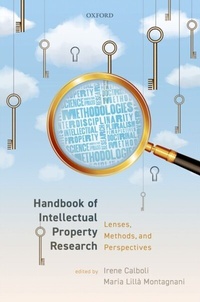
Handbook of Intellectual Property Research
Lenses, Methods, and Perspectives
1st Edition
Published on 20. May 2021
912 pages
978-0-19-258560-8 (ISBN)
Description

The relevance of intellectual property law has increased dramatically over the last several years. Globalization, digitization, and the rise of post-industrial information-based industries have all contributed to a new prominence of IP law as one of the most important factors in driving innovation and economic development. At the same time, the significant expansion of IP rules has impacted many areas of public policy such as public health, the environment, biodiversity, agriculture, and information in an unprecedented manner. The growing importance of IP law has led to an exponential growth of academic research in this area. This book offers a comprehensive overview of the methods and approaches that could be used as guidelines to address and develop scholarly research questions related to intellectual property law. In particular, this volume aims to provide a useful resource that can be used by IP researchers who are interested in expanding their expertise in a specific research method or seek to acquire an understanding of alternative lenses that could be applied to their research. This edited collection is one of the largest compilations, to date, of existing methods and approaches from different lenses, perspectives, and experiences from a diverse group of scholars who derive from a wide range of countries, backgrounds, and legal traditions. This diversity, both regarding the topics and the authors of the contributions, is a fundamental feature of this collection, which seeks to assist IP researchers across many countries in the developing and developed world.
This is an open access title available under the terms of a CC BY-NC-ND 4.0 International licence. It is offered as a free PDF download from OUP and selected open access locations.
More details
Other editions
Additional editions
Irene Calboli | Maria Lilla Montagnani
Handbook of Intellectual Property Research
Lenses, Methods, and Perspectives
Book
06/2021
Oxford University Press
€141.50
Shipment within 15-20 days
Persons
Irene Calboli is Professor of Law at Texas A&M University School of Law, Transatlantic Technology Law Fellow at Stanford University, and Visiting Professor of Law at the National University of Singapore. She is a member of the American Law Institute, the board of the European Policy for Intellectual Property Law Association, and the Executive Committees of the Comparative Law, Art Law, and East Asia Sections of American Association of Law Schools. A widely published and cited scholar, she serves in the editorial boards of the Journal of IP Law and Practice, the Queen Mary Journal of IP, and the WIPO-WTO Colloquium Papers. She is an expert, inter alia, for WIPO, the EUIPO, the EU Commission, and several national Intellectual Property offices.
Maria Lillà Montagnani is Associate Professor of Commercial Law at Bocconi University in Milan, where she teaches and research in the field of Intellectual Property Law and Information Technology Law, and is the Director of LL.M program in European Business and Social Law. She is Visiting Professor at Peking University School of Transnational law and NYU Global Hauser Research Fellow 2019-2020, NYU Law School. She has widely published in the field of Intellectual Property and Technology Law in national and international journals and prestigious book series. She is a member of the editorial board of several law journals and is an expert with the European Commission.
Content
- Introduction
- Part I: Intersections Between Intellectual Property Law and Other Areas of Law
- 1.: Henning Grosse Ruse-Khan: Intellectual Property and International Law: A Research Framework
- 2.: Graeme W. Austin: A Conflicts of Law Approach to Intellectual Property Research
- 3.: Irene Calboli: Comparative Legal Analysis and Intellectual Property Law: A Guide for Research
- 4.: Jacques de Werra: Contract Law and Intellectual Property Transactions: Research Perspectives
- 5.: Giancarlo Frosio: Intellectual Property Law and Extra-Contractual Liability
- 6.: Michael Grynberg: Property Law and the Intellectual Property Agenda
- 7.: Laurent Manderieux: The Relationship Between Intellectual Property and Administrative Law
- 8.: Mariateresa Maggiolino and Laura Zoboli: The Intersection Between Intellectual Property and Antitrust Law
- 9.: Megan Richardson: Intellectual Property Law and (Data) Privacy
- 10.: Maria Lillà Montagnani: The Interface Between Intellectual Property and Information Technology Law
- 11.: Joshua D. Sarnoff: A Research Framework for Intellectual Property and Environmental Law
- 12.: Peter K. Yu: Intellectual Property, Human Rights and Methodological Reflections
- 13.: Ajay K. Sharma and Dipa Dube: The Relevance of Criminal Law in Intellectual Property Law Research
- 14.: Althaf Marsoof: Intersections Between Intellectual Property and Dispute Resolution
- Part II: Intersections Between Intellectual Property Law and the Humanities
- 15.: Marketa Trimble: Intellectual Property Law and Geography
- 16.: Michael Birnhack: A Post-colonial Framework for Researching Intellectual Property History
- 17.: Jose Bellido: Intellectual Property and the Question of the Archive
- 18.: Maurizio Borghi: Interpreting Historical-Philosophical Sources of Intellectual Property
- 19.: Jeremy N. Sheff: Philosophical Approaches to Intellectual Property Law Scholarship
- 20.: George Nicholas and Catherine Bell: Intellectual Property and Archaeology: Research Concerns and Considerations
- 21.: Fiona MacMillan: Intellectual Property and Cultural Heritage: Towards Interdisciplinarity
- 22.: Alan Durant and Jennifer Davis: Directions in Intellectual Property Law Research: A Linguistic Contribution
- 23.: Zahr K. Said: Law and Literature in Intellectual Property Methodologies
- 24.: David Tan: Intellectual Property and Semiotics: The Signs of the Times
- 25.: Arpan Banerjee: A Primer on Intellectual Property and Popular Culture Research
- Part III: Intersections Between Intellectual Property Law and (Social) Science
- 26.: Shubha Ghosh: Consequentialist Thinking and Economic Analysis in Intellectual Property
- 27.: Bruno van Pottelsberghe de la Potterie: Innovation Economics Approach to Intellectual Property Law Scholarship
- 28.: Geertrui Van Overwalle and Lina Kestemont: Multidisciplinary Legal Research: Science and Technology and Intellectual Property
- 29.: Daniel Seng: Intellectual Property, Information Science and Quantitative Legal Analysis
- 30.: Sharon Bar-Ziv: A Content Analysis Approach to Intellectual Property Research
- 31.: Thomas Margoni: Computational Legal methods: Text and Data Mining in Intellectual Property Research
- 32.: Rudi Bekkers and Arianna Martinelli: A Network Analysis Approach to Intellectual Property Research
- 33.: Alan C. Marco and Saurabh Vishnubhakat: Survival Analysis in Intellectual Property Research
- 34.: William T. Gallagher and Debora J. Halbert: Intellectual Property Law and Sociolegal Studies
- 35.: Gregory N. Mandel: The Psychology of Intellectual Property
- 36.: Elfriede Penz and Eva Hofmann: Intellectual Property and Behavioral Studies: Methodological Perspectives
- 37.: Jessica Silbey: Intellectual Property and Ethnography: A Qualitative Research Approach
- 38.: Dilip Sharma and Abhijeet Kumar: Methods for Intellectual Property Valuation
- Part IV: Intersections Between Intellectual Property Law and Pluralism
- 39.: Ahmed Abdel-Latif and Pedro Roffe: The Interface between Intellectual Property and Sustainable Development
- 40.: J. Janewa Osei Tutu: A "Human Development" Approach to Intellectual Property Law
- 41.: Tim Taylor and Estelle Derclaye: Intellectual Property Rights and Well-Being: A Methodological Approach
- 42.: Lateef Mtima and Steven Jamar: Researching Social Justice Aspects of Intellectual Property
- 43.: Peter Jaszi: A Prolegomenon to Future Research on Intellectual Property and the Old Arts
- 44.: Caroline B. Ncube: Intellectual Property and Openness: A Research Perspective and Agenda
- 45.: Jeremy de Beer: Intellectual Property and "Open" Innovation: A Synthesis of Concepts
- 46.: Margaret Chon: Intellectual Property Research and Critical Studies
- 47.: Ann Bartow: Feminist Methodologies and Intellectual Property
- 48.: Anjali Vats and Deidré Keller: Critical Race Theory as Intellectual Property Methodology
- 49.: Christine Haight Farley: A Research Framework on Intellectual Property and Morality
- 50.: Margo Bagley: Exploring Intellectual Property Through the Lens of Religious Thought
- 51.: Miranda Risang Ayu Palar: Research Perspectives on Intellectual Property Law and Spirituality
- 52.: Ida Madieha Abdul Ghani Azmi: Divergent Methodological Approaches to Intellectual Property Law in Mixed Jurisdictions
