

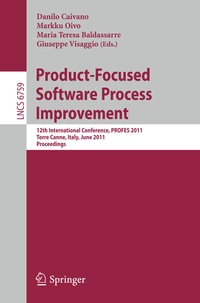
Product-Focused Software Process Improvement
12th International Conference, PROFES 2011, Torre Canne, Italy, June 20-22, 2011. Proceedings
Published on 29. June 2011
XIII, 353 pages
978-3-642-21843-9 (ISBN)
Description

This book constitutes the refereed proceedings of the 12 International Conference on Product-Focused Software Process Improvement, PROFES 2011, held in Torre Canne, Italy, in June 2011. The 24 revised full papers presented together with the abstracts of 2 keynote addresses were carefully reviewed and selected from 54 submissions. The papers are organized in topical sections on agile and lean practices, cross-model quality improvement, global and competitive software development, managing diversity, product and process measurements, product-focused software process improvement, requirement process improvement, and software process improvement.
More details
Other editions
Additional editions
Danilo Caivano | Markku Oivo | Maria Teresa Baldassarre
Product-Focused Software Process Improvement
12th International Conference, PROFES 2011, Torre Canne, Italy, June 20-22, 2011. Proceedings
Book
06/2011
1st Edition
Springer
€53.49
Shipment within 7-9 days
Content
- Title
- Preface
- Organization
- Table of Contents
- Keynote Addresses
- The Impact of Emerging Software Paradigms on Software Quality and User Expectations
- Acquiring Information from Diverse Industrial Processes Using Visual Analytics
- Agile and Lean Practices
- Monitoring Bottlenecks in Agile and Lean Software Development Projects - A Method and Its Industrial Use
- Introduction
- Related Work
- Case Study Design
- Context
- Research Questions and Units of Analysis
- Monitoring Throughput and Queue
- Definitions
- Realization at Ericsson
- Results
- Industrial Validation
- Good Practices
- Validity Discussion
- Conclusions
- References
- Applying Agile and Lean Practices in a Software Development Project into a CMMI Organization
- Introduction
- Background
- Context of the Software Development Project
- Project Description
- Experience Report
- Project Execution
- Data Collection
- Results
- Conclusions and Future Work
- References
- Adopting Agile Practices in Teams with No Direct Programming Responsibility - A Case Study
- Introduction
- Background
- Characteristics of Plan-Driven and Agile Development
- Agile Transformation
- Research Design
- Context
- Research Questions
- Data Collection and Analysis
- Threats to validity
- Agile Experience in the Organization
- Adopting the Agile Practices
- Feedback on the Agile Transformation
- Developer Team
- System Level Testing Team
- Support Team
- Discussion
- Conclusions and Future Work
- References
- Cross-Model Quality Improvement
- Proposing an ISO/IEC 15504-2 Compliant Method for Process Capability/Maturity Models Customization
- Introduction
- Requirements for SPCMMs
- Existing Methods for SPCMMs Customization
- Existing Methods for the Development of Capability/Maturity Models
- Processes for the Development of Standards
- Development of SPCMMs in Practice
- Discussion
- A Proposal for a Method for the Customization of SPCMMs
- First Results and Discussion
- A Model for Software as a Service (SaaS) Domain
- Medi SPICE
- Observed Results
- Conclusions
- References
- Homogenization, Comparison and Integration: A Harmonizing Strategy for the Unification of Multi-models in the Banking Sector
- Introduction
- Related Work
- Configuration of the Harmonization Strategy
- Execution of the Harmonization Strategy
- Homogenizing the Models
- Comparing the Models
- Integrating the Models
- Discussion and Conclusions
- References
- Supporting Audits and Assessments in Multi-model Environments
- Introduction
- Related Work
- Multi-model Audits and Assessments
- Model Mappings Considerations and Implications
- Tracing Quality Requirements to Implemented Practices
- Multi-model Audits and Assessments
- Multi-model Process Audit Example
- Conclusions
- References
- Global and Competitive Software Development
- Scrum Practices in Global Software Development: A Research Framework
- Introduction
- Research Background
- GSD Challenges
- Scrum Practices in GSD
- Research Framework Development
- Research Framework
- Communication Challenges
- Coordination Challenges
- Control Challenges
- Discussion
- Limitations
- Future Work
- Conclusion
- References
- Towards the Competitive Software Development
- Introduction
- The Software Monopolisation Syndrome
- Demonopolising Software Development
- Experimental Assessment
- Discussion: The Impact of Competitive Development
- The Savings from Software Demonopolisation
- Conclusion
- References
- Defect Detection Effectiveness and Product Quality in Global Software Development
- Introduction
- Metrics
- Related Work
- A Case Study
- Context of the Study
- Research Hypotheses
- Data Collection
- Threats to Validity
- Results
- Descriptive Statistics
- Normality Tests
- Hypothesis Testing
- Discussion
- Conclusion and Future Work
- References
- Managing Diversity
- Managing Process Diversity by Applying Rationale Management in Variant Rich Processes
- Introduction
- State of the Art
- Rationale in the SPRINTT Institutionalization Framework
- Rationale in Tailoring Variant Rich Processes
- Application Study
- Description of the Tailoring Context
- Rationale in Tailoring MEDUSAS to the Organization
- Tailored Process from the MEDUSAS Variant Rich Process
- Lessons Learned from the Proposal of Application Study
- Conclusions and Future Work
- References
- Usage of Open Source in Commercial Software Product Development - Findings from a Focus Group Meeting
- Introduction
- Methodology
- Focus Group
- Objectives and Discussion Questions
- Analysis Procedure
- Validity
- Results from Focus Group Meeting
- Participants
- Identification
- Selection
- Modification
- Giving Back Code
- Summary of Results
- Comparison to Literature
- Company Participation in Open Source Development Communities
- Open Source as Part of Component Based Software Engineering
- Conclusions
- References
- Identifying and Tackling Diversity of Management and Administration of a Handover Process
- Introduction
- Research Steps
- EM3 Handover Taxonomy
- EM3: Software Handover
- Management and Administration (MA)
- Component Evaluation
- Identify Maintenance Organization (MA 1)
- Establish Transition Team (MA 2)
- Establish a Transition Plan (MA 3)
- Develop Management Plans (MA 4)
- Final Remarks
- References
- Product and Process Measurements
- A Process Complexity-Product Quality (PCPQ) Model Based on Process Fragment with Workflow Management Tables
- Introduction
- Related Work
- Process Complexity Based on Process Fragment
- Process Fragment
- Calculation of Process Complexity
- Setting a Base Process and Extracting Process Fragments
- Application to Six Industrial Projects
- The HInT V2 project
- Changes of Process Complexities of the 6 Projects
- A Trial Tool for Visualizing Process Complexity
- Process Complexity - Product Quality (PCPQ) Model
- A Procedure of Building a PCPQ Model
- An Example of Making a PCPQ Model
- Predicting Product Quality Based on the PCPQ Model
- Summary
- References
- Using Web Objects for Development Effort Estimation of Web Applications: A Replicated Study
- Introduction
- Experimental Method
- The Dataset
- The Web Objects Method
- The Employed Effort Estimation Methods
- Validation Method and Evaluation Criteria
- Empirical Results
- Obtaining Estimates with OLSR
- Obtaining Estimates with Web-COBRA
- Obtaining Estimates with CBR
- Discussion and Comparison
- Comparison with Ruhe et. al. Analyses
- The Empirical Study Validity
- Related Work
- Conclusions
- References
- Applying EFFORT for Evaluating CRM Open Source Systems
- Introduction
- Background
- Product Quality
- Community Trustworthiness
- Product Attractiveness
- Data Aggregation and Interpretation
- EFFORT Specialization
- Results
- Conclusion
- References
- Product-Focused Software Process Improvement
- A Factorial Experimental Evaluation of Automated Test Input Generation
- Motivation
- Related Work
- Experiment Setup
- Input Generators
- Testing Environment
- Selected Application
- Research Methods and Question
- Research Question
- Research Methods
- Threats to Validity
- Results
- Pilot Execution
- Main Execution - Descriptive Statistics
- Main Execution - Statistical Analysis
- Discussion
- Conclusions and Further Work
- References
- Automating and Evaluating Probabilistic Cause-Effect Diagrams to Improve Defect Causal Analysis
- Introduction
- DPPI: Defect Prevention-Based Process Improvement
- Development Activity Result Analysis
- DCA Preparation
- DCA Meeting
- Development Activity Improvement
- DPPI Framework
- Experimental Study
- Experimental Study Design
- Experimental Study Results
- Conclusions
- References
- A Genetic Algorithm to Configure Support Vector Machines for Predicting Fault-Prone Components
- Introduction
- Support Vector Machines and Genetic Algorithms
- Support Vector Machines
- A Genetic Algorithm to Configure SVMs
- Case Study Planning
- Dataset
- Validation Method
- Evaluation Criteria
- Results and Discussion
- Fitness Function Impact and Effectiveness of GA to Configure SVMs
- Comparison of GA+SVM with other Estimation Techniques and between Intra- and Inter-release Prediction Performance
- Validity Evaluation
- Related Work
- Conclusions
- References
- Requirement Process Improvement
- A Systematic Approach to Requirements Engineering Process Improvement in Small and Medium Enterprises: An Exploratory Study
- Introduction
- State of the Art
- Research Approach
- Field Study and Analysis of RE Process and Practices in Ugandan SMEs
- Current RE Processes and Practices in Ugandan SMEs
- Challenges and Recommendations to Successful REPI in SMEs
- Design of the Systematic Approach to REPI in Ugandan SMEs
- Requirements for the Systematic Approach
- Conclusion and Future Work
- References
- Understanding the Dynamics of Requirements Process Improvement: A New Approach
- Introduction
- State of Practice in Process Improvement
- System Dynamics Modeling
- Statistical Process Control
- Factors that Influence Requirements Process Improvement
- Modeling Requirements Process Improvement Dynamics
- Descriptive Model for RPI
- Propositions Derived from the Model
- A Practical Case Study
- Summary and Further Research Directions
- References
- Precise vs. Ultra-Light Activity Diagrams - An Experimental Assessment in the Context of Business Process Modelling
- Introduction
- Process Modeling with UML: Ultra-Light and Precise Styles
- Ultra-Light Style
- Precise Style
- Experimentation Setup
- Context
- Hypotheses Formulation
- Design
- Selected Variables
- Experimental Material, Pilot and Execution
- Analysis and Results
- Pilot Experiment
- Comprehension Level - Main Experiment
- Comprehension Effort - Main Experiment
- Co-factors and Post Questionnaire Results - Main Experiment
- Related Work
- Conclusion
- References
- Software Process Improvement
- If the SOK Fits, Wear It: Pragmatic Process Improvement through Software Operation Knowledge
- Introduction
- Related Work
- Research Approach
- Research Site
- Canonical Action Research
- SOKIntegration
- Instantiation
- Concepts
- Activities
- Three Pragmatic In-the-Field Method Instantiations
- Observations
- Experience Evaluation
- Lessons Learned
- Threats to Validity
- Conclusions and Future Work
- References
- Critical Issues on Test-Driven Development
- Introduction
- Literature Survey
- Sources
- Search Procedure
- Data Extraction and Analysis
- Evaluation
- Role of Literature Review in This Paper
- Issues with Empirical Evidence on TDD
- External Quality
- Internal Quality
- Productivity
- Summary of the Issues with the Empirical Evidence
- Other Issues and Challenges with TDD
- Lack of Design
- Applicability
- Test Code Size
- Required Skill Level
- Challenges in Adopting TDD
- Discussion
- Conclusions
- References
- On the Difficulty of Computing the Truck Factor
- Introduction
- Related Works
- Truck Factor Usage Problems
- No Shared and Validated Measurements
- No Reliable Thresholds
- No Tools
- No Empirical Evidence
- Truck Factor Tool
- Exploratory Study
- Execution and Results
- Lesson Learnt and Open Issues
- Conclusion
- References
- Author Index
