

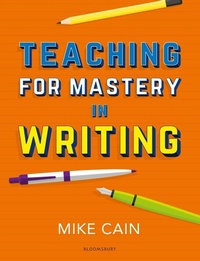
Teaching for Mastery in Writing
A Strategy for Helping Children Get Good at Words
1st Edition
Published on 12. July 2018
128 pages
978-1-4729-4988-2 (ISBN)
Description

Teaching for Mastery in Writing provides a practical approach to developing mastery in writing which helps all primary children to develop their skills and inspires a love of writing. This innovative book follows an approach that integrates mastery into existing teaching sequences - an approach which aims to improve the writing ability of all children, not just the more able.
Writing is a tough discipline for children in today's primary schools. The number of skills they are expected to learn is a source of amazement to many adults outside education. It is no easier to teach, not least because of the many and varied demands on schools, including the National Curriculum, SPaG tests, assessment frameworks and inspections. Now, more than ever, it is crucial that teachers focus on helping children become the most effective communicators they can be through the medium of writing.
Throughout the book, Mike Cain promotes the importance of a classroom culture characterised by focused talk and reasoning, and provides lots of ideas for challenging children in their writing through the development of key learning dispositions and critical thinking skills.
Writing is a tough discipline for children in today's primary schools. The number of skills they are expected to learn is a source of amazement to many adults outside education. It is no easier to teach, not least because of the many and varied demands on schools, including the National Curriculum, SPaG tests, assessment frameworks and inspections. Now, more than ever, it is crucial that teachers focus on helping children become the most effective communicators they can be through the medium of writing.
Throughout the book, Mike Cain promotes the importance of a classroom culture characterised by focused talk and reasoning, and provides lots of ideas for challenging children in their writing through the development of key learning dispositions and critical thinking skills.
Reviews / Votes
It's more important than ever that our children get good at words. The ideas in this book offer a strategy for learning to be good at words. Because just as with football and maths you can only get good at words if you practise, play, share, experiment and above all enjoy that richest of educational opportunities - failure. Even though this book covers the ways to teach mastery in writing at a primary level I believe it can be easily adapted to teach secondary students who enter the next stage of schooling and are not at the required level of writing at the timeMore details
Edition
1. Auflage
Language
English
Place of publication
London
United Kingdom
Publishing group
Bloomsbury Publishing PLC (Digital)
Target group
Professional and scholarly
Primary & secondary/elementary & high school
ISBN-13
978-1-4729-4988-2 (9781472949882)
Copyright in bibliographic data and cover images is held by Nielsen Book Services Limited or by the publishers or by their respective licensors: all rights reserved.
Schweitzer Classification
Other editions
Additional editions
Book
07/2018
Bloomsbury Education
€19.00
Shipment within 10-20 days
Person
Mike Cain is deputy headteacher at St Thomas of Canterbury Primary School, in St Helens, Merseyside. He was a newspaper journalist and corporate communications specialist for 12 years before becoming a primary school teacher. He is passionate about helping children become the best communicators they can be, and aiding teachers and school leaders to develop English curricula that inspire and maximise progress. Mike has many years of experience as a class teacher, subject and school leader, local authority moderator and consultant, and is now in great demand in his part-time role as a private English consultant.
Content
- Cover
- Title
- Copyright
- Contents
- Acknowledgements
- Foreword by Frank Cottrell-Boyce
- Introduction: Mastery learning
- A long-term aim for primary writers
- Journey over destination
- A checklist approach
- F STEPS
- Planning for mastery learning
- The planning pyramid
- How to use this book
- 1 Feedback
- Focus on a goal
- Setting relevant goals
- Responding to pupils' efforts
- Example goals
- Bringing the 'me' into cognition
- Formative assessment
- Implications for the classroom
- Divert time from other tasks
- Feedback, not marking
- Feedback before the writing process
- Feedback during the writing process
- Feedback after the writing process
- Self- and peer-assessment
- Self-assessment
- Peer-assessment
- Rising above the writing task
- The helicopter task
- Developing growth mindsets
- A whole-school approach
- Reflection points
- 2 Skills
- A culture of consolidation
- Learning to read write
- Phonics
- Most common words
- Read, write link
- The literacy legacy
- Teaching grammar
- Deeper learning through logical progression
- The Steps in Learning for writing
- Reflection points
- 3 Talk and thought
- There's group work and there's group work
- Why should children learn to collaborate?
- Thinking through talk
- Exploratory talk
- Ground rules
- Philosophy for children
- Benefits of P4C
- Drama into writing
- What the research says
- Seizing the moment to write
- Clear thinking to clear writing
- Internal dialogue
- Reflection points
- 4 Engagement
- The joy of learning
- Implications for the classroom
- Create a safe haven
- Use humour
- Make it relevant
- Get the challenge right
- Novelty
- Independent discovery learning
- Implications for teaching writing
- Choosing an appropriate text
- Short and sweet
- Topic as the context
- Children's experiences
- Music into writing
- 5 Practice
- Lessons from Mozart and Mo
- Deliberate practice in the classroom
- From unconscious incompetence
- Conscious incompetence
- Conscious competence
- Unconscious competence
- Practising phonics
- Practising spelling
- In practice
- Spelling strategies
- Grammar for writing
- In practice
- Choices and possibilities
- Using shared writing
- In practice
- Using guided writing
- Differentiation
- In practice
- ACE IT!
- In practice
- Practise across the curriculum
- Reflection points
- 6 Sequence
- Overview of a unit of work
- The planning pyramid
- Skills
- Writing outcomes
- Talk and thought
- Writing forms
- Long-term planning
- The Explore phase
- The Practise phase
- Feedback and engagement
- The Compose phase
- Planning for writing
- Destination writing
- Reflection points
- Conclusion
- Appendix 1 Helicopter task pro-forma
- Appendix 2 Steps in Learning documents
- Appendix 3 Key words and prompts using Bloom's taxonomy
- Bibliography
