
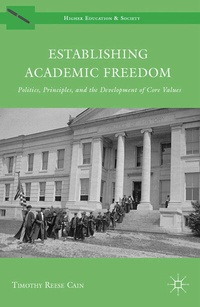
Establishing Academic Freedom
Description
Alles über E-Books | Antworten auf Fragen rund um E-Books, Kopierschutz und Dateiformate finden Sie in unserem Info- & Hilfebereich.
Reviews / Votes
"Timothy Cain provides a compelling account of how the academic profession haltingly organized itself to protect academic freedom, explaining the AAUP's role and clarifying it by comparing its activities to those of the American Association of Colleges (AAC), the American Federation of Teachers (AFT), the American Civil Liberties Union (ACLU), and the Progressive Education Association (PEA). While the time frame for Cain's account is 1915-1940, the issues raised and discussed are relevant to much that is currently experienced on college and university campuses across the nation." - Wayne J. Urban,Paul W. Bryant Professor, College of Education, The University of Alabama Tuscaloosa
"This important book offers the first comprehensive look at how academic freedom, and the tenure system that supports it, developed in the United States. Whereas previous volumes have focused on particular organizations, specific topics, or individual cases, Cain blends all three to show what academic freedom came to mean to the profession, and how it has been defined and defended over time." - Linda Eisenmann, professor of education, professor of history, Wheaton College
More details
Other editions
Additional editions

Person
Content
System requirements
File format: PDF
Copy protection: Watermark-DRM (Digital Rights Management)
System requirements:
- Computer (Windows; MacOS X; Linux): Use the free software Adobe Reader, Adobe Digital Editions, or any other PDF viewer of your choice (see eBook Help).
- Tablet/Smartphone (Android; iOS): Install the free app Adobe Digital Editions or another reading app for eBooks, e.g., PocketBook (see eBook Help).
- E-reader: Bookeen, Kobo, Pocketbook, Sony, Tolino and many more (only limited: Kindle).
The file format PDF always displays a book page identically on any hardware. This makes PDF suitable for complex layouts such as those used in textbooks and reference books (images, tables, columns, footnotes). Unfortunately, on the small screens of e-readers or smartphones, PDFs are rather annoying, requiring too much scrolling.
This eBook uses Watermark-DRM, a „soft” copy protection. This means that there are no technical restrictions to prevent illegal distribution. However, there is a personalised watermark embedded in the eBook that can be used to identify the purchaser of the eBook in the event of misuse and to provide evidence for legal purposes.
For more information, see our eBook Help page.