

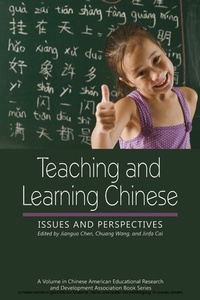
Teaching and Learning Chinese
Issues and Perspectives
1st Edition
Published on 7. January 2010
369 pages
978-1-61735-066-5 (ISBN)
Description

The book is linked to the annual theme of the 2008 CAERDA International Conference with contributing authors serving as keynote speakers, invited panelists, paper presenters, as well as specialists and educators in the field. The book provides a most comprehensive description of and a theoretically wellinformed and a scholarly cogent account of teaching and learning Chinese in general and in the United States in particular. It examines a wide range of important issues in Chinese teaching and learning: current state in teaching Chinese as a Second Language (TCSL) in the United States, US national standards for learning foreign languages K-12, policy making about how to meet the growing demand for Chinese language and cultural education with regard to a national coordination of efforts, professional teacher training in terms of the quantity and quality of Chinese language teachers at all levels, promotion of early language learning, characteristics of Chinese pedagogy, aspects of Chinese linguistics, methods and methodology in teaching TCSL, techniques and technology in Chinese language education, curriculum and instruction in TCSL, cultural aspects of teaching Chinese as a Second Language, issues in Chinese pedagogy, development of Chinese as a Heritage Language (HL) and the issue of cultural identity for bilingual/multilingual learners (particularly bilingual/multilingual children), testing and evaluation in TCSL, Chinese literacy and reading, approaches to instruction and program design, etc.
All prices
More details
Other editions
Additional editions
Book
06/2010
Information Age Publishing
€75.90
Article not available at the moment
Content
- Front Cover
- Teaching and Learning Chinese
- Issues and Perspectives
- A volume in
- Chinese American Educational Research and Development Association Book Series
- Series Editor: Jinfa Cai, University of Delaware
- CONTENTS
- PART I: CHINESE LANGUAGE EDUCATION- A HISTORICAL PERSPECTIVE
- 1. Chinese Language Education in the United States: A Historical Overview and Future Directions
- 2. A Historical Perspective of Teaching Chinese as a Second Language
- PART II: CHINESE LANGUAGE EDUCATION- CASE STUDIES AT COLLEGE LEVEL
- 3. Effects of Using Prompt Sentences in Beginning Chinese Classes
- 4. Creative Writing in CFL Curriculum
- 5. Language Attitudes Among American College Students in Chinese Language Classes
- 6. Motivating U.S. Students to Learn Chinese as a Second Language: Understanding the Interactions Among Motivation, Ethnicity, and Teaching Strategies
- PART III: CHINESE LANGUAGE EDUCATION- CASE STUDIES AT K-12 SCHOOL LEVEL
- 7. What Difficulties Do Children Experience While Learning to Read and Write Chinese?
- 8. Literacy Practices in the Family Household of Taiwanese American Children
- 9. Acquiring Chinese Simultaneously With Two Other Languages: Effective Home Strategies
- PART IV: PROGRAM DEVELOPMENT, CURRICULUM DESIGN, AND THE ACQUISITION OF CHINESE LITERACY
- 10. The Role of Chinese Culture and Language in Global Education: The Chinese International Engineering Program at University of Rhode Island
- 11. Curriculum Design and Special Features of "Computer Chinese" and Chinese For Tomorrow
- 12. Morphological Awareness: Why and How to Link it to Chinese Literacy Teaching and Learning
- 13. An Analysis of Orthographic Processing: Non-Chinese and Chinese Readers' Visual-Spatial Concept
- PART V: ISSUES IN TEACHING CHINESE LITERATURE IN AMERICAN CLASSROOM
- 14. Teaching Chinese Literature in the Post-American World
- 15. To Be or Not to Be?: Death as the Paradox of Survival- Chinese Literature in the American Classroom
- Chinese American Educational Research and Development Association Book Series
- Chinese American Educational Research and Development Association Book Series
- Jinfa Cai, Series Editor
- Teaching and Learning Chinese
- Issues and Perspectives
- edited by
- Jianguo Chen University of Delaware
- Chuang Wang University of North Carolina at Charlotte
- and
- Jinfa Cai University of Delaware
- Information Age Publishing, Inc.
- Charlotte, North Carolina www.infoagepub.com
- Introduction: Teaching and Learning Chinese in a Global Era
- Issues and Perspectives
- Jianguo Chen, Chuang Wang, and Jinfa Cai
- Origin of the Book
- Structure of the Book
- Toward new directions
- notes
- part i
- chinese language education- a historical perspective
- Chinese Language Education in the United States
- A Historical Overview and Future Directions
- Shuhan C. Wang
- Abstract
- Introduction
- An Ecological System Framework for Language Planning
- Positioning Chinese Language and Its Speakers in the Historical and Current U.S. Context
- Three Language Orientations in the U.S. Environment
- Chinese as a Heritage Language
- 1960-2000: an Emerging Field of Chinese as a Foreign/World Language
- 2004 to Present: Chinese as an Expanding Field
- Effects of the Interface of Environment, Policy, Practice, and Players
- Conclusion: Future Directions
- Acknowledgment
- notes
- References
- Useful Websites
- CHAPTER 1
- Table 1.1. ADD A TITLE TO THIS TABLE
- Table 1.2.
- Table 1.3. Percentage of Students Studying Chinese in Schools and Colleges: 10 Year Comparison
- Figure 2. 1. Categorization of proceedings by research topic for the first eight IATCSL international conferences.
- Table 2.1. Common Disyllabic Chinese Compound-Words
- A Historical Perspective of Teaching Chinese as a Second Language
- Zhiping Zhu
- Abstract
- The Development of Chinese Teaching in History
- A Short History of Teaching Chinese as a Second Language
- 1950-1977
- 1978-1997
- 1998-2008
- Research Fields Formed in TCSL
- The Evolution of Linguistic Theories in TCSL
- The Influence of Structuralism
- The Influence From Other Theories and the Demands of Teaching
- Pedagogic Grammar-Centered Teaching
- (a) An object is moved by an action, such as "???????? (Ta¯ ba? shu¯ f àng zài zhuo¯zi shàng
- She placed the book on the table)." This kind of "?" sentence accounts for approximately 27.8% of the total usage of "?"
- (b) A change of something due to an action, such as "???? ? (Wo? ba? ta¯ jiàoxingle
- I awakened him)." This kind of "?" sentence comprises about 49.8% of total usage.
- (c) An action is related to certain other things, such as "?????? ? (Ta¯ ba? xìn yo'u niànle yibiàn
- She also read the entire letter)." This usage of "?" constitutes 8.4% of the total.
- (d) A property of an object is altered by the subject through an action, such as "?????? ???? (Ta¯ ba? xuésheng dàngzuò zìjide háizi
- She regards the student as her own child)." This kind of "?" sentence encomp...
- (e) To express an unsatisfactory result, as "????? (Wo? ba? ta¯ da?le
- I accidentally hit him)." Using "?" in this way embodies about 5.1% of the total.
- (f) The remaining 2.9% of sentences consist of all other usages of "?."
- Phonetics in Teaching Research
- Vocabulary and Chinese Characters in Teaching Research
- Comparing Chinese With Other Languages and Cultures
- Development of Language Comparison
- Language Comparison in TCSL
- Teaching Chinese Culture in Cross-Cultural Classrooms
- Language Instruction Based on Cross-Cultural Research
- Research Based on Second Language Acquisition of Chinese
- The Period of Foreign Theory Introduction
- The Period of Integrated Research
- A. Characteristics of the learner's language
- B. Learner external factors
- C. Learner internal mechanisms
- and
- D. The language learner.
- Teaching Methods and Textbook Compilation Research
- Integration of Foreign Language and Traditional Chinese Teaching Methods
- Structure-Centered to Communicative-Centered Textbook Compilations
- 1. Listening and speaking only.
- 2. Listening and speaking first, followed by reading and writing.
- 3. Listening, speaking, reading and writing combined together.
- 1. Should the textbooks only teach Pinyin (?
- pinyin)?
- 2. If listening and speaking are taught first, how should reading and writing be arranged?
- 3. If the four skills are taught at the same time, how should Chinese characters be addressed?
- 1. For integrated Chinese skills training (57
- 10% of total)
- 2. For focused training of the four skills individually (136
- 25% of total)
- 3. For language content understanding (16
- 3% of total)
- 4. For special purposes, such as HSK, commercial communication, for tourist travel (145
- 26.5% of total)
- 5. For different kinds of learners, such as children, pre-college students, etc. (67
- 12.3% of total)
- and
- 6. For special learning purposes like Chinese characters, Chinese culture, reading materials (127
- 23.2% of total).
- Language Tests and Teaching Chinese Through the Internet
- Language Tests and the HSK
- Computers in the Classroom and Online Instruction
- NOTE
- References
- CHAPTER 2
- PART II
- CHINESE LANGUAGE EDUCATION- CASE STUDIES AT COLLEGE LEVEL
- Table 3.1. The Comparison of Error Occurrence Between Different Question Types From Round 1 Through Round 3
- Table 3.2. The Comparison of Error Occurrence on the Same Question Type From Round 1 Through Round 3
- Table 3.3. The Overall Difference of Response Time to Difference Types of Questions in Rounds 1, 2, and 3
- Table 3.4. Mean Difference of Response Time to Different Types of Questions in Round 1, 2, and 3
- Effects of Using Prompt Sentences in Beginning Chinese Classes
- Yongan Wu
- Abstract
- Methods
- Participants and Setting
- Procedures
- Data Analysis
- Results
- Discussion and Conclusion
- NOTES
- Reference
- CHAPTER 3
- Table 4.1. Chinese Composition Evaluation Checklist (Essay One)
- Creative Writing in CFL Curriculum
- Wei Hong
- Abstract
- 1. Why is active writing an important skill to learners of Chinese?
- 2. How should various active writing assignments be designed?
- 3. How should teachers read, comment on, and grade student writing?
- Course Goals
- 1. Encourage personal development of students (Grauerholz, 1999)
- 2. Develop student skills of free expression
- 3. Teach students appropriate writing in different contexts
- 4. Increase student understanding of Chinese language and culture
- 5. Encourage student appreciation of their own culture
- 1. To reinforce students' knowledge of how Chinese students typically spend their summer vacation (culture)
- 2. To review language materials on this topic (language)
- 3. To develop students' critical thinking skills on how to make arguments (thinking).
- 1. To reinforce students' knowledge of weather (culture)
- 2. To review language materials on this topic (language)
- 3. To develop students' skills on how to describe objective reports such as weather (prosing).
- 1. To reinforce students' knowledge of writing a family letter in Chinese (culture)
- 2. To review language materials on this topic (language)
- 3. To develop students' skills related to expressive writing by expressing personal feelings in the form of a letter (expressing feeling)
- 4. To introduce students to Chinese family values as reflected in a family letter (culture).
- Assignment Design
- 1. Purpose (anticipated achievements after writing is complete)
- 2. Content (knowledge that relates to course content)
- 3. Language requirements (students' written language competence that relates to the particular grammar covered in the course)
- 4. Format (editorial requirements)
- 5. Due dates (required timely submissions of all drafts)
- 6. Revisions (guidelines for revisions)
- and
- 7. Grading criteria (grade distributions).
- Modes of Evaluation
- Summary
- 1. Give them confidence
- 2. Raise their interests
- 3. Give enough time
- 4. Identify a problem and elaborate on it
- 5. Find topics related to their personal interests
- 6. Give opportunities for revisions
- and
- 7. Be available for consultation and conference.
- 1. The purpose/goal of the assignment
- 2. Clear instructions
- 3. Necessary components
- 4. Minimal requirements
- 5. Format conventions
- 6. Due dates
- 7. Grading criteria
- and
- 8. Language conventions.
- Appendix 1: Guidelines for Writing Assignment One
- Summer Vacation ????
- Appendix 2: Guidelines for Writing Assignment Two
- Weather in Indiana or your hometown ?????/??????
- Appendix 3: Guidelines for Writing Assignment Three
- A Family Letter-???
- References
- CHAPTER 4
- Table 5.1. Descriptive Statistics: Top Five Reasons to Study Chinese
- Table 5.2. Principal Components Analysis With Varimax Rotation of Four-Factor Solution for the 21 Language Attitude Items
- Table 5.2. (Continued)
- Language Attitudes Among American College Students in Chinese Language Classes
- Ko-Yin Sung
- Abstract
- Rationale
- 1. What kinds of language attitudes do learners have toward Chinese in a formal classroom setting?
- 2. Is there a significant relationship between learners' attitudes toward Chinese and their gender, ethnicity, major, and age?
- Review of the Literature
- Research Design
- 1. Six questions intended to measure ethnic-heritage-related language attitudes (e.g., "It is my heritage language or mother tongue")
- 2. Three questions intended to measure school-related language attitudes (e.g., "I heard that the Chinese professors at my school were good")
- 3. Four questions intended to measure self-oriented language attitudes (e.g., "I thought that studying the language would be interesting")
- 4. Four questions intended to measure economy-related language attitudes (e.g., "Enterprises are increasingly entering China")
- and
- 5. Four questions intended to measure culture-related language attitudes (e.g., "I will be able to participate in cultural activities of the Chinese language group").
- Sampling
- Data Collection
- Results
- Factor Analysis
- Multiple Regression
- Ethnic Heritage-Related
- Culture-Related
- Economy-Related
- School-Related
- Conclusions
- APPENDIX
- References
- CHAPTER 5
- Table 6.1. Basic Demographic Information for Urban Charter School
- Table 6.2. Basic Demographic of Third Grade Focus Group Participants
- Motivating U.S. Students to Learn Chinese as a Second Language
- Understanding the Interactions Between Motivation, Ethnicity, and Teaching Strategies
- Aubrey H. Wang
- Abstract
- Language Learning Motivation
- Student Diversity and Motivation
- Language Developmental Stage, Learning Environment, and Motivation
- Teaching Effectiveness and Motivation
- 1. Learning objectives: measuring the extent to which learning objectives were meaningful to the learner and expectations for performance were challenging and demanding.
- 2. Organization of content: evaluating whether new learning information was visually presented and organized to best facilitate student comprehension.
- 3. Content presentation: addressing whether new ideas and procedures were presented in a step-by-step manner and whether big ideas were highlighted and restated throughout the lesson.
- 4. Motivation of students: assessing the extent to which lesson examples were meaningful to students and whether there were high levels of engagement with content, classmates, and the teacher.
- 5. Learning time: measuring the pacing of the lesson, the degree to which student attention was sustained, and the degree to which academic time was maximized.
- 6. Lesson structure: concerning whether the lesson had a clear beginning, middle, and end, and whether it met the needs of students at high, middle, and low performing levels.
- 7. Questions: examining whether teacher questions were frequent, varied, and used all types of questions.
- 8. Feedback: relating to the extent to which feedback was frequent, immediate, specific, and required students to discuss, share, and to explain their thinking.
- 9. Learning tasks: examining how well the learning tasks sustained student attention, required multiple types of thinking from the students, and were game-like.
- 10. Student thinking: evaluating whether students demonstrated a variety of thinking types such as monitoring their own thinking to insure that they understood, explaining and justifying their responses, comparing/contrasting new information, and/or ...
- Setting and Participants
- Data Collection and Analysis
- Students' Motivation to Learn Chinese
- Student Perception about Learning Chinese
- Student Perception about Chinese Classroom Activities
- Observation of Teaching Practices
- 1. Making her lessons game-like
- 2. Creating opportunities for students to work in small groups with goal-oriented assigned tasks
- 3. Providing opportunities for student self-assessments related to the lesson's content
- 4. Delivering the class content with established beginning, middle, and end points
- and
- 5. Providing clear step-by-step directions.
- 1. Review of vocabulary from the last class in which he asked his students to use the words in short Chinese phrases
- 2. Dictation of the vocabulary from the previous class, which required students to write the Chinese characters that the instructor then graded and informed the students of their level of performance
- 3. Group reading of a new book chapter in Chinese
- 4. Individual reading of a sentence in Chinese from the new book chapter
- 5. Individual translation of the Chinese sentence into English
- and
- 6. Individual composition of sentences containing the new vocabulary words.
- Conclusion
- References
- CHAPTER 6
- part iii
- chinese language education- case studies at k-12 school level
- Figure 7. 1. Distribution of subjects by gender and age (N = 14).
- Table 7.1. Demographics
- What Difficulties do Children Experience While Learning to Read and Write Chinese?
- Hui-Hua Wang and Alice Sterling Honig
- Abstract
- Writing
- Reading
- Method
- Participants
- Procedure
- Results and Discussion
- Writing
- Character Strokes
- Analysis of Homework Sentences
- Reading
- Reasons Why Parents Send Their Children to Chinese School
- Limitations of This Study
- Conclusions
- Appendix: Questionnaire
- 1. Briefly describe why you send your child to learn Chinese? (You can write either in English or Chinese)
- 2. Briefly describe what difficulties you feel your child is having in speaking/reading Chinese? (You can write either in English or Chinese)
- References
- CHAPTER 7
- Figure 7. 2. Character writing sample for "?."
- Figure 7. 3. Character writing sample for " ."
- Figure 7. 4. Character writing sample for "?."
- Literacy Practices in the Family Household of Taiwanese American Children
- Hui-Ching Yang
- Abstract
- Introduction
- 1. What constitutes the home literacy environment of Taiwanese American children?
- 2. What kind of literacy activities are carried out in a Taiwanese American household?
- 3. What kind of skills and knowledge do Taiwanese American children gain from household literacy activities?
- 4. Does the gender of two Taiwanese American children affect their home literacy experiences? If so, how?
- Literature Review
- Funds-of-Knowledge Approach
- Out-of-School Literacy
- Research Gap
- Method
- Setting and Participants
- Data Collection Procedures
- Ethnographic observation
- Semistructured Interviewing
- Artifacts
- Data Analysis
- Findings
- Angel's and Andy's Home Literacy Environment
- Angel's Home Literacy Activities
- Andy's Home Literacy Activities
- Chinese Language Ability Angel and Andy Learned From Home Literacy Activities
- Conclusion
- Reference
- CHAPTER 8
- Table 9.1. Percentage of the Children's Exposure to Three Languages (Birth to 3 & 4 Years)*
- Acquiring Chinese Simultaneously with Other Two Languages
- Effective Home Strategies
- Xiao-Lei Wang
- Abstract
- Methods
- Participants
- Data Collection
- Data Transcription, Coding, and Analysis
- Results
- Early Years
- Ensuring the Quality of Heritage-Language Input
- Preschool and Kindergarten Years
- Matching Emergent School Literacy Skills With Home Literacy Skills
- Elementary School Years
- Building Heritage-Language Reading Skills
- Building Heritage-Language Writing Skills
- Discussion
- Realistic Expectations
- Communication Should Be the Top Priority in Heritage-Language Learning
- Language Learning Occurs in Context
- Language and Culture Should Be Taught Together
- Children Are Active Learners
- Language Learning Is a Life-Long Process
- It's Never Too Late to Start
- notes
- References
- CHAPTER 9
- Table 10.1. Current Chinese IEP students at URI (6 Semesters)
- Figure 10. 1. The comparison of Chinese IEP students among the overall learners of Chinese.
- The Role of Chinese Culture and Language in Global Education
- The Chinese International Engineering Program at the University of Rhode Island
- Wen Xiong and John Grandin
- Abstract
- Background
- The CIEP
- The Establishment and Growth of the Chinese Program at URI
- Chinese Language Flagship Partner Program
- Current Chinese IEP Students
- Courses for Chinese IEP
- Support From Other Resources
- Achievements and Innovations of the Chinese IEP
- The IEP Model: Implications for Other Programs
- Appendix 1
- Appendix 2
- References
- CHAPTER 10
- part iv
- program development, curriculum design, and the acquisition of chinese literacy
- Figure 11. 1.
- Figure 11. 2.
- Figure 11. 3.
- Curriculum Design and Special Features of "Computer Chinese" and Chinese For Tomorrow
- Wayne W. He and Dela Jiao
- Abstract
- Necessity of Creating Computer Chinese (CC)
- Existing Types of Chinese Curricula
- Using Computer Technology to Solve Chinese Character Problems
- The Computer Chinese Approach and a Pilot Study
- Computing Chinese as the Fifth Language Skill
- Computer Chinese: A New Approach to Learning the Chinese Language
- Integration of Computer Input and Handwriting Instruction
- Improvement of Vocabulary Retention and Language Ability
- Accelerating Language Learning and Reducing Psychological Barriers
- Some Common Concerns
- Chinese for Tomorrow, the Textbook Series Designed for CC
- Key Features of Chinese for Tomorrow
- Useful, Interesting, Natural, and Relevant to Daily Life
- Large Numbers of New Vocabulary Each Lesson
- A Diverse Set of Practice Activities
- Importance Placed on Cultural Knowledge
- Discussion
- Note
- References
- CHAPTER 11
- Figure 11. 4.
- Morphological Awareness
- Why and How to Link it to Chinese Literacy Teaching and Learning
- Phil D. Liu, Yanling Zhou, and Catherine McBride-Chang
- Abstract
- The Role of Morphological Awareness for Learning Chinese
- Pedagogical Implications
- Summary
- References
- CHAPTER 12
- Figure 13. 1. Examples of items with varying difficulty levels.
- Table 13.1. Scores of Non-Chinese and Chinese Readers
- Table 13.2. Item Difficulties
- Table 13.3. Comparisons of Original Predictions and Results
- Table 13.4. Analysis of Participant Errors
- 1. Components are more cluttered in mixed boundary or L-shaped structures, making the pseudo- characters more difficult to distinguish
- 2. Strong distracters typically (a) add or omit an internal component and/or (b) alter an external component of the target
- 2. Items in which the target contains one or more salient features that do not appear in the distracters are easy
- An Analysis of Orthographic Processing
- Non-Chinese and Chinese Readers' Visual-Spatial Concepts
- Pei-Ying Lin and Ruth A. Childs
- Abstract
- Method
- Participants
- Measure
- 1. Horizontal structure type 1 : Two separate component units, right and left
- for example, " (bào
- leopard)."
- 2. Horizontal structure type 2 : Three separate component units, left, middle, and right
- for example, "? (chuan
- short for Sichuan Province)."
- 3. Vertical structure type 1 : Two separate component units, up and down
- for example, "? (zhì
- willpower)."
- 4. Vertical structure type 2 : Three separate component units, up, middle, and down
- for example, "? (xiang
- enjoy)."
- 5. P-shaped : The character is shaped as a "P
- " for example, "? (chuáng
- bed)."
- 6. L-shaped : The character is shaped as an "L
- " for example, " / (zhè
- this)."
- 7. Enclosure structure or : An internal unit is enclosed by an external unit
- for example, "? (kuàn
- tired)" and "? (jiàng
- artisan)."
- (a) High level: 16-24 strokes
- (b) Medium level: 9-15 strokes
- (c) Low level: 3-8 strokes
- Data Analyses
- Interviews
- Results and Discussion
- Score Distribution
- Item Difficulties
- Interviews
- Strategy 1: Apply Background Knowledge
- Strategy 2: Code Analytically or Holistically Into Visual-Spatial Working Memory
- Strategy 3: Use of Visual Chunking Skills
- Strategy 4: Recognize Salient Feature(s)
- Strategy 5: Alphabetic Reading Patterns (Horizontal Versus Vertical)
- Error Analysis
- Conclusions
- References
- CHAPTER 13
- part v
- issues in teaching chinese literature in american classroom
- Teaching Chinese Literature in a Post-American World
- Rujie Wang
- Abstract
- Chinese Culture and American Parochialism
- The Difficulties with Modern Chinese Literature
- The Difficulties with Women in Chinese LITERATURE
- The Difficulties with Chinese Cinema
- The Challenge and Fun in Teaching Chinese Culture
- notes
- References
- CHAPTER 14
- "To Be or Not to Be?"- Death as the Paradox of Survival
- Chinese Literature in the American Classroom
- Jianguo Chen
- Abstract
- The Philosophical Problem of Life and Death
- A Writer of a "Metaphysical" Mindset
- The Intricate Web of Death and Desire-The Case of "Hallucination of the Realm of The Dead"
- The Problematic of the Perfect Order of Completeness
- Desire a Desire
- Desire and Theatricality
- References
- CHAPTER 15
- About the Contributors
- Back Cover

