

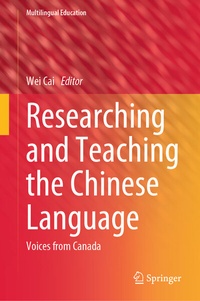
Researching and Teaching the Chinese Language
Description

This book offers an in-depth exploration of the unique landscape of Chinese language learning and teaching in Canada. It is the first to highlight the distinctive features of Chinese language education in the country and to introduce the Canadian approach to teaching and researching Chinese language, termed the "Canadian school of Chinese education." This approach, largely unfamiliar to the global academic community, is illuminated in this book, filling a critical gap in the literature and providing a platform for Canadian voices and perspectives in the field.
The book delves into original and under-investigated areas, addressing important issues in Chinese teaching and learning that require more sophisticated research approaches due to advancements in our understanding and the discovery of complex Chinese learner populations. Structured into four sections, the book offers an overview of Chinese language education in Canada, examines comparisons of learning conditions, explores interactive dynamics and communication strategies, and delves into social and cultural dimensions. This book will be invaluable to researchers, instructors, advanced-level undergraduate students, and graduate students in the field of Chinese language learning and teaching.
More details
Other editions
Additional editions
Person
Dr. Wei Cai is a professor in the School of Languages, Linguistics, Literatures, and Cultures at the University of Calgary, Canada. She is a former Chair of the Division of Chinese Studies and Japanese Studies, Director of the Language Research Centre, and President of the Chinese Language Teaching and Research Association. In 2023, she was awarded the Robert Roy Award by the Canadian Association of Second Language Teachers (CASLT). Her research interests include second language listening, second language acquisition, teacher education, artificial intelligence in language learning and teaching. She has recently published "Teaching and researching Chinese second language listening" (2022, Routledge).
Content
Introduction.- Overview.- An overview of Chinese language learning and teaching in the Canadian context.- The use of educational technology in Chinese language teaching in Canada.- Comparisons of learning conditions .- Factors influencing global accent ratings of students in Mandarin bilingual programs.- The use of translation activities in L2 grammar teaching.- Chinese L2 idiom learning through academic listening.- Interactive dynamics and communication strategies .- Using syntactically incomplete structures and visual signs to elicit students' knowledge display in CSL classrooms: A multimodal perspective.- A study of miscommunication and repair process in native-nonnative Chinese conversations.- Social and cultural dimensions .- Chinese heritage learners' language and literacy socialization.- Reconceptualizing culture teaching in Chinese classrooms in Canada: A theoretical model.- Chinese culture: The syntax of the language.
